
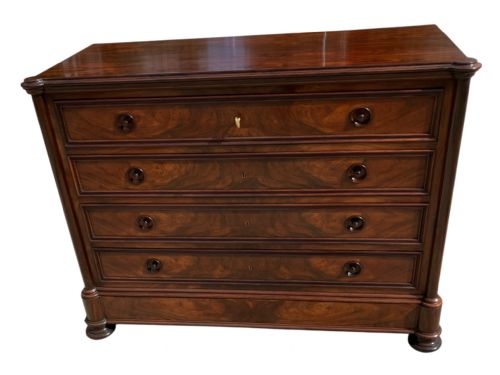
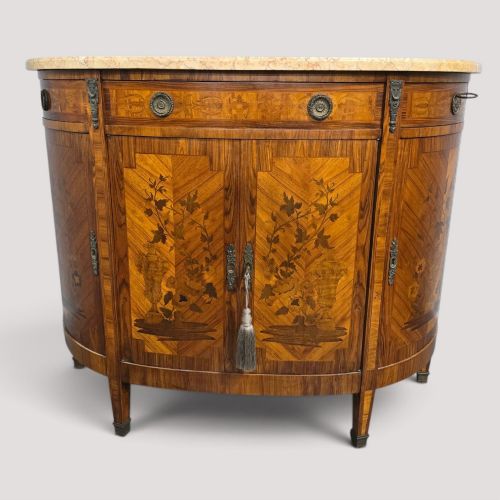
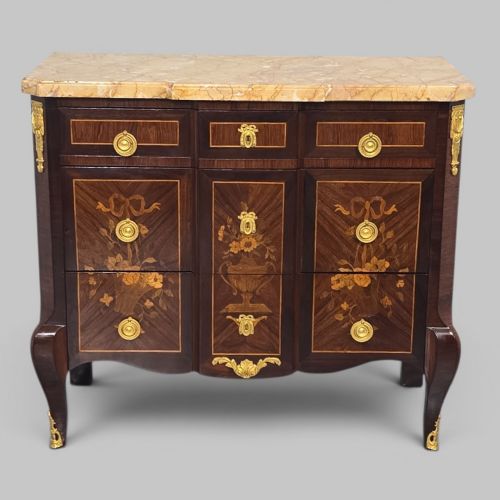


Rosewood French Commode
A rosewood french commode brings rich timber grain and polished marble into a room, offering practical storage with distinct continental elegance.
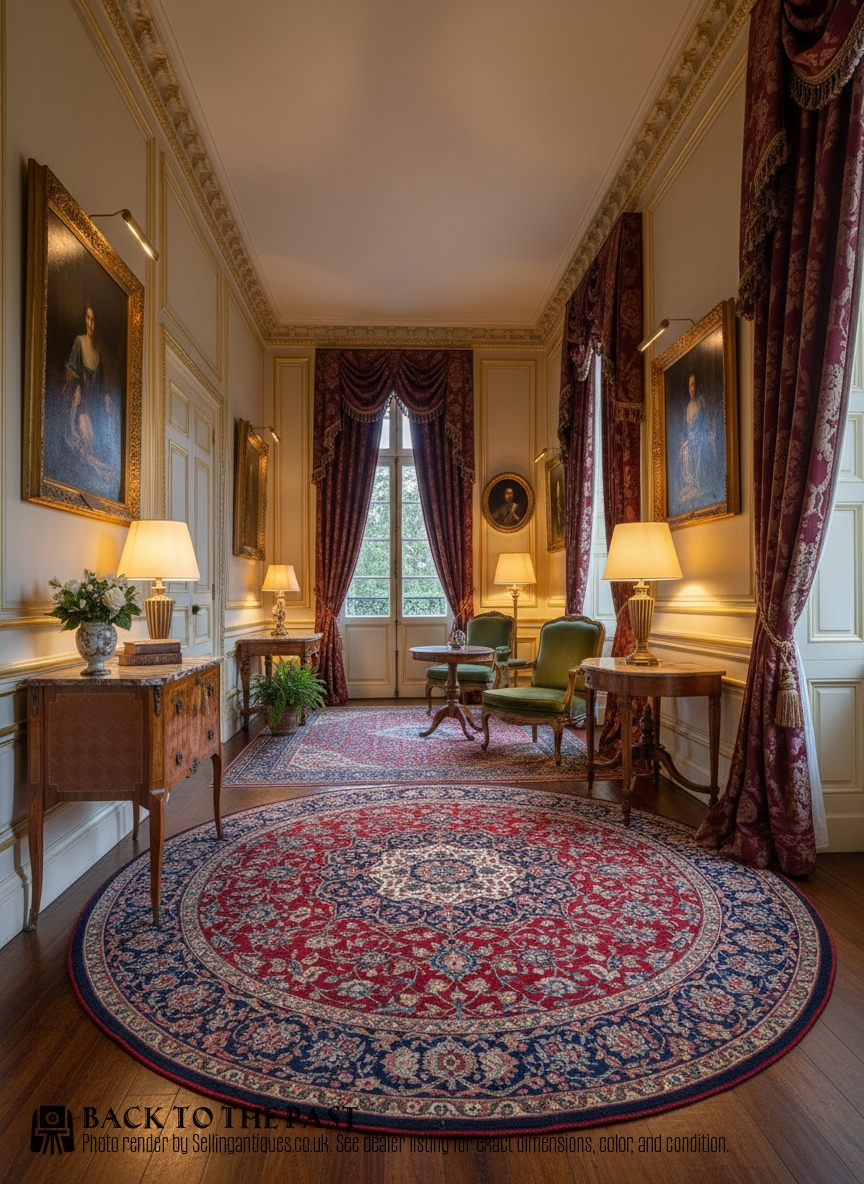
Rosewood French Commode
When you search for a rosewood french commode, you encounter low storage furniture originating from France, spanning eras from the eighteenth century through the art deco period. These pieces function primarily as chests of drawers, side cabinets, and bedside tables designed for formal reception rooms or bedrooms.
The selection ranges from serpentine eighteenth century régence originals to nineteenth century revival pieces and twentieth century interpretations. Most examples combine rich rosewood surfaces with fitted marble tops and marquetry details.
Judging quality and execution
The sophistication of the marquetry and the precision of the veneer matching dictate the standing of a piece. Finer examples exhibit seamless transitions across curved surfaces and complex serpentine shapes without distortion in the grain.
Hardware execution also separates standard production from exceptional work. Cast ormolu mounts with sharp chiselling and original heavy marble tops indicate superior workshop output.
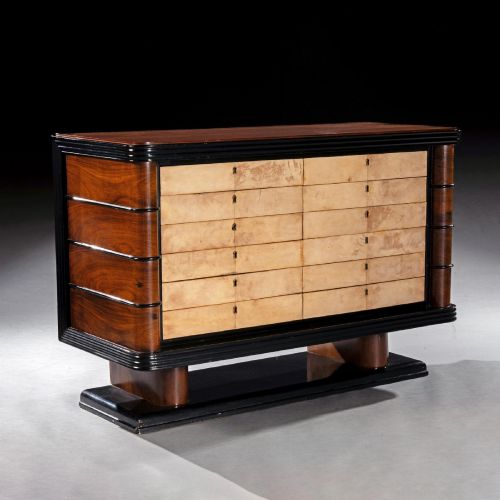
One exceptional art deco piece hides parchment-covered drawers behind its curved palisander doors.
Mercier Frères
The Rosewood French Commode Glossary
- Commode
- A low chest of drawers or cabinet developed in France during the seventeenth century. It typically stands on relatively tall legs compared to English chest designs.
- Marquetry
- The art of applying decorative veneer pieces to a structure to form intricate pictures or geometric patterns. Makers use various tinted woods to achieve naturalistic shading.
- Ormolu
- Gilded bronze used for furniture mounts and decorative hardware. Artisans cast and then mercury-gilded the bronze to create a bright golden finish.
- Serpentine
- A furniture front or top curving in and out in a continuous wave. This shape requires skilled carpentry to fit drawers and carcases accurately.
- Bombe
- A swelling or bulging commode profile where the sides and front curve outward. It demands advanced veneer work to follow the compound contours.
Rosewood French Commode: Frequently Asked Questions
What is a french commode used for?
These pieces serve as decorative storage units in living spaces, hallways, or bedrooms. Their surface provides a display area for lamps or decorative objects while the drawers hold linens or tableware.
Historically, they sat in formal salons and private chambers to project status and taste. Today, they function similarly in domestic interiors as focal storage furniture.
How do I identify a régence commode?
Régence pieces display transitional characteristics between baroque and rococo styles, featuring restrained asymmetry and bold serpentine outlines. They often incorporate heavy ormolu mounts and dense rosewood veneers.
Examining the construction of the drawer linings and the timber ageing helps confirm the eighteenth century origin against later revival copies.
Are marble tops original to these commodes?
Most antique french commodes retain their fitted marble tops, which were designed specifically to match the contour of the wooden carcase. These slabs vary in colour from white to mottled grey and deep beige.
Replacement marble is sometimes encountered during restoration, though matching the precise edge profiling reveals original pairing.
How do I care for rosewood veneer?
Rosewood surfaces respond best to stable indoor humidity and protection from direct sunlight to prevent fading. Regular dusting with a soft, dry cloth preserves the polished finish.
Avoid liquid polishes and silicone sprays, which build up over the antique polish and dull the natural grain depth.