

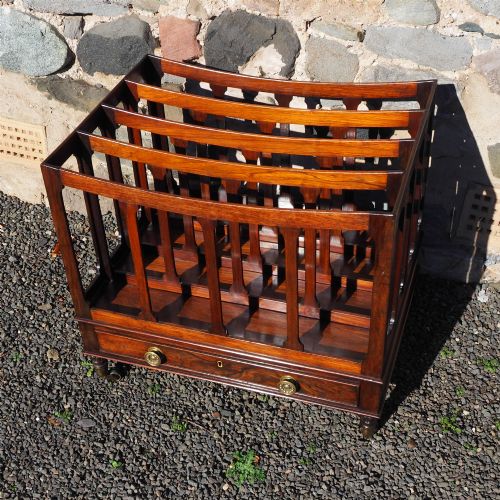
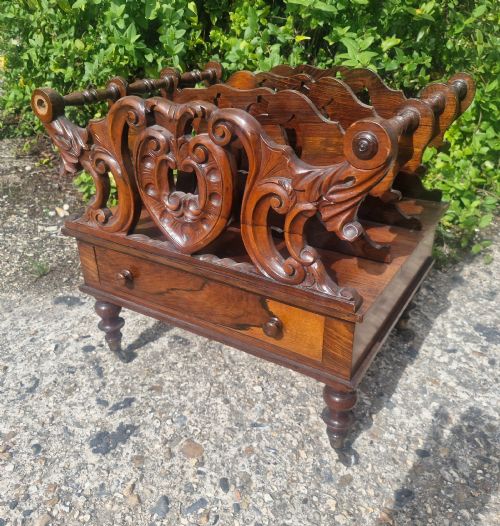
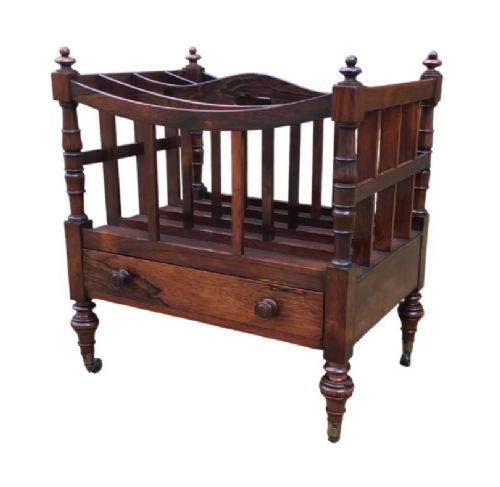
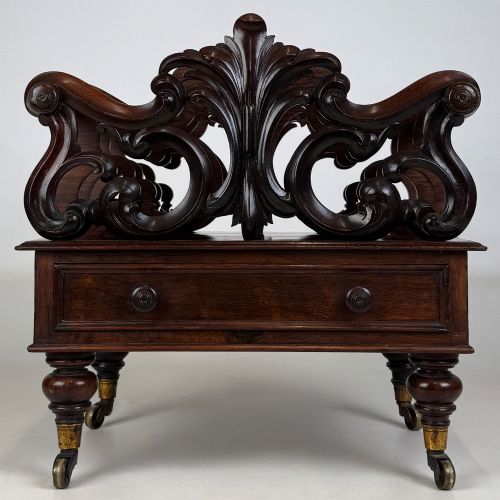
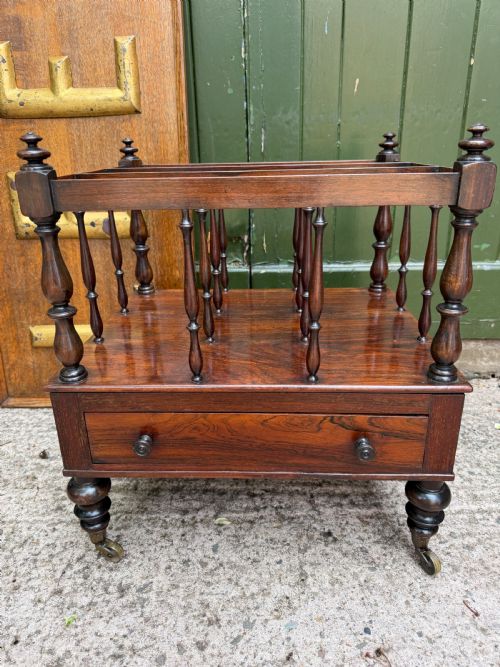


Rosewood Canterbury with Drawer
These rosewood canterbury with drawer pieces are refined timber stands designed to hold periodicals, sheet music, and papers in style.
Rosewood Canterbury with Drawer
When you search for a rosewood canterbury with drawer, you encounter a specialised nineteenth-century stand designed for organising sheet music, newspapers, and magazines. These furnishings appear across several distinct historical periods, including Regency, George IV, William IV, and Victorian eras.
The most common formats on this page include boat-shaped designs and multi-division racks fitted with a low storage drawer beneath the partitions. Makers utilised rich timber and incorporated carrying handles, foliate carvings, and turned supports to suit domestic libraries and drawing rooms.
Examples span the early nineteenth century up to the broader Victorian period, often designated as music canterburys, newspaper racks, or general tidy stands. Each piece combines vertical dividers for holding papers with a practical compartment at the base.
Materials and construction methods
Cabinet makers constructed these stands predominantly from rosewood, sometimes pairing the dense grain with mahogany elements or brass castors for mobility. Timber selection defined the visual weight and richness of the finished stand.
Joinery techniques involved precise division assembly for the partitions alongside dovetailed drawer construction beneath the rack. Carved details such as Prince of Wales feathers or foliate motifs were hand-shaped directly into the solid wood elements.
Rosewood Canterbury with Drawer Retail Price Guide 2026
Typical asking prices for rosewood canterbury with drawer among the pieces listed under this phrase on Sellingantiques today, from the lower quarter to the upper quarter. They describe what is for sale here now, not the wider market.
Current listings span the Regency, George IV, William IV, and Victorian periods, featuring rosewood alongside brass and ceramic components.
Distinctions in quality and execution
Superior examples display crisp, hand-carved ornamentation such as foliate designs or carved feather motifs rather than plain mouldings. The refinement of the turning on the upright supports and the integration of the drawer mechanism separate finer workshop output from standard production.
The choice of timber figure and the subtlety of the brass mounts also indicate grade. Better proportioned divisions and robust internal framing ensure the stand maintained structural integrity under the weight of heavy paper collections.
The Rosewood Canterbury with Drawer Glossary
- Regency
- A British design period spanning the early nineteenth century, characterised by classical restraint, elegant proportions, and refined ornamental details. Pieces from this era often display clean architectural lines.
- Rosewood
- A heavy, dense timber prized for its dark grain patterns and polished finish. It served as the primary material for high-end nineteenth-century cabinet work.
- Division
- One of the vertical partitions that creates individual slots within the rack. These divisions keep papers upright and separated.
- Castor
- A small wheel attached to the base of a stand for ease of movement. Brass mounts frequently secure these wheels to the legs.
Rosewood Canterbury with Drawer: Frequently Asked Questions
What were canterburys originally used for?
These stands served primarily for holding sheet music, unbound books, and newspapers near pianofortes or sitting room seating.
The lower drawer provided supplementary storage for smaller items like manuscript papers, writing materials, or musical accessories.
How do I date a rosewood canterbury?
Dating relies on stylistic markers associated with periods like Regency, George IV, William IV, and Victorian. Regency examples often display classical turning and boat-shaped profiles, while later Victorian pieces may incorporate heavier foliate carving.
Construction methods within the drawer and the character of the rosewood grain further assist in establishing the approximate decade of manufacture.
Are these stands sturdy enough for daily use?
Solid rosewood construction and internal framing make these pieces robust when handled with reasonable care. The vertical divisions are built to support moderate quantities of paper and periodicals.
Lifting the stand by its designated carrying handle rather than pulling on the divisions preserves the structural joints over time.