


Rosewood Cabinet Brass Grille
Rosewood cabinet brass grille pieces are architectural storage units prized for their rich timber and woven metal doors, bringing refined utility to a room.
Rosewood Cabinet Brass Grille
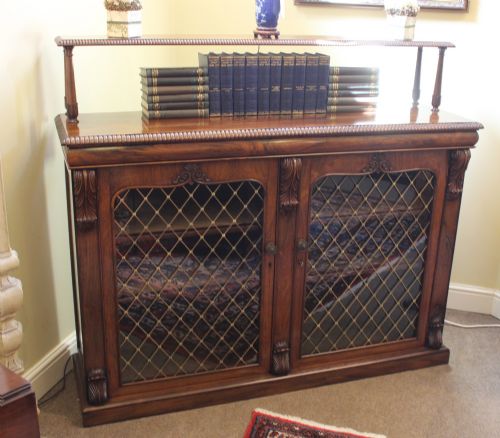
A rosewood cabinet brass grille typically appears as a chiffonier, side cabinet, or bookcase originating from the Regency and Victorian periods, often taking the form of a low storage unit designed for a parlour or dining room. The version most frequently met on this page is the Regency chiffonier, which combines a lower cupboard enclosed by woven brass wire doors with an upper tier or shelf supported by pillars.
Makers and workshops of the nineteenth century utilised dense tropical timber alongside traditional carcase construction to build these pieces, integrating fabric linings behind the metal wire to protect contents from dust while softening the visual transparency. Buyers encounter variations ranging from simple single-door cupboards to breakfront sideboards fitted with mirror glass backs and marble tops.
The historical function of these cabinets involved housing books, china, or private papers, with secretaire variants including a pull-down writing drawer fitted with smaller compartments. Their proportions remain remarkably adaptable for modern interiors, offering surface display space above enclosed storage that conceals modern media or collections.
How they were made
Cabinet makers constructed the primary carcase using solid timbers and secondary woods, applying figured rosewood veneers to visible exterior surfaces to create rich grain patterns across the front doors and drawer panels. Brass inlay, boxwood stringing, and gilt metal mounts were frequently integrated into the design to accentuate the architectural lines of the piece.
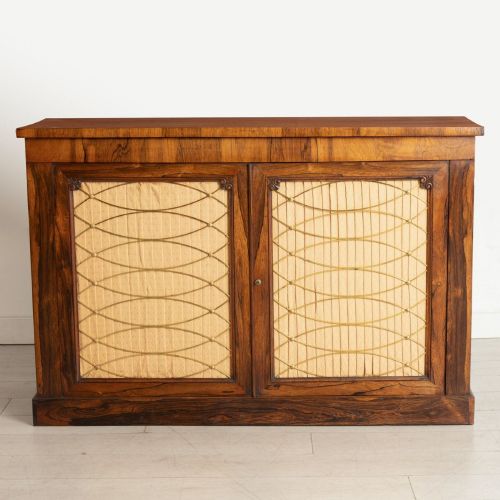
The distinctive grilles consist of fine brass wire woven into intricate geometric or trellis patterns, tensioned tightly within wooden frames to form the door inserts. Silk, fabric, or pleated backing materials were often placed behind this brass mesh to obscure the interior shelving while maintaining ventilation.
Form variations on this site range from compact single-door pier cabinets to large breakfront chiffoniers spanning over seventy inches in width.
What varies in quality
The primary distinction in quality lies in the selection and matching of the rosewood veneer, where superior examples exhibit symmetrical grain patterns across the entire front elevation rather than mismatched sections. Finely executed brass inlay and robustly woven wire grilles indicate a higher grade of workshop production from the Regency era onwards.
Structural integrity and the retention of original components, such as the internal mahogany linings, marble tops, and silk-backed grille panels, determine the standing of an individual piece within its period. Pieces bearing attribution to documented makers or workshops demonstrate superior joinery and more refined carving on structural pillars and feet.
Holland and Sons·Gillow·John McLean
The Rosewood Cabinet Brass Grille Glossary
- Chiffonier
- A low sideboard or cabinet with enclosed cupboards below, frequently surmounted by a shelf with mirror glass or scrolling supports.
- Grille
- A lattice or screen formed of woven brass wire fitted into cabinet doors to allow ventilation while partially concealing the interior.
- Regency
- An English design period spanning the early nineteenth century defined by classical restraint, architectural proportions, and exotic timber usage.
- Secretaire
- A cabinet or chiffonier incorporating a pull-down writing drawer fitted with small pigeonholes and drawers for correspondence.
- Breakfront
- A piece of furniture featuring a central section that projects forward from the flanking flanking wings, creating visual depth.
Rosewood Cabinet Brass Grille: Frequently Asked Questions
What is a rosewood cabinet brass grille used for today?
These cabinets serve as versatile credenzas or sideboards in living areas, providing enclosed storage for media equipment, books, or tableware while offering a decorative surface for lamps and art objects.
The combination of internal shelving and secure doors makes them practical for organising household items while maintaining a historic focal point in a room.
How do I identify a Regency period piece?
Regency pieces typically display classical architectural motifs, such as brass inlay, pilasters, and restrained geometric lines, reflecting the aesthetic of the early nineteenth century.
Secondary woods like mahogany inside drawers and specific construction techniques help distinguish these earlier examples from later Victorian reproductions or revivals.
Why do the brass grilles have fabric behind them?
The original fabric or silk backing behind the woven brass wire served to keep dust out of the interior compartment while concealing stored items from direct view.
Many surviving pieces retain traces of these textile linings, which soften the metallic gleam of the wire mesh against the dark rosewood timber.
Are marble tops original to these cabinets?
Certain side cabinets and chiffoniers from the nineteenth century were specified with white or grey marble tops to provide a durable, heat-resistant surface for serving or display.
These marble slabs sit directly on the wooden carcase, adding weight and a formal architectural quality frequently seen on mid-period examples.