
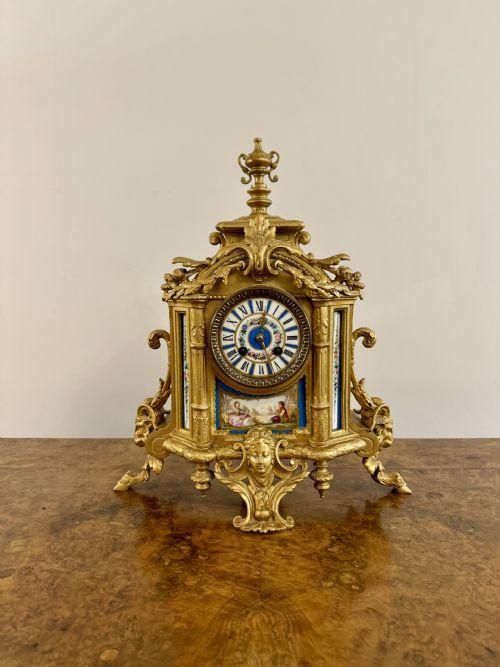


Rococo Revival Mantle Clock
A rococo revival mantle clock brings fluid nineteenth-century French styling and gilt bronze to a room, offering ornate scrollwork and dependable mechanical timekeeping.
Rococo Revival Mantle Clock
A rococo revival mantle clock is a decorative timekeeper rooted in nineteenth-century interpretations of earlier French design styles. These pieces combine sculptural cases with mechanical clockwork movements designed for domestic display on a mantelpiece or shelf.
The versions most commonly met on this page originate from French workshops during the Victorian era, particularly the middle and later decades of the nineteenth century. They frequently appear as standalone mantel clocks or as part of matched clock garnitures with flanking ornaments.
Materials and construction methods
Cases rely heavily on cast ormolu, gilt bronze, and gilt metal, which provide the reflective surfaces necessary for elaborate scrollwork and asymmetrical motifs. Manufacturers also integrated painted porcelain plaques, enamel dials, and marble stands to add colour and weight to the composition.
Movements were housed within these decorative shells, often featuring eight-day striking mechanisms produced by specialist makers. Artisans combined metal casting, hand chasing, and ceramic painting to complete each individual clock.
One cheerful nineteenth-century model pairs gilt ormolu with a charming motif of cherubs and a dragonfly.
Factors influencing quality
The crispness of the casting work separates standard production from superior pieces, as finer examples retain sharp relief in the scrollwork and foliage without softening. The quality of the gilding and the weight of the bronze or ormolu dictate the visual presence of the case.
Movement attribution plays a significant role, with clocks bearing signed or recorded maker marks on the backplate demonstrating higher manufacturing standards. Hand-painted porcelain details and intact enamel dials further distinguish the better items in this category.
Japy Freres·Phillipe H. Mourey·Meissen
The Rococo Revival Mantle Clock Glossary
- Ormolu
- A gilded bronze technique utilising finely ground gold mercury amalgam applied to a brass or bronze base. This finish produces a warm, enduring golden lustre characteristic of nineteenth-century French decorative arts.
- Clock garniture
- A matching set consisting of a central mantel clock accompanied by two side ornaments such as vases or candelabra. These sets were designed to create a balanced decorative arrangement on a fireplace mantel.
- Japy Freres
- A prominent French manufacturing firm producing clock movements during the nineteenth century. Their works are frequently encountered in quality mantel clocks of the period.
- Enamel
- A glassy substance fused to metal dial plates through high-temperature firing. It provides a smooth, white ground for painted numerals and chapter rings.
- Boulle
- A marquetry technique involving inlaid brass and tortoiseshell arranged in intricate patterns. It appears on selected decorative clock cases from the period.
Rococo Revival Mantle Clock: Frequently Asked Questions
What is a rococo revival mantle clock?
A rococo revival mantle clock is a nineteenth-century timepiece featuring asymmetrical scrollwork, naturalistic motifs, and ornate cast metal cases influenced by earlier French decorative styles. These clocks served both a practical timekeeping function and a prominent decorative role in Victorian interiors.
They are most commonly found in French or Victorian contexts, utilising materials such as ormolu, porcelain, and marble to create an imposing visual effect on a fireplace mantel.
How do I wind the clock?
Winding typically involves inserting a key into the winding holes on the enamel dial to tension the internal springs. Care must be taken not to overwind the movement to preserve the mechanical components.
Most nineteenth-century examples utilise an eight-day movement requiring weekly attention to maintain accurate timekeeping.
What is a clock garniture?
A clock garniture is a decorative set comprising a central mantel clock paired with matching side ornaments, such as urns or vases. These matched pieces were designed to be displayed together on a mantelpiece for visual symmetry.
The materials and styles of the side pieces directly mirror the central clock case.
How do I identify the period?
Dating relies on stylistic clues, materials, and maker marks stamped on the movement backplates. Nineteenth-century pieces often display specific revival characteristics, cast bronze signatures, or registration marks.
Comparing the dial construction and case materials helps narrow down the production decade between 1850 and 1900.