
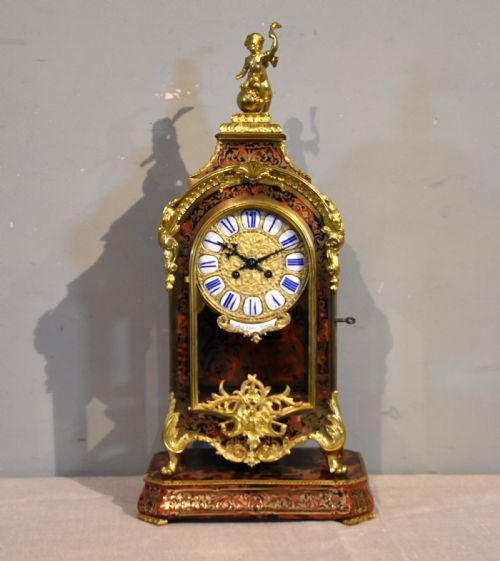


Victorian Decorative Table Timepiece
These Victorian decorative table timepieces are striking mantle and desk clocks that bring period mechanical charm and ornate metals to a room.
Victorian Decorative Table Timepiece
A victorian decorative table timepiece encompasses a wide array of clock forms designed for mantelpieces, desks, and boudoirs. These objects range from architectural marble and oak cases to delicate glass-cased carriage designs and sculptural gilt bronze figural pieces.
The versions most commonly met on this page are French carriage clocks and mantel clocks dating from the mid-nineteenth century to the early twentieth century. Makers housed these movements within brass, ormolu, porcelain, and ebonised wood structures.
Buyers also encounter specialised forms such as skeleton clocks, four glass clocks, and desk timepieces featuring hand-painted dials and enamel work. Each piece serves primarily as a functional timekeeper while doubling as an ornamental centrepiece.
Materials and construction
Metals form the structural core of these objects, with brass, gilt bronze, and ormolu shaping the housings, bezels, and decorative mounts. Artisans combined these polished and cast metals with glass panels and marble plinths to achieve substantial weight and visual contrast.
Enamel and porcelain provided the canvas for hand-painted dials and decorative panels, often integrated into carriage clocks and mantel models. Wood also appears, utilising ebonisation and hand carving in oak for architectural and bracket clock housings.
Object forms range from traditional mantel clocks and desk timepieces to specialised four glass clocks and French carriage clocks.
Distinctions in quality
The refinement of the metal casting and the intricacy of the decorative mounts distinguish upper-tier examples from simpler models. Finer timepieces display crisp chiselling on gilt bronze and ormolu alongside detailed hand-painted enamel work on the dial and panels.
The complexity of the internal mechanism, such as repeater functions or fusee movements, elevates the standing of a piece. Housing materials like heavy marble, multi-glass construction, and carved hardwood similarly separate standard production from elevated workshop output.
John Bennett Cheapside London·Barwise London
The Victorian Decorative Table Timepiece Glossary
- Carriage clock
- A small, portable spring-driven clock originally designed for travel, typically housed in a brass case with glass panels.
- Ormolu
- Gilded bronze, where a finely ground high-carat gold-mercury amalgam is applied to a bronze object, creating a rich golden surface.
- Skeleton clock
- A clock with an open framework that exposes the gear train and movement plates, allowing the mechanics to be viewed from the side.
- Fusee
- A conical pulley used in mechanical clocks to maintain an even pull on the gear train as the mainspring unwinds.
- Champlevé
- An enamelling technique where troughs are carved into the metal surface and filled with vitreous enamel before firing.
Victorian Decorative Table Timepiece: Frequently Asked Questions
What is a carriage clock?
A carriage clock is a portable timepiece housed in a brass frame with glass windows, designed for easy transport during the nineteenth century.
These clocks rely on a spring-driven movement and often feature a swinging handle on top for carrying.
How do I identify a skeleton clock?
A skeleton clock exposes its gear train and movement plates through an open metal framework rather than enclosing them in a solid wooden or marble case.
This design allows light to pass through the clock, showcasing the mechanical complexity of the escapement and wheels.
What materials were used for these clocks?
Makers utilised a variety of materials including brass, gilt bronze, ormolu, glass, marble, and porcelain.
Some examples also incorporate ebonised wood, hand-carved oak, and champlevé enamel to enrich the outer case and dial.
Where should I place a table timepiece?
These timepieces suit mantelpieces, desks, brackets, and boudoir tables where their decorative cases and dial work remain visible.
Placement should avoid areas of high humidity or direct sunlight to protect the delicate enamel dials and metal finishes.