


Rococo Giltwood Bench
A rococo giltwood bench brings undeniable theatre to a room through lavish carved ornamentation and warm metallic leaf.
Rococo Giltwood Bench
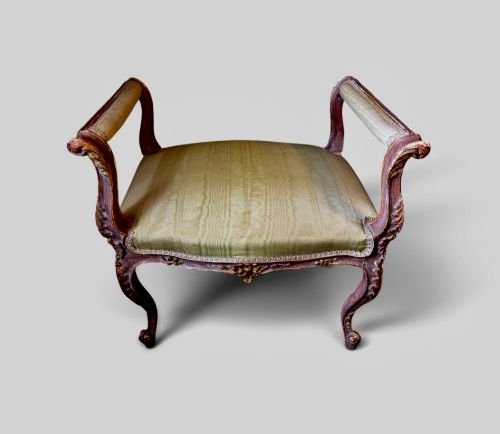
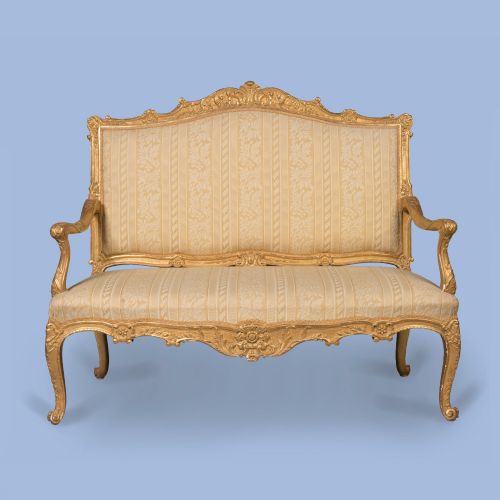
A rococo giltwood bench is a seat finished with gold leaf over carved wood, following the ornate, asymmetrical lines typical of the style. The listings show forms ranging from small footstools and window seats to long settees, canapés, and tete-a-tete sofas.
Most examples you encounter on this page date from the nineteenth century, including revivals in the Louis XV and Italian taste, alongside eighteenth-century Georgian and Venetian pieces. They serve as statement seating for drawing rooms, boudoirs, and grand hallways.
The variations in shape reflect diverse historical origins, from French chateau styles to Venetian polychrome work. Buyers often select them to anchor a room as a focal point or to provide accent seating alongside traditional furniture.
What varies in quality
The depth and crispness of the hand carving separate finer examples from simpler production, particularly in the definition of scrolls and floral details. Sharp undercutting and fluid movement in the wooden ornament indicate superior craftsmanship.
The quality of the gilding also dictates value, with well-preserved gold leaf showing subtle patination rather than flat modern paint. The weight and selection of the underlying timber contribute significantly to the structural integrity of the frame.
The object forms range widely across these listings, encompassing French canapés, Italian long stools, and boudoir window seats.
The Rococo Giltwood Bench Glossary
- Giltwood
- Wood that has been coated with thin sheets of gold leaf over a prepared gesso and bole ground. This technique creates a luminous metallic surface that catches the light differently than modern paint.
- Canapé
- A traditional French term for an upholstered sofa or settee, often featuring an exposed carved wooden frame. These pieces typically seat two or more people and match the stylistic details of contemporaneous armchairs.
- Rococo
- An artistic style originating in eighteenth-century France characterised by elaborate ornamentation, C-scrolls, S-scrolls, and naturalistic asymmetrical motifs. Revivals in the nineteenth century reinterpreted these lively forms for Victorian and Edwardian interiors.
- Caning
- Woven rattan or split reed used to form supportive panels for seats and backs. It provides a lighter alternative to solid upholstery and appears frequently on chairs and stools from various periods.
- Parcel gilt
- A decoration method where only specific parts of an object are gilded, leaving other areas of the wood or painted surface exposed. This creates contrast and highlights particular carved architectural elements.
Rococo Giltwood Bench: Frequently Asked Questions
Where should I place a gilt bench?
These seats suit focal points such as the foot of a bed, an entrance hall, or beneath a large mirror in a reception room. Their decorative frames work best when positioned where light catches the metallic surface.
Because of their ornate nature, they also function effectively as standalone statement pieces rather than everyday lounging furniture.
Are these seats comfortable?
Comfort varies considerably depending on the specific form, with larger settees offering upholstered backrests while stools provide simple padded seating. Many historical examples prioritize aesthetic presence and formal posture over deep lounging comfort.
Adding small decorative cushions can adjust the seating depth and comfort level for everyday use.
How do I distinguish a revival piece?
Nineteenth-century revival pieces often display machine-assisted elements alongside hand carving, alongside specific secondary timbers characteristic of later manufacturing. Examining the construction joints and the wear patterns on the gold leaf helps reveal the true age of the object.
Comparative study of eighteenth-century originals clarifies the stylistic shifts introduced by later makers.