
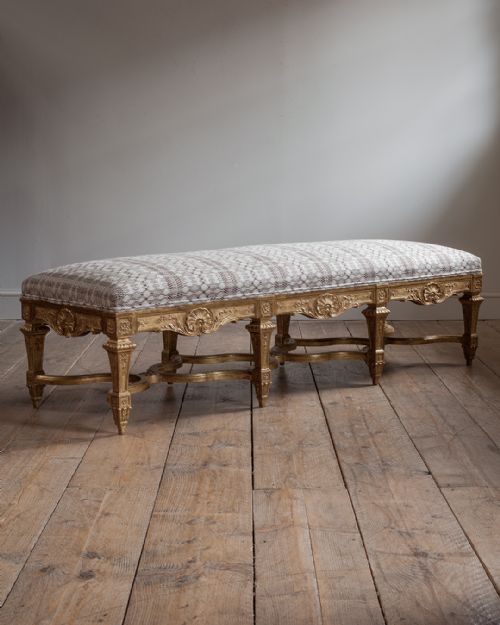


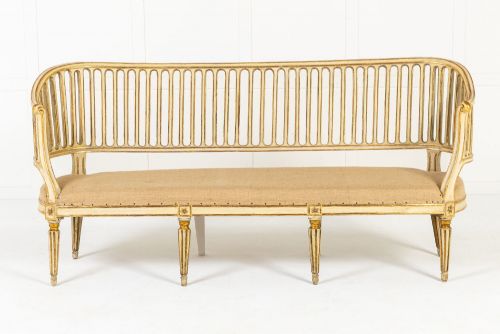


Carved Gilt Window Seat
A carved gilt window seat offers a gilded frame and long seat designed to sit beneath glass.
Carved Gilt Window Seat
A carved gilt window seat combines a gilded timber frame with an upholstered top, forming a long stool or bench built to sit beneath a room's fenestration. The selection ranges from compact 19th century French and Italian examples to larger Victorian and 18th century pieces.
The forms span simple benches, long stools, duet stools, and two-seater window sofas. These versatile seats frequently adopt neoclassical, Louis XV, Louis XVI, Rococo revival, and Empire styles.
Buyers seeking a carved gilt window seat will encounter various iterations featuring exposed giltwood, gilded wood, painted wood, and fabric upholstery.
How they were made
Craftsmen built the structural frames using timber, shaping wood and applying gesso before laying down thin sheets of gold leaf to create the characteristic gilt finish.
Some pieces feature painted wood surfaces alongside gilding, while others incorporate brass details or woven textile and fabric upholstery secured to the seat.
Listings feature pieces spanning the 18th century, the 19th century, and the Victorian era, utilising giltwood, painted wood, and brass.
What varies in quality
The crispness of the carved ornament on the wooden frame separates ordinary joinery from finer examples. Deeply defined foliage, scrolls, and neoclassical motifs demonstrate superior hand-carving skill.
The integrity of the gilt surface and the quality of the underlying gesso layer dictate the visual richness of the piece. Well-preserved gilding maintains its lustre without heavy flaking or clumsy modern repainting.
The Carved Gilt Window Seat Glossary
- Giltwood
- Timber coated with gold leaf or powder over a prepared gesso ground. This finish provides the bright metallic surface seen on neoclassical and revival frames.
- Curule stool
- An ancient Roman seat shape featuring two curved legs that cross in an X-frame configuration. This classical form appears in 19th century revival seating.
- Gesso
- A plaster mixture applied to wood frames to create a smooth base for gilding. It allows carvers to achieve sharp relief details before applying gold leaf.
- Neoclassical
- A style drawing inspiration from classical antiquity, featuring restrained proportions, symmetry, and architectural motifs. It dominates many 18th and 19th century French and Italian seats.
- Duet stool
- An elongated seat built for two people to sit together at a piano or in a window recess. These proportions match many surviving window benches.
Carved Gilt Window Seat: Frequently Asked Questions
Where should I place a window seat?
These long seats fit naturally beneath large windows, in hallways, or at the foot of a bed.
Their slender proportions allow them to occupy narrow spaces without blocking light or movement.
How do I identify a French style?
French revival pieces often display Louis XIV, XV, or XVI decorative vocabularies with flowing curves or straight fluted legs.
Look for refined giltwood carving and classic upholstery forms that reflect Parisian seating fashions.
What is a curule frame?
A curule frame uses crossing X-shaped legs inspired by Roman magistrate seats.
This architectural geometry adds strong diagonal lines to an interior scheme.
Are these seats comfortable for sitting?
Most examples provide firm padded seating suitable for short resting periods rather than deep lounging.
The upholstery depth varies depending on whether the piece functions as a stool or a two-seater sofa.