





Rococo Ceramic Group
These rococo ceramic group pieces capture elaborate 18th-century theatricality through porcelain figures, adding dramatic narrative and intricate modelling to a room.
Rococo Ceramic Group
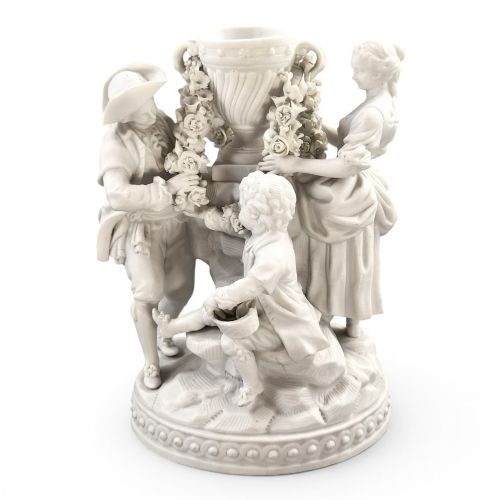
A rococo ceramic group brings together multiple porcelain figures engaged in a narrative scene, whether portraying courting couples, musicians, mythological subjects like Venus and Cupid, or domestic settings such as gardeners and children. When exploring this selection, buyers frequently encounter pieces originating from major European factories, most notably Meissen and Derby, spanning both the 18th century and later 19th-century revival periods.
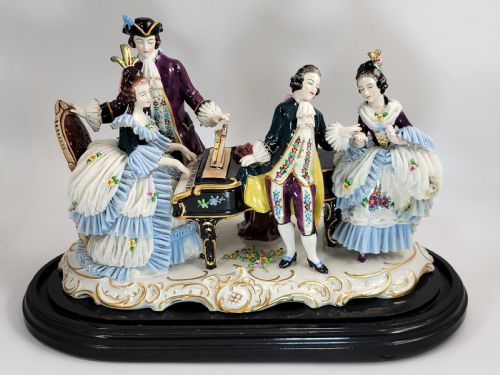
The physical forms range from modest table figures to large sculptural groups complete with bocage backgrounds, musical instruments, floral garlands, and architectural elements like classical busts or pianos. These sculptures serve primarily as decorative centrepieces, drawing the eye through complex multi-figural arrangements and dynamic poses.
Beyond the standard 18th-century originals, the category encompasses Victorian and later continental interpretations influenced by French rococo taste, including Volkstedt lace porcelain and Parisian works by makers such as Bourdois and Bloch or Eugene Clauss.
What varies in quality
The application of colour and gilding marks another distinction, with superior pieces showing deft brushwork in the enamel and precise placement of gold leaf that accentuates the asymmetrical curves of the rococo style. Additionally, the survival rate of delicate protrusions like porcelain lace, flower petals, and leafy arbours heavily influences the overall integrity of the piece.
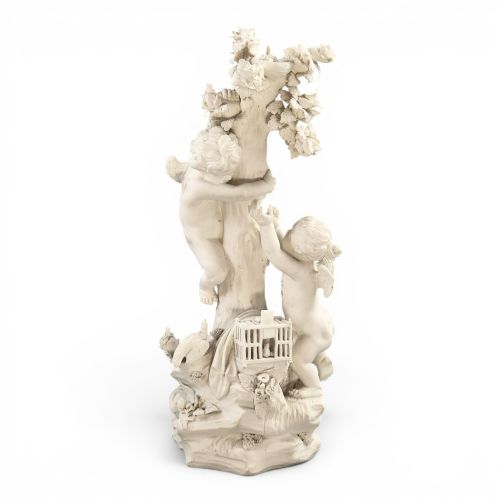
Cupid gets his wings clipped by Father Time in two different sculptural groups.
Meissen·Derby Porcelain·Bourdois and Bloch·Ernst Bohne Sohne·Triebner Ens and Co
The Rococo Ceramic Group Glossary
- Bocage
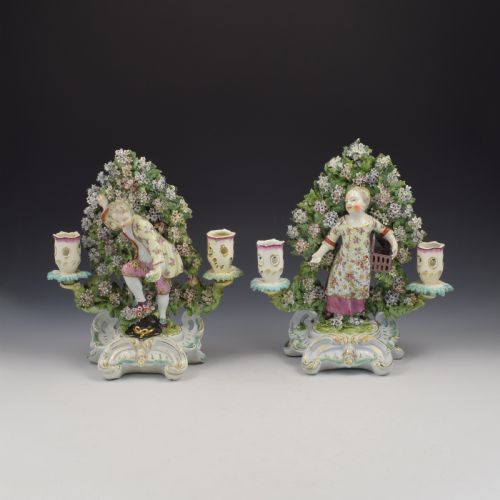
- An ornamental background of leaves and flowers made from porcelain, often encrusting the back of 18th-century Derby and continental candlestick figures. This leafy screen mimics natural woodland arbours.
- Biscuit Porcelain
- Unglazed porcelain fired to a matte, smooth finish that resembles white marble. It was widely utilised for neoclassical and Victorian sculptural figures to highlight fine modelling.
- Hard-Paste Porcelain
- A durable ceramic composition fired at very high temperatures, made from kaolin and petuntse. European factories such as Meissen adopted this formula for its resilience and bright glaze.
- Soft-Paste Porcelain
- An artificial porcelain body fired at lower temperatures, prized for its warm, slightly translucent glaze and soft texture. It was common in early French and English manufacturing before hard-paste became standard.
Rococo Ceramic Group: Frequently Asked Questions
What is a rococo ceramic group?
A rococo ceramic group is a sculptural porcelain composition featuring multiple figures engaged in a narrative scene, such as musicians, gardeners, or mythological characters. These pieces are characterised by asymmetrical scrolls, dynamic movement, and ornate detail.
Originating primarily in 18th-century European factories like Meissen and Derby, they were designed as ornamental centrepieces for dining tables and salons.
How do I tell an 18th-century piece from a 19th-century revival?
Eighteenth-century pieces typically exhibit hand-modelled spontaneity, softer paste bodies, and specific factory marks from their initial period of operation. The modelling tends to feel organic and closely tied to the height of the rococo movement.
Nineteenth-century revival pieces, often inspired by earlier Meissen or Chelsea styles, generally utilise harder porcelain bodies, crisper factory stamps, and sometimes incorporate applied elements like porcelain lace.
How were these figures used originally?
In the 18th century, porcelain figure groups served as elaborate table centrepieces for elite banquets, often arranged along the length of a dining table as a form of visual entertainment. Wealthy patrons also displayed them on mantelpieces and in specialised cabinet furniture.
They functioned as conversation pieces that reflected the refined taste, classical knowledge, and theatrical interests of the household.
What does bocage mean on a figurine?
Bocage refers to the decorative background of porcelain foliage, leaves, and flowers that frames figures on certain candlesticks and pastoral groups. It creates a leafy arbour effect behind the main characters.
This technique required careful hand-assembly and firing, making surviving examples with intact foliage particularly desirable for collectors of early Derby and continental porcelain.