


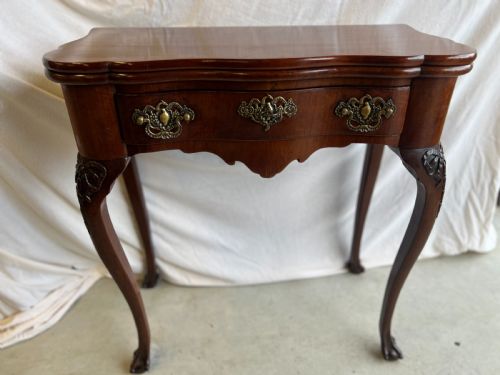


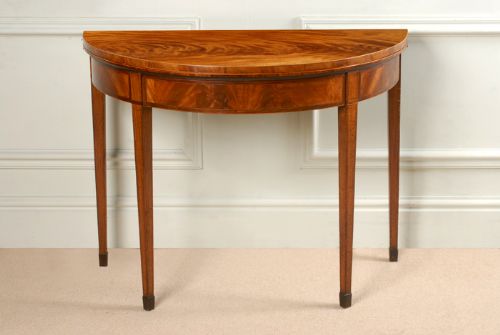
Rich Brown Games Table
A rich brown games table brings centuries of social parlour life directly into a modern drawing room with warm timber tones and clever folding tops.
Rich Brown Games Table
A rich brown games table encompasses versatile furniture designed for card playing, tea drinking, and general social gatherings across the eighteenth and nineteenth centuries. These pieces typically present rich timber surfaces that fold or swivel open to reveal baize-lined playing spaces or concealed storage compartments.
Buyers browsing this selection will most frequently encounter Georgian and Victorian examples fashioned from sturdy mahogany or highly figured burr walnut. These forms range from rectangular fold-over card tables to demi-lune shapes and combined tea and silver tables.
Originating in periods where domestic entertainment centred around the card table, these objects demonstrate a high degree of functional adaptability. They shift effortlessly from compact console furniture to stable surfaces prepared for play.
Materials and construction
Cabinet makers utilised dense native timbers such as mahogany and walnut, frequently selecting burr walnut to create dramatic, swirling grain patterns across the primary surfaces. Finer examples incorporate delicate boxwood and wood inlay alongside metal mounts in ormolu and brass.
The construction relies on sturdy joinery to support pivoting or folding leaves that conceal wells for counters and cards. Marquetry techniques add intricate floral detail to the timber tops, distinguishing elaborately decorated Victorian pieces from earlier Georgian iterations.
Current listings span the eighteenth and nineteenth centuries, featuring walnut, mahogany, and kingwood alongside brass and ormolu details.
Distinctions in quality
Quality rests upon the selection of timber, where intensely figured burr walnut or rich mahogany grain elevates the visual impact of the piece. The crispness of the wood inlay and floral marquetry further separates standard furniture from masterworks.
Structural integrity during the transition from closed console to open playing surface determines the success of the mechanism. Superior examples maintain a tight, flush fit when closed and steady support when the top is unfolded.
The Rich Brown Games Table Glossary
- Burr walnut
- A prized timber harvested from walnut tree growths, producing swirling and mottled grain patterns. Cabinet makers prized it for decorative veneering on high-status surfaces.
- Demi-lune
- A half-moon shape used for table tops and frames. This form allows the furniture to sit flat against a wall when closed.
- Marquetry
- Decorative veneer work arranged in pictorial or geometric patterns using various coloured woods. Craftsmen applied this technique to tabletop surfaces for visual enrichment.
- Ormolu
- Gilt bronze mounted onto furniture for decorative effect. It appears frequently on pieces influenced by continental French styles.
Rich Brown Games Table: Frequently Asked Questions
How were these tables used historically?
Households utilised these surfaces for card games, social gatherings, and serving tea during the Georgian and Victorian eras.
The clever compartments beneath the folding tops stored playing cards, counters, and small accessories safely out of sight.
How do I tell a Georgian table from a Victorian one?
Georgian examples often favour clean mahogany construction with simpler geometric lines and understated elegance.
Victorian pieces frequently display elaborate burr walnut veneers, floral marquetry, and heavier ornamental detailing influenced by earlier continental revivals.
How do I care for timber veneer surfaces?
These pieces require placement away from direct sunlight and sudden temperature shifts to protect the antique wood and delicate inlay.
Regular dusting with a dry, soft cloth maintains the natural lustre of the polished mahogany or walnut without risking moisture damage.