
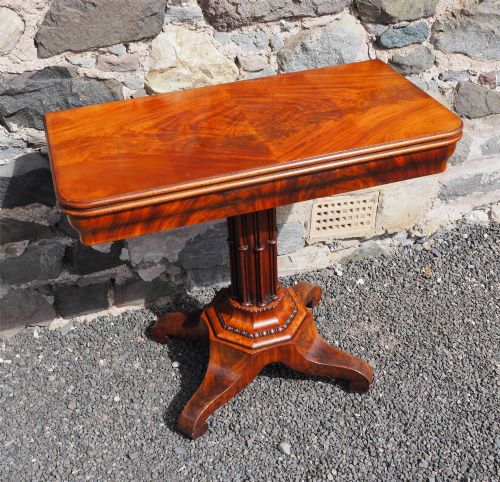
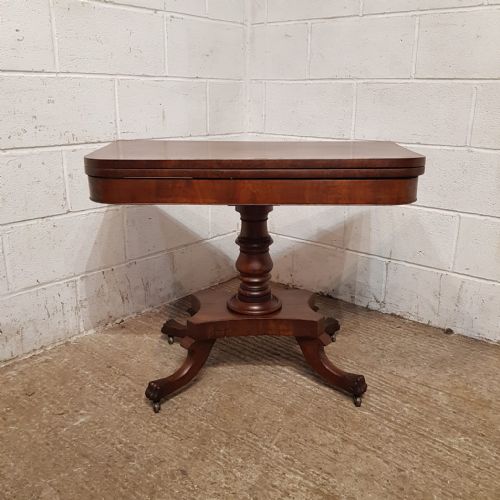
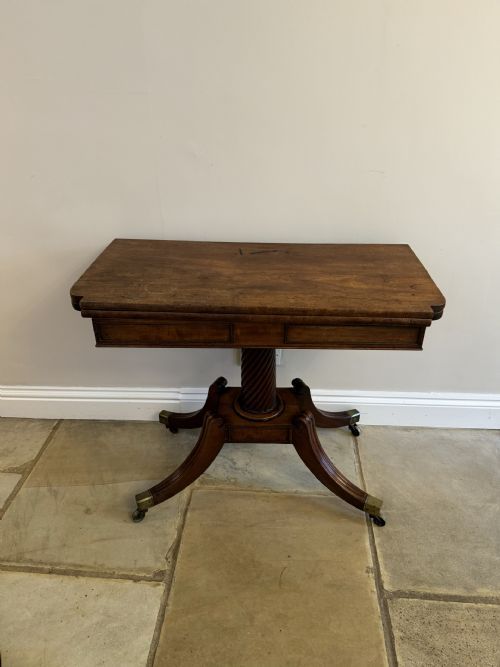
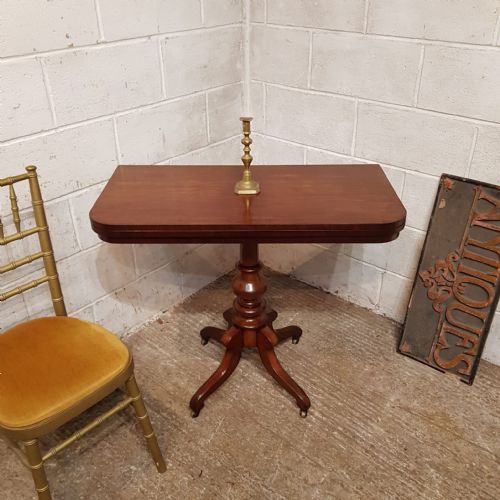


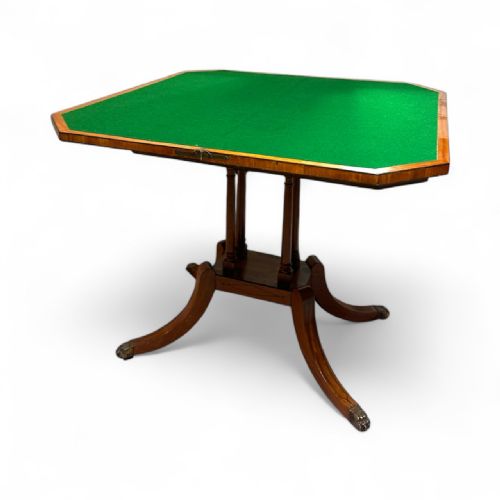

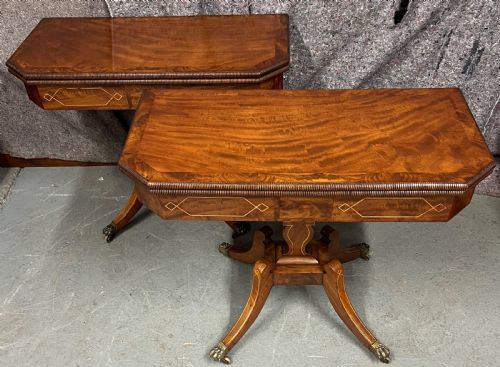


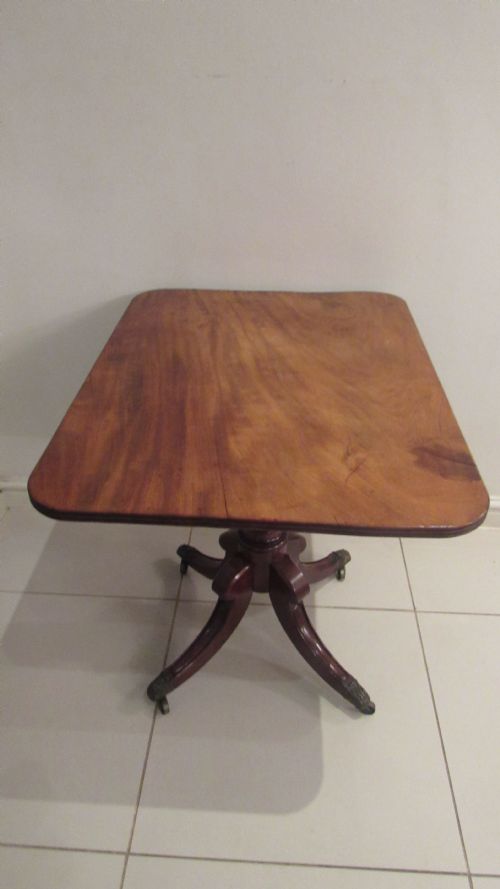
Quadruped Pedestal Card Table
A quadruped pedestal card table brings a clever folding top and a sturdy four-footed pillar into the room.
Quadruped Pedestal Card Table
A quadruped pedestal card table offers a hinged surface that opens to double its size for play or dining, supported by a central pillar mounted on four feet. These pieces emerge chiefly from the Regency and Victorian periods, spanning from the early nineteenth century through to the eighteen-eighties.
Examples range from restrained mahogany sides to highly figured rosewood and burr walnut surfaces decorated with brass inlay or satinwood details. Each piece combines a compact closed profile with a wide surface ready for evening entertainment.
Materials and construction
Cabinet makers utilised solid timbers and choice veneers, applying flame mahogany, burr walnut, and rosewood over robust core woods to create rich surface patterns. Brass mounts, fine inlay work, and gilding frequently accent the primary woods.
The central pillar stands upon four distinct feet, often carved or fitted with castors to support the weight of the pivoting and folding top leaf. Joinery relies on traditional framing to ensure the hinged leaf remains stable when open.
Some tables hide secret compartments beneath the fold-over top, ready to swallow stray playing cards and mother-of-pearl counters after a late game.
Distinctions in quality
The choice of timber grain defines the visual success of the piece, where select flame mahogany veneers or figured burr walnut display deeper movement and contrast. Simpler, straight-grained mahogany surfaces sit at the plainer end of the range.
Refinement in the pillar carving and the precision of brass inlay or satinwood banding separate standard workshop production from finer examples. The smoothness of the fold-over mechanism and the stability of the four-footed base further distinguish the build.
William Trotter
The Quadruped Pedestal Card Table Glossary
- Quadruped
- Having four feet or supports. In these tables, the base consists of a central pillar resting on four distinct legs or feet.
- Fold-over
- A table top hinged along the back edge that opens out to reveal a larger surface, frequently lined with baize for card games.
- Loo table
- A round or oval table designed for the nineteenth-century card game loo, often featuring a tilt-top mechanism on a central pillar.
- Veneer
- A thin layer of figured wood applied to a secondary timber base to provide decorative grain patterns without excessive weight or cost.
Quadruped Pedestal Card Table: Frequently Asked Questions
How do I open the top?
The hinged leaf lifts and rotates on pivots or swings out on a pivot arm to rest flat over the open wooden framework.
Once turned into position, the top provides a stable surface supported by the hinged rail beneath.
Where were these tables placed?
They stood against parlour or drawing room walls when closed to save space during the day.
Opened up, they moved toward the centre of the room for evening card games or tea.
How do I date a table?
Regency examples often feature rosewood, brass inlay, and crisp classical pillar turning from the early nineteenth century.
Victorian pieces from the mid to late nineteenth century frequently show figured walnut, heavier proportions, and oval loo table formats.
Are the interiors lined?
Many card and games tables feature recessed playing surfaces originally lined with baize or leather beneath the folding leaf.
Some interiors also incorporate small wells or compartments for storing cards and counters.