

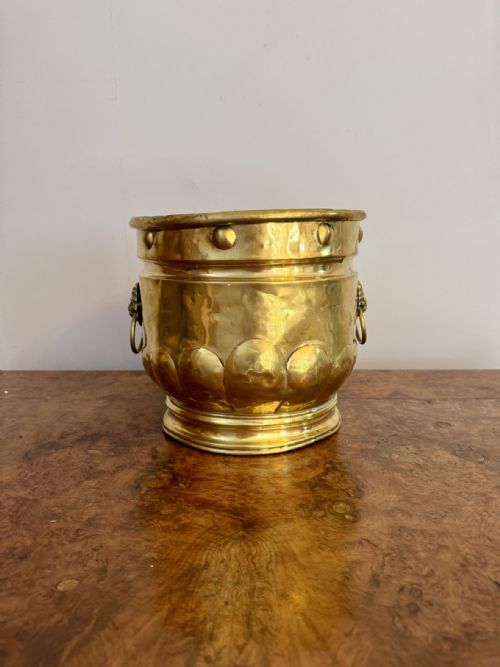
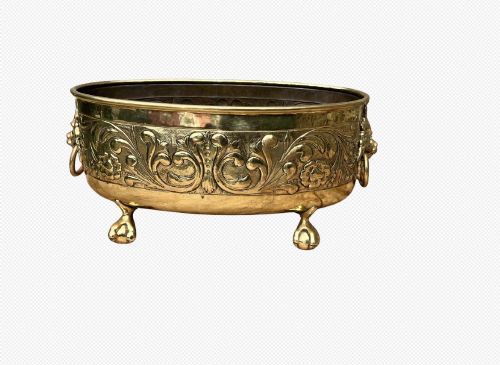
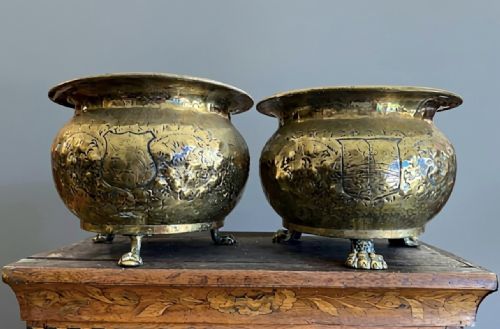


Repousse Plant Container
These repousse plant containers bring texture and warmth to a room, holding greenery within hammered metal vessels shaped by Victorian and Arts and Crafts hands.
Repousse Plant Container
A repousse plant container is a domestic vessel designed to hold potted plants or logs, appearing on this page most often as a brass or copper jardiniere from the Victorian and Arts and Crafts periods. These pieces serve primarily as decorative cachepots, taking forms that range from square plant stands to rounded bowls fitted with handles.
The selection centres on nineteenth century manufacture, spanning from mid Victorian examples through to 1903 Arts and Crafts and Art Nouveau designs. Alongside standard jardinieres, buyers encounter related forms such as coal boxes and planters featuring animal heads or lion masks.
Origins stretch across British workshops and continental makers, including Belgian and Dutch pieces alongside domestic production. The form remains a practical interior accessory, designed to elevate ordinary houseplants by enclosing them in decorative metalwork.
How they were made
Makers fashioned these containers principally from sheet brass and copper, hammering the metal from the reverse side to raise ornamental patterns in relief. Iron also appears in the construction, often providing structural support or subsidiary components within the vessels.
Surface decoration relies heavily on repousse technique, where artisans chased and punched the metal to create distinct motifs such as animal heads and lion masks. Handles and feet were cast separately and attached mechanically to the main body of the jardiniere.
Repousse Plant Container Retail Price Guide 2026
Typical asking prices for repousse plant container among the pieces listed under this phrase on Sellingantiques today, from the lower quarter to the upper quarter. They describe what is for sale here now, not the wider market.
Several of these botanical vessels stare back at you with cast lion masks and animal heads welded firmly to their sides.
What varies in quality
Quality rests on the depth and crispness of the hammered relief work, distinguishing boldly hand-modelled surfaces from shallow, machine-pressed alternatives. Heavier gauge metal provides a more substantial feel and better structural integrity across the vessel.
The refinement of cast additions, such as lion mask handles and applied feet, marks the distinction between standard production and superior workshop output. Well-defined detailing on animal heads and balanced proportions elevate the status of an individual jardiniere.
J Sankey and Sons
The Repousse Plant Container Glossary
- Repousse
- A metalworking technique where the artisan hammers sheet metal from the reverse side to create a raised design on the front. This method allows for detailed pictorial and ornamental work on vessels.
- Jardiniere
- An ornamental pot or stand designed to hold flowers or plants, typically manufactured from ceramic or metal. These vessels function as cachepots to conceal plain flower pots.
- Cachepot
- An outer decorative pot that houses a plain planting pot with drainage holes, protecting indoor surfaces from water. Metal jardinieres serve this exact domestic purpose.
- Arts and Crafts
- A design movement valuing handcraft, traditional materials and vernacular styles over mass production. Pieces from this era often display honest construction and visible hand-hammered surfaces.
Repousse Plant Container: Frequently Asked Questions
What is a repousse plant container?
A repousse plant container is a decorative metal vessel, often formed as a jardiniere or planter, decorated with raised patterns hammered from the reverse side. These pieces date largely from the Victorian and Arts and Crafts eras.
They function as cachepots to hold potted plants indoors, combining utilitarian purpose with ornamental metalwork.
How do I use a jardiniere at home?
Jardinieres sit on tabletops, plant stands or hearths, holding potted greenery or functioning as dry storage for logs and coal. They add metallic warmth and historical character to modern and traditional interiors alike.
Place a waterproof liner inside older metal vessels if watering plants directly, though most are intended to hold a separate plastic pot.
How do I tell Victorian from Arts and Crafts pieces?
Victorian containers often feature formal decoration, classical motifs, and bright brass finishes typical of nineteenth century manufacturing. They encompass square forms and standard planters.
Arts and Crafts pieces tend to emphasise the handmade quality of copper, showing deliberate hammer marks and stylised motifs inspired by earlier Dutch or continental metalwork.
What metals were used for these containers?
The primary metals found in these pieces are brass and copper, chosen for their malleability and rich appearance. Iron also appears in structural parts or associated coal boxes.
Over time, these metals develop a natural patina that distinguishes older nineteenth century items from modern reproductions.