
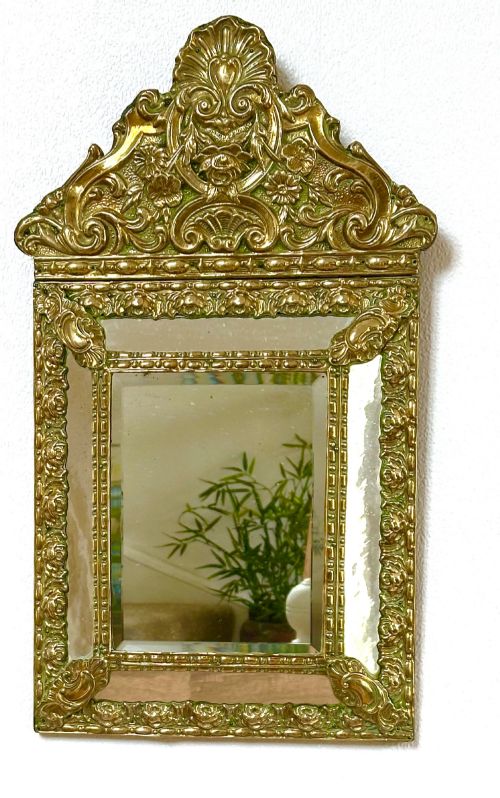


Repousse Cushion Mirror
These repousse cushion mirror pieces bring tactile metalwork and deep frames into a room, offering distinct historical character.
Repousse Cushion Mirror
A repousse cushion mirror presents a convex, rounded frame profile wrapped in metalwork, predominantly taking the form of wall mirrors. These pieces emerge from the nineteenth century, drawing heavily on earlier Dutch, Flemish, and French decorative traditions.
The visual weight of a repousse cushion mirror lies in its sloping border, which projects outward from the wall before turning back toward the glass. Buyers encounter variations spanning the Victorian era, the Edwardian period, and Regency styles.
Origin points cluster across France, the Netherlands, and Flanders. French and Dutch interpretations dominate the available examples, often utilising rich brass surfaces.
How they were made
Makers formed the characteristic profile using wood or ebonised wood as a structural core, building up the rounded cushion shape before applying metal elements. Pressed brass and embossed brass sheets provide the outer layer, shaped by hammering from the reverse side to create raised motifs.
Tortoiseshell, ebonised wood, and silvered surfaces appear alongside standard brass mounts to frame the glass plates. Mirror glass sits recessed within the deep frame, occasionally utilising mercury plates in older examples.
Some mirrors require extra space simply to accommodate their generous, puffed-out metal cheeks.
What varies in quality
The definition and depth of the metal relief work separate finer examples from simpler production. Crisper hammering creates distinct floral, scroll, or figurative details across the brass borders.
The choice of secondary materials beneath the metal dictates the overall substance of the object. Solid ebonised wood or tortoiseshell foundations provide greater durability and visual richness compared to lighter backing materials.
The Repousse Cushion Mirror Glossary
- Repousse
- A metalworking technique where the artisan hammers the design from the reverse side to form raised patterns on the front. This method creates the tactile surface relief seen on the frames.
- Cushion frame
- A convex, rounded frame profile that slopes outward from the wall toward the glass plate. This voluminous shape defines the optical presence of the piece.
- Foxed plate
- Mirror glass displaying age spots, oxidation, or dark patches behind the silvering layer. Such marks indicate the historical age of the glass.
- Ebonised wood
- Timber treated to resemble ebony, providing a dark, dense contrasting border for the metal mounts. This material often frames the outer edges of the cushion profile.
Repousse Cushion Mirror: Frequently Asked Questions
Where were these mirrors made?
The available evidence points primarily to French, Dutch, and Flemish workshops during the nineteenth century. Makers in these regions produced decorative wall mirrors utilising local stylistic revivals.
French and Flemish interpretations frequently incorporated elaborate brass repousse work mounted over wooden cores.
How do I hang a heavy brass mirror?
Given the substantial weight of wood and brass construction, secure wall fixings are essential for support. Wall mirrors require appropriate brackets or direct attachment to wall studs rather than relying on standard picture hooks.
Professional installation ensures the frame remains stable against the wall surface.
How do I tell nineteenth century mirrors apart?
Makers during the nineteenth century drew upon various regional revivals, including French Chateau, Flemish Renaissance, and Dutch Baroque styles. Examining the metal motifs, frame timber, and joining methods helps distinguish between French and Flemish origins.
Dates range from Regency and 1860 examples through to later Victorian and Edwardian interpretations.