

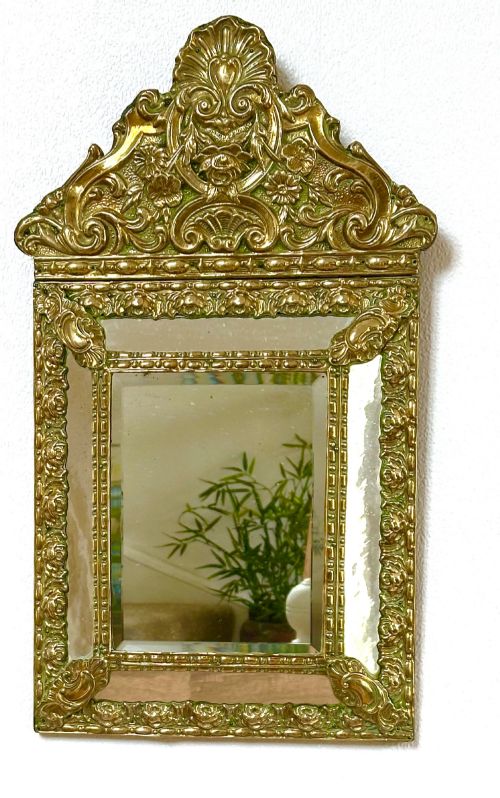


Repousse Brass Cushion Mirror
A repousse brass cushion mirror brings deep relief metalwork and curving wooden frames into a room, offering both historical weight and bright reflection.
Repousse Brass Cushion Mirror
A repousse brass cushion mirror presents a convex frame profile wrapped in patterned metalwork, designed to hang on a wall as a focal point. These wall mirrors appear across nineteenth century periods, including Victorian, Regency, and Edwardian eras, drawing on earlier Flemish and Dutch seventeenth century design traditions.
The form relies on a rounded wooden core, often ebonised or accented with tortoiseshell, which carries the beaten brass ornamentation. French and Dutch stylistic influences dominate the available examples, ranging from smaller domestic pieces to large wall-hanging formats.
Makers and workshops from the nineteenth century reproduced these heavy cushion profiles using revival idioms such as Flemish Renaissance Revival and Dutch Baroque Revival. Buyers encounter these mirrors in various proportions, all sharing the characteristic puffed frame geometry.
Materials and construction methods
Construction combines a timber foundation with sheet metal elements, utilising wood and ebonised wood to build the distinctive swelling cushion shape. Craftsmen then mounted embossed, pressed, or repousse brass panels onto this armature, securing the metalwork with pins or mounts.
The reflective surface typically consists of mirror glass, with archive examples noting mercury plates, held within the layered wooden and metal rebate. Secondary materials such as tortoiseshell appear on select frames, adding rich dark tones beneath the raised brass detailing.
Repousse Brass Cushion Mirror Retail Price Guide 2026
Typical asking prices for repousse brass cushion mirror among the pieces listed under this phrase on Sellingantiques today, from the lower quarter to the upper quarter. They describe what is for sale here now, not the wider market.
Some nineteenth century makers tucked extra padding behind the brass to make the cushion frame extra plump.
Distinctions in craftsmanship and condition
Quality rests in the crispness and depth of the metal relief work, where deeply beaten repousse details show sharper definition than simpler pressed sheets. The hand of the metalworker dictates whether floral and figurative motifs read with clarity or appear flat.
The integrity of the underlying cushion frame and the originality of the mirror plate determine the standing of an individual piece. Frames that retain their original ebonised finishes, tortoiseshell insets, and period mirror glass hold greater historical coherence.
The Repousse Brass Cushion Mirror Glossary
- Repousse
- A metalworking technique where the artisan hammers the design from the reverse side to form raised relief on the front. This process creates tactile depth across the brass cushion frames.
- Cushion mirror
- A wall glass featuring a rounded, convex frame profile that swells outward toward the outer edge. The puffed shape provides a dramatic surround for the central plate.
- Foxed plate
- Mirror glass displaying aged spots, darkening, or speckling caused by the degradation of the backing over time. Collectors often prize these patinated surfaces for their authentic period character.
- Ebonised wood
- Timber treated to imitate costly ebony, typically through dark staining and polishing. It frequently forms the contrasting dark borders on these nineteenth century frames.
Repousse Brass Cushion Mirror: Frequently Asked Questions
Where should I hang a cushion mirror?
These wall mirrors suit principal reception rooms, hallways, or above a fireplace where their reflective glass and heavy metal frames command attention. Their projecting profiles benefit from spaces with good side lighting to catch the beaten brass relief.
Ensure the wall construction safely supports the substantial weight of timber and metal. Positioning them opposite a window will maximise the light they bring into the interior.
How do I care for the brass frame?
Dust the raised metalwork gently with a soft dry brush to prevent dirt settling in the recessed areas of the repousse pattern. Avoid harsh metal polishes that can strip away the accumulated patination and historic character of the brass.
Keep the mirrors away from damp environments to protect both the wooden cushion core and the integrity of the antique glass plate.
Are these mirrors French or Dutch?
The listings include both French and Dutch origins, alongside Flemish revival interpretations produced during the nineteenth century. French examples often incorporate fine metal mounts and tortoiseshell, while Dutch styles lean toward robust baroque floral embossing.
Many nineteenth century pieces deliberately emulate seventeenth century designs, meaning stylistic influences frequently overlap across different regional workshops.
What does cushion framed mean?
A cushion frame curves outward like a stuffed pillow, sloping away from the central mirror glass toward the outer wall edge. This volumetric shape gives the object a sculptural presence distinct from flat picture frames.
The puffed wooden core creates deep shadows and highlights across the embossed brass decoration wrapped around it.