

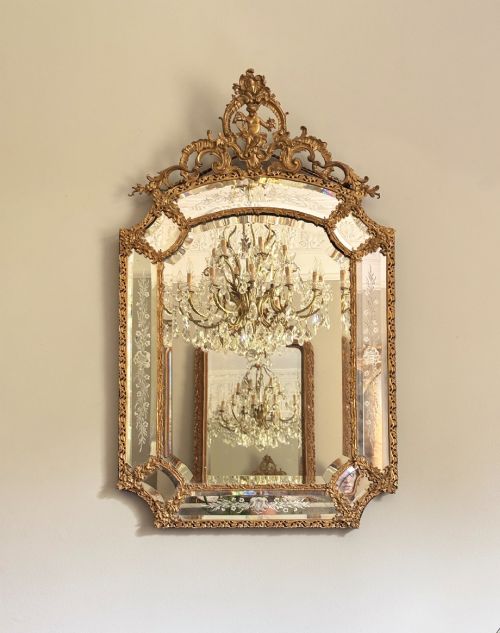
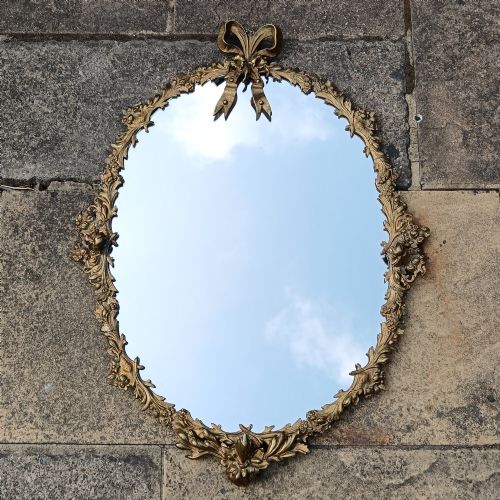
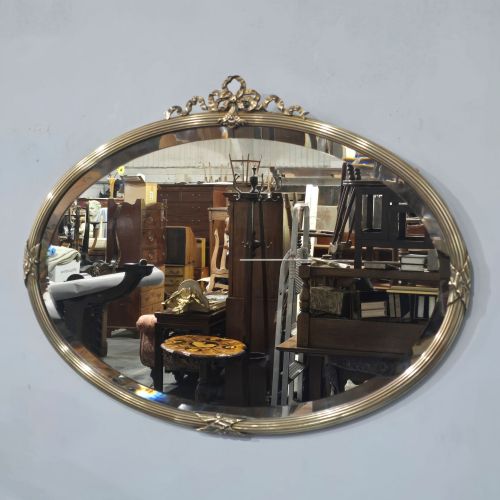
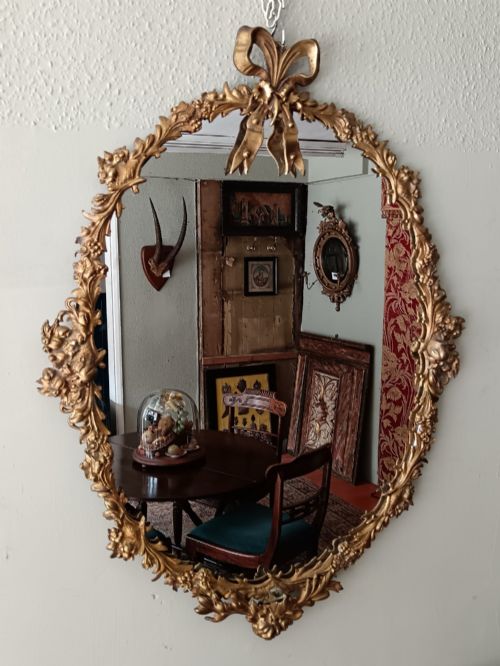


Crested Brass Frame Mirror
These crested brass frame mirror pieces bring warmth and reflection into a room, combining heavy metalwork with period charm.
Crested Brass Frame Mirror
A crested brass frame mirror is a wall-hung looking glass housed in a metal surround featuring an ornate top ornament, known as the crest. These pieces appear frequently from the nineteenth century onward, drawing on Victorian, Edwardian, and Regency tastes.
The selection on this page centres on wall mirrors fashioned from brass, gilt bronze, and cast or embossed metal. Forms range from simple ovals to cushion frames and Dutch Baroque revivals.
Buyers often encounter French Louis XVI revival styles alongside Flemish repousse work and domestic Victorian designs. The crests frequently incorporate masks, scrolls, or architectural motifs that visually anchor the hanging glass.
How they were made
Maker's workshops utilised brass, gilt bronze, and cast metal to build structural frames around mirror glass. Metal was beaten, embossed, or cast in sections before being assembled around the backing wood and secured.
Cushion frames and repousse panels required skilled hand-hammering from the reverse side to push ornamental designs forward in high relief. Gilt bronze elements received careful surface finishing to highlight the chased details of the crests and borders.
Crested Brass Frame Mirror Retail Price Guide 2026
Typical asking prices for crested brass frame mirror among the pieces listed under this phrase on Sellingantiques today, from the lower quarter to the upper quarter. They describe what is for sale here now, not the wider market.
Listings feature brass, gilt bronze, and bevelled glass across Victorian, Edwardian, and Regency periods.
What varies in quality
Quality rests upon the crispness of the casting and the depth of the repousse work on the brass and gilt bronze frames. Heavy, finely chased metalwork and securely jointed corners separate superior examples from simpler production pieces.
The integrity of the mirror glass itself alters the character of the piece, particularly where original bevelled plates or cushion-moulded panels survive intact within the metal rebate.
The Crested Brass Frame Mirror Glossary
- Crest
- The decorative ornament mounted at the top of the mirror frame. This feature often defines the stylistic period of the piece.
- Repousse
- A metalworking technique where the artisan hammers the design from the reverse side to create raised relief on the front. Flemish and Dutch workshops utilised this method heavily.
- Cushion frame
- A convex, rounded frame profile that swells outward toward the outer edge. These forms are common in seventeenth-century Dutch styles and their nineteenth-century revivals.
- Gilt bronze
- An alloy of copper and zinc treated with a gold-coloured finish or mercury gilding. French Louis XVI revival pieces frequently employ this material.
- Bevelled glass
- A mirror plate with edges cut and polished at an angle to catch the light. This treatment adds depth and refinement to the reflection.
Crested Brass Frame Mirror: Frequently Asked Questions
What periods do these brass mirrors come from?
The selection spans the Regency, Victorian, and Edwardian eras, alongside specific revival styles from the nineteenth century.
Maker's interpretations often reach back to Dutch Baroque and Flemish Renaissance aesthetics while using manufacturing techniques of their own time.
How were these mirrors hung on walls?
Most pieces feature integrated metal loops or rings fixed to the wooden backing or directly to the brass frame structure.
Given the substantial weight of cast brass and glass, secure wall fixings suited to the specific wall type are necessary.
Are the brass frames solid metal?
Many frames combine cast brass ornaments and embossed sheet metal mounted over a wooden core or backing structure.
This method provided sufficient rigidity to support heavy mirror plates without making the overall hanging weight unmanageable.
What is a mask crest?
A mask crest is an ornamental facial motif, often grotesque or classical, incorporated into the top decoration of the frame.
Victorian cast brass mirrors frequently used these sculptural faces to draw the eye upward and finish the composition.