


Renaissance Revival Credenza
A renaissance revival credenza brings substantial architectural presence into a room through bold carving, rich woods and classical proportions.
Renaissance Revival Credenza
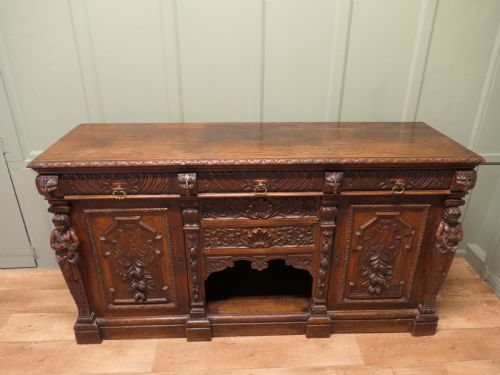
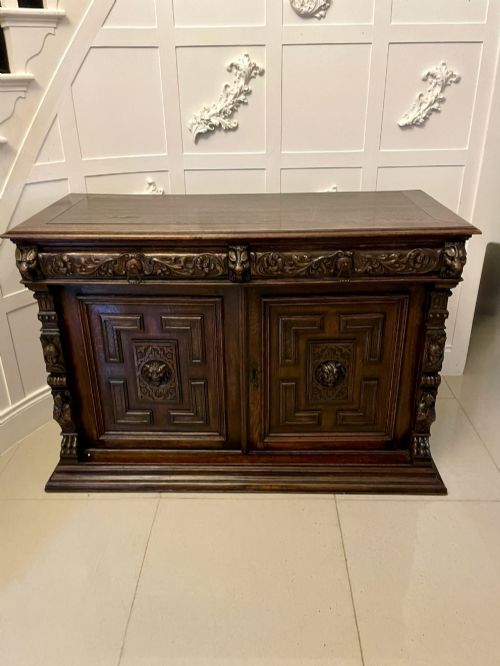
A renaissance revival credenza embodies the heavy architectural forms, architectural mouldings and decorative carving inspired by sixteenth-century European design. When searching for a renaissance revival credenza, you encounter substantial storage furniture primarily built during the nineteenth century, including sideboards, cabinets, cupboards and buffets. These pieces draw heavily upon French, Italian and Gothic design vocabularies translated through Victorian craftsmanship.
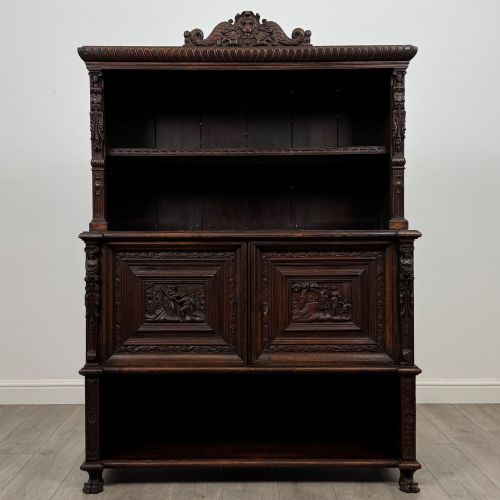
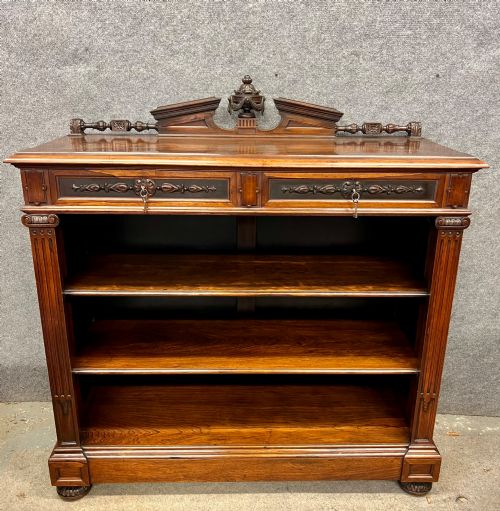
The pieces listed on this page span the nineteenth and early twentieth centuries, featuring robust constructions designed to anchor large dining rooms, halls and libraries. Alongside standard sideboards and cupboards, you find specialised forms such as mirror-back buffets, open bookcases, pot cupboards and cabinets on stands. Oak and walnut dominate the selection, often enriched with marquetry inlay or contrasting marble tops.
Continental workshops from France, Italy, Spain and Vienna produced many of these elaborate items, alongside British Victorian interpretations. Regional stylistic shifts appear clearly across the selection, ranging from French buffet cabinets to Italian marquetry chests and grand architectural sideboards featuring figural carving like the Green Man motif. Each piece utilises heavy timber framing to support deep relief panels and projecting cornices.
Materials and construction methods
Surface decoration relies heavily on hand carving, creating high-relief strapwork, figural elements, scrolling foliage and classical architectural motifs across doors and drawer fronts. Cabinet doors are constructed with heavy panel-and-frame joints to accommodate seasonal wood movement, while larger sideboards incorporate mirrored backs and separate upper display tiers supported on carved pilasters.
Marble inserts appear frequently on top surfaces of cabinets and pot cupboards, providing a durable and decorative counterpoint to dark carved timber frames. Metal hardware including brass hinges, keyplates and drop handles fastens heavy doors and drawers built for practical domestic storage.
Several cupboards stare back intently through the foliage of carved Green Man masks.
Defining factors of quality
Quality rests primarily on the depth, sharpness and ambition of the hand carving, distinguishing crisp figural and botanical relief from mechanical or shallow replication. The finest examples display naturalistic proportion within classical motifs, where human figures, foliage and strapwork possess distinct musculature and clean undercuts.
Material selection and decorative complexity elevate certain examples above standard utility furniture, particularly where cabinetmakers integrated fine walnut burls, contrasting marquetry, mother of pearl inlay or substantial inset marble slabs. The integrity of the original joinery, including heavy mortise and tenon framing and well-fitted doors, determines the structural success of these large timber forms.
Attribution to documented makers or specific regional workshops, such as Austrian cabinetmakers or Italian wood sculptors, adds considerable distinction to individual pieces. The sophistication of auxiliary details, from bevelled mirror glass to original brass hardware, signals a higher grade of nineteenth-century workshop production.
Sigmund Jaray Wien·Gordovil Spain
The Renaissance Revival Credenza Glossary
- Credenza
- A sideboard or cabinet designed for storage and display, originating in Renaissance Italy. These pieces typically feature enclosed cupboards beneath a flat top surface.
- Marquetry
- The art of applying small pieces of wood veneer to a structure to form decorative patterns or pictorial scenes. Makers utilised contrasting timbers to create geometric and floral designs.
- Green Man
- A sculptural architectural ornament depicting a human face surrounded by or emerging from foliage. This motif appears frequently on nineteenth-century carved oak furniture.
- Buffet
- A large piece of dining room furniture used for storing and serving food and tableware. Nineteenth-century examples often combine lower cupboards with upper shelving or mirrors.
- Strapwork
- A decorative carving motif resembling interlaced leather bands or flat ribbons. It serves to frame panels and architectural borders on revival furniture.
- Pedestal
- A structural support base carrying the main body of a cabinet or sideboard. Pedestal sideboards often feature flanking cupboards beneath a central serving surface.
Renaissance Revival Credenza: Frequently Asked Questions
What is a renaissance revival credenza?
A renaissance revival credenza is a heavy nineteenth-century storage cabinet inspired by sixteenth-century classical architecture and decorative arts. These pieces utilise dark woods like oak and walnut to showcase deep relief carving and architectural mouldings.
They function as substantial sideboards, cupboards or buffets, originally designed to anchor grand dining rooms and reception halls. Their imposing scale and elaborate ornamentation reflect Victorian tastes for historical revival styles.
How do you date a carved oak sideboard?
Dating relies upon examining construction methods, timber preparation, hardware and stylistic details present in the carving. Nineteenth-century revival pieces often combine historical motifs with contemporary mechanical saw marks or modern secondary woods hidden inside.
Comparing the specific depth of the relief work, the presence of factory-made brass fittings and regional design traits helps narrow the period of manufacture between the early and late Victorian eras.
Where were these heavy cabinets made?
These pieces originate from workshops across Britain and continental Europe, including France, Italy, Spain and Austria. Regional preferences dictated whether a cabinet featured Italian marquetry, French polish, or heavy British oak carving.
Continental makers often utilised native walnut and incorporated sculptural elements like marble tops, while British cabinetmakers favoured sturdy domestic oak for grand Victorian dining room furniture.
How do you incorporate a large sideboard into a modern interior?
These large storage pieces serve well as grounding architectural anchors in modern rooms with high ceilings and neutral walls. Their deep wood tones and sculptural surfaces contrast effectively against minimalist surroundings.
Practical uses include dining room storage for tableware, hallway credenzas for household items, or living room media consoles where the deep timber top accommodates lamps and decorative objects.