


Relief Carved Oak Sideboard
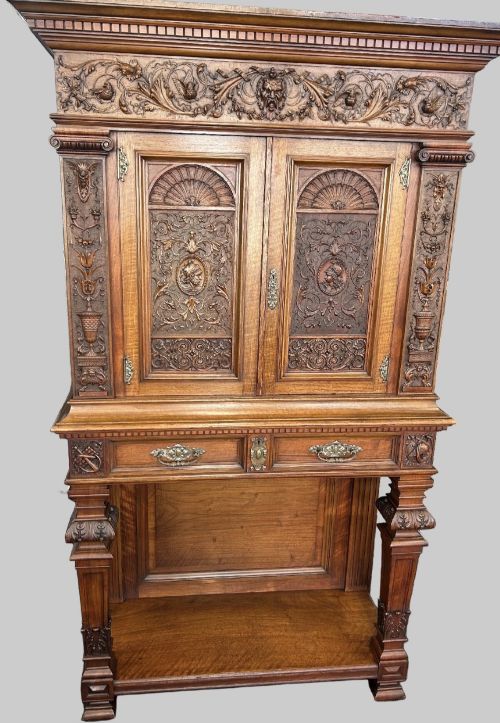
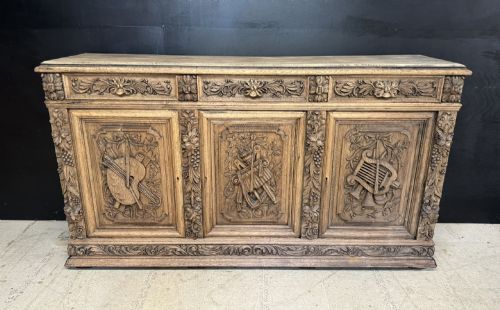
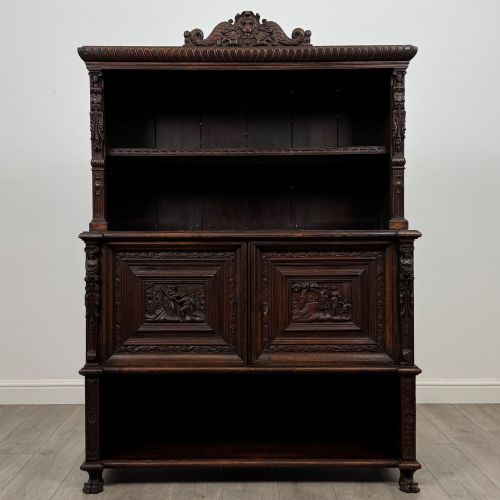
A relief carved oak sideboard brings substantial presence to a room, offering deep-relief woodwork and sturdy storage built to last for generations.
Relief Carved Oak Sideboard
When you search for a relief carved oak sideboard, you enter a category defined by heavy timber construction and sculptural woodwork. These pieces function primarily as storage furniture, taking the form of sideboards, cabinets, and cupboards designed to anchor a dining room or hall.
The versions most commonly met on this page span the nineteenth century, including Victorian interpretations and revival styles. Alongside full-scale sideboards, you will encounter related storage forms such as French buffets de corps and hall cupboards, all united by prominent carved decoration.
Materials and construction
The construction relies fundamentally on solid oak, chosen for its durability and suitability for deep chisel work. Master carvers worked directly into the timber to create high-relief panels featuring architectural motifs, figures, and foliage.
Metal hardware such as brass and iron appears on hinges, locks, and handles, providing structural reinforcement and functional contrast to the dark timber surfaces.
Several French cabinets here are specifically designated as game cupboards, once tasked with storing the day's hunt.
Assessing quality in carved oak
Quality in these pieces rests heavily on the depth and crispness of the carving itself. Skilled hand-carved relief work exhibits sharp undercut details and naturalistic proportions that separate superior examples from mechanical or shallow tooling.
The architectural integrity of the overall carcass, the quality of the timber selection, and the integration of period hardware further distinguish finer examples from standard production.
The Relief Carved Oak Sideboard Glossary
- Buffet de corps
- A large, two-stage French dining room cupboard or sideboard featuring enclosed lower cabinets and upper storage. This form provides substantial display and storage space.
- Relief carving
- Sculpture where figures and ornaments project from a flat background. This technique creates dramatic shadow and depth across the timber panels.
- Gothic Revival
- A nineteenth-century design movement drawing inspiration from medieval architecture and ornament. Pieces in this style often incorporate pointed arches and tracery.
- Renaissance Revival
- A style looking back to sixteenth-century classical forms, featuring heavy symmetry, pilasters, and sculptural figures. It dominates much nineteenth-century continental cabinetmaking.
Relief Carved Oak Sideboard: Frequently Asked Questions
Where should I place a relief carved oak sideboard?
These large storage pieces suit dining rooms, grand hallways, or spacious living areas where their substantial proportions and dark timber can anchor the room. Ensure the wall space allows the piece to sit comfortably without dominating the circulation of the space.
Because they project significantly into a room, measure the depth carefully before placing one in a narrow hall or restricted dining layout.
How do I maintain oak furniture?
Keep oak furniture away from direct heat sources and strong sunlight, which can dry out the timber and cause splits in the panels. Regular dusting with a dry cloth and occasional application of appropriate beeswax will preserve the finish.
Avoid liquid polishes containing silicone, as they build up over time and attract dust to the intricate recesses of the relief carving.
How do I identify Gothic Revival pieces?
Gothic Revival items feature architectural motifs borrowed from medieval churches and castles, such as pointed arches, quatrefoils, and heavy tracery. The carving often emphasises vertical lines and religious or heraldic iconography.
In this category, these details appear rendered in solid oak on nineteenth-century cabinets and sideboards.