
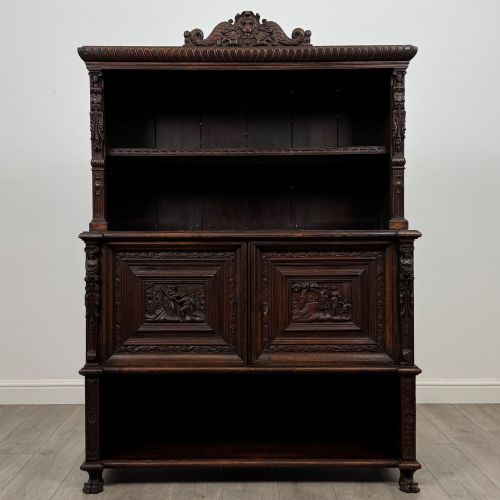
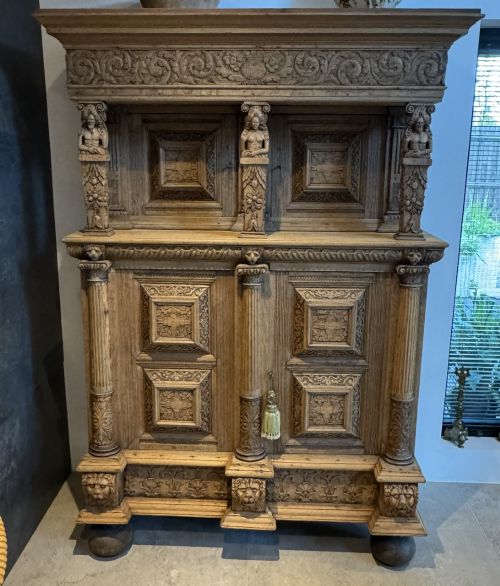


Carved Flemish Court Cupboard
These carved flemish court cupboard examples bring heavy timber architecture indoors, offering serious storage and deep historical presence.
Carved Flemish Court Cupboard
When you search for a carved flemish court cupboard, you are looking at substantial timber furniture designed to display plate and store provisions in grand interiors. These pieces combine architectural presence with deep relief carving, often standing on sturdy bases or stands.
The versions you are most likely to meet on this page date from the nineteenth century, drawing heavily on earlier sixteenth and eighteenth-century Flemish designs. Oak is the primary medium for these revival pieces, carrying dense ornamentation that reflects Renaissance and Baroque motifs.
Forms range from tall hall cupboards and sideboards to cabinets on stands featuring lion masks and panelled doors. They serve as focal points in a room, offering heavy proportion and intricate surface work that dominates the surrounding space.
How they were made
Joiners built these cupboards predominantly from solid oak, sometimes turning to walnut for continental pieces, ensuring a heavy and durable carcass. Construction relied on traditional mortise and tenon joints to bear the weight of projecting upper tiers and heavy cornices.
Carvers worked directly into the seasoned timber using gouges and chisels to create deep relief panels, figures, and scrollwork. Iron and brass hardware, including strap hinges and drop handles, secured the heavy doors and drawers.
Lion masks peer from cabinet corners, keeping a stern, wooden watch over centuries of dining rooms.
What varies in quality
The depth and sharpness of the chisel work separate ordinary output from finer examples, where figures and foliage retain crisp edges and clear dimensionality. Timber selection also dictates value, with well-figured oak showing straight grain and minimal patching across large expanses.
Proportion and architectural integrity define the better pieces, ensuring that projecting cornices and turned supports balance the heavy carvings without appearing clumsy.
The Carved Flemish Court Cupboard Glossary
- Court cupboard
- A two-tier cabinet used historically for storing and displaying food and plate. The upper section is often recessed beneath a projecting canopy supported by columns.
- Flemish Baroque
- A flamboyant artistic style originating in Flanders during the seventeenth century. It employs dramatic curves, rich ornamentation, and dynamic figurative carving.
- Lion mask
- A decorative carving shaped like a lion face, frequently placed on drawer fronts or furniture corners. It symbolises strength and nobility in classical design.
- Renaissance Revival
- An architectural and decorative style from the nineteenth century that reinterprets sixteenth-century forms. It brings symmetry, robust columns, and heavy relief panels back into fashion.
Carved Flemish Court Cupboard: Frequently Asked Questions
What is a court cupboard?
A court cupboard is a traditional tiered storage piece featuring an enclosed lower section and a recessed or supported upper stage. It was originally built for elite dining rooms to display silver and store provisions.
Today, these pieces function as prominent storage units in large reception rooms, providing deep cupboards and surface space.
How do I care for solid oak furniture?
Solid oak requires stable indoor humidity to prevent the timber from splitting or warping as seasonal temperatures shift. Keep heavy pieces away from direct heat sources and radiators.
Apply a traditional beeswax polish occasionally to nourish the grain and protect the carved surfaces from dust accumulation.
How can I tell a nineteenth-century revival piece from an earlier one?
Nineteenth-century revival pieces often display machine-sawn timber elements hidden behind hand-carved facades, alongside standardised iron hardware. Tool marks on sixteenth and eighteenth-century originals tend to show greater irregularity from pit-sawn boards and hand forging.
Examine the backboards and interior construction methods, as nineteenth-century joiners used different assembly techniques than earlier makers.
Where should I place a large carved cabinet?
These substantial cabinets require generous floor space and strong structural support due to their significant weight. A long dining room wall or a wide hallway allows the heavy proportions and deep carvings to be viewed properly.
Ensure the floor is level so that heavy doors swing true and close evenly within their frames.