


Relief Carved Metal Box
A relief carved metal box is a decorative container shaped by surface chisel and relief, offering lasting utility and tactile form for the collector.
Relief Carved Metal Box
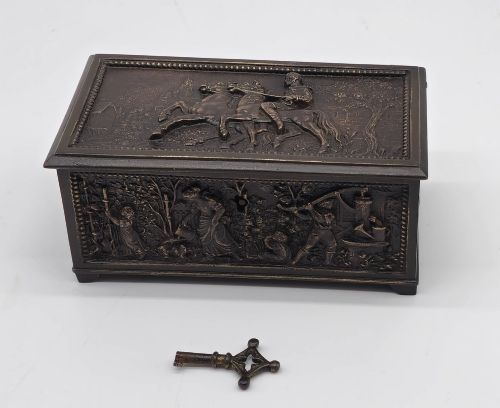
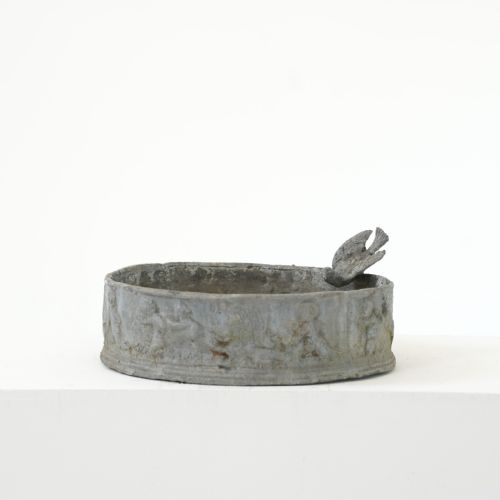
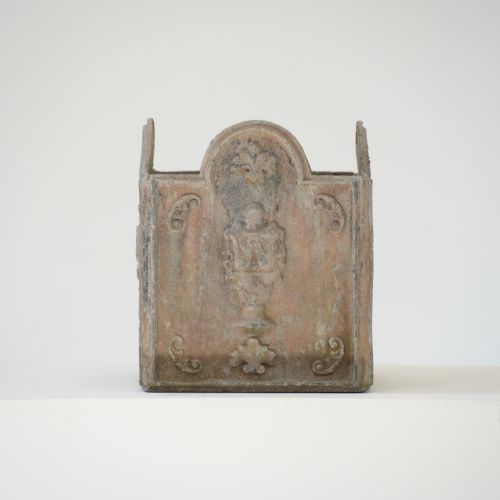
When you search for a relief carved metal box, you encounter a selection spanning the Victorian, Georgian, and Art Deco periods, alongside Asian Export and Anglo-Indian designs. These items function primarily as jewellery caskets, card cases, tobacco boxes, and trinket boxes, while larger forms extend to lead planters and bird baths.
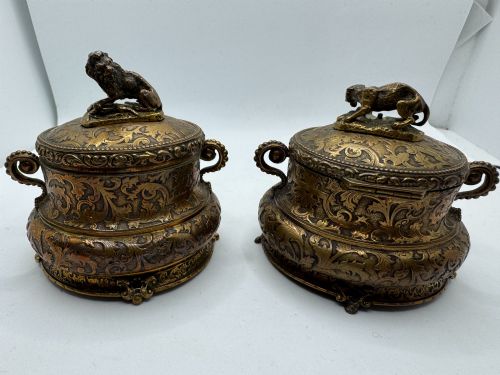
The pieces on this page originate from diverse workshops and regions, incorporating French Rococo Revival aesthetics, oriental bamboo motifs, and rural scenes. Domestic and international makers utilise bronze, brass, lead, silver plate, and pewter to create both intimate table containers and heavy garden vessels.
How they were made
Craftsmen shape these containers using base metals, bronze, brass, and copper, often applying silver plating, gilding, or silvered finishes to the exterior surface. Relief decoration is achieved through casting, carving, and electro-forming techniques to raise pictorial scenes and botanical motifs above the plane.
Many examples incorporate specialised fittings, such as dog finials on casket lids or hinged closures for card cases and cigarette boxes. Detail work ranges from rural figural tableaus to bamboo-patterned metalwork.
Listings span the 18th century to the 20th century, encompassing Victorian, Georgian, and Art Deco styles.
What varies in quality
Quality rests in the crispness of the chased and carved relief work, where deep definition in figurative scenes or botanical elements separates standard production from finer output. The integration of surface treatments, such as even gilding or silver plating over base metal, dictates the visual success of the piece.
Structural integrity in hinges, lids, and mounts also marks the distinction between domestic trinket boxes and more substantial caskets or heavy garden planters. Maker involvement, evidenced by established firms like Walker and Hall, adds a layer of distinction to the construction.
Walker and Hall·AB Paris
The Relief Carved Metal Box Glossary
- Gilt metal
- Metal coated with a thin layer of gold or gold-coloured wash. This treatment provides a bright, reflective surface finish.
- Electro-form
- A metal-forming process that uses electroplating to produce detailed objects over a mould. This technique allows for complex, thin-walled metallic vessels.
- Silver plate
- A layer of silver applied to a base metal core. This method offers the appearance of solid silver at a different weight and cost.
- Finial
- A decorative ornament fixed to the top of a lid or box. It often takes figurative shapes such as dogs or foliage.
Relief Carved Metal Box: Frequently Asked Questions
What is a relief carved metal box?
It is a metallic container featuring surface ornamentation raised above the background plane through casting, carving, or embossing. These items include small jewellery caskets and card cases as well as larger tobacco boxes.
Such vessels combine storage utility with decorative metalwork across various historical periods and international styles.
How were these metal boxes used?
Smaller examples served on dressing tables and desks to hold personal ornaments, calling cards, or cigarettes. Larger forms functioned as pocket containers or specialised tabletop receptacles.
Heavier metal items extended domestic utility into outdoor spaces as garden planters and bird baths.
How do you clean a metal box?
Maintenance depends entirely on the specific surface finish, whether it is silver plate, gilt metal, bronze, or raw pewter. Gentle dusting with a soft cloth preserves delicate relief work without wearing away thin metallic coatings.
Harsh chemical polishes should be avoided to protect antique patinas and electro-formed details.
How can you tell periods apart?
Stylistic indicators such as French Rococo Revival scrolls, Georgian proportions, or Art Deco geometry help establish the era of manufacture. Material choices and manufacturing marks further refine the dating of each piece.
Comparative analysis of decorative motifs provides the clearest guide to temporal origin.