
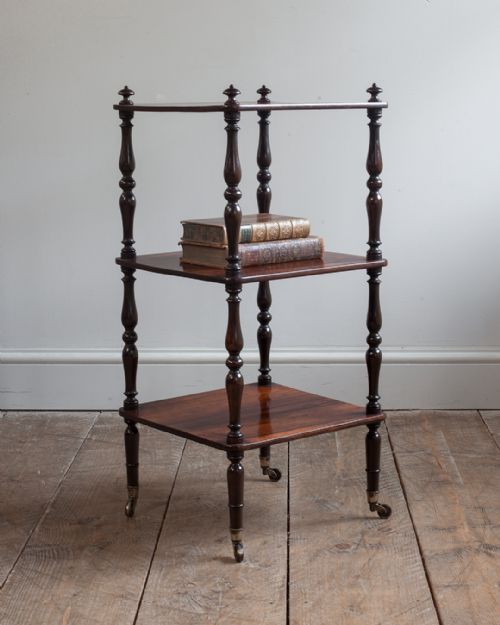
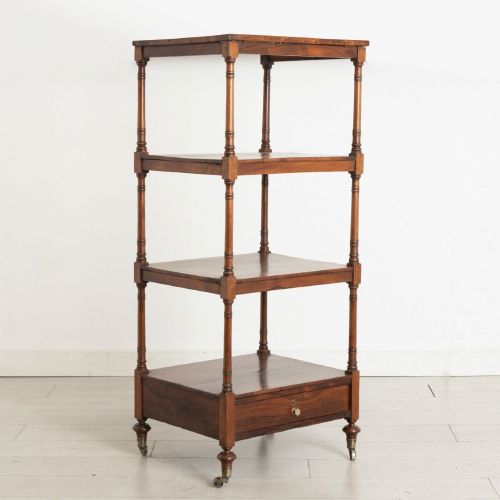


Regency Rosewood Whatnot
A regency rosewood whatnot brings multi-tiered elegance to a room, offering open display shelving defined by rich tropical timber.
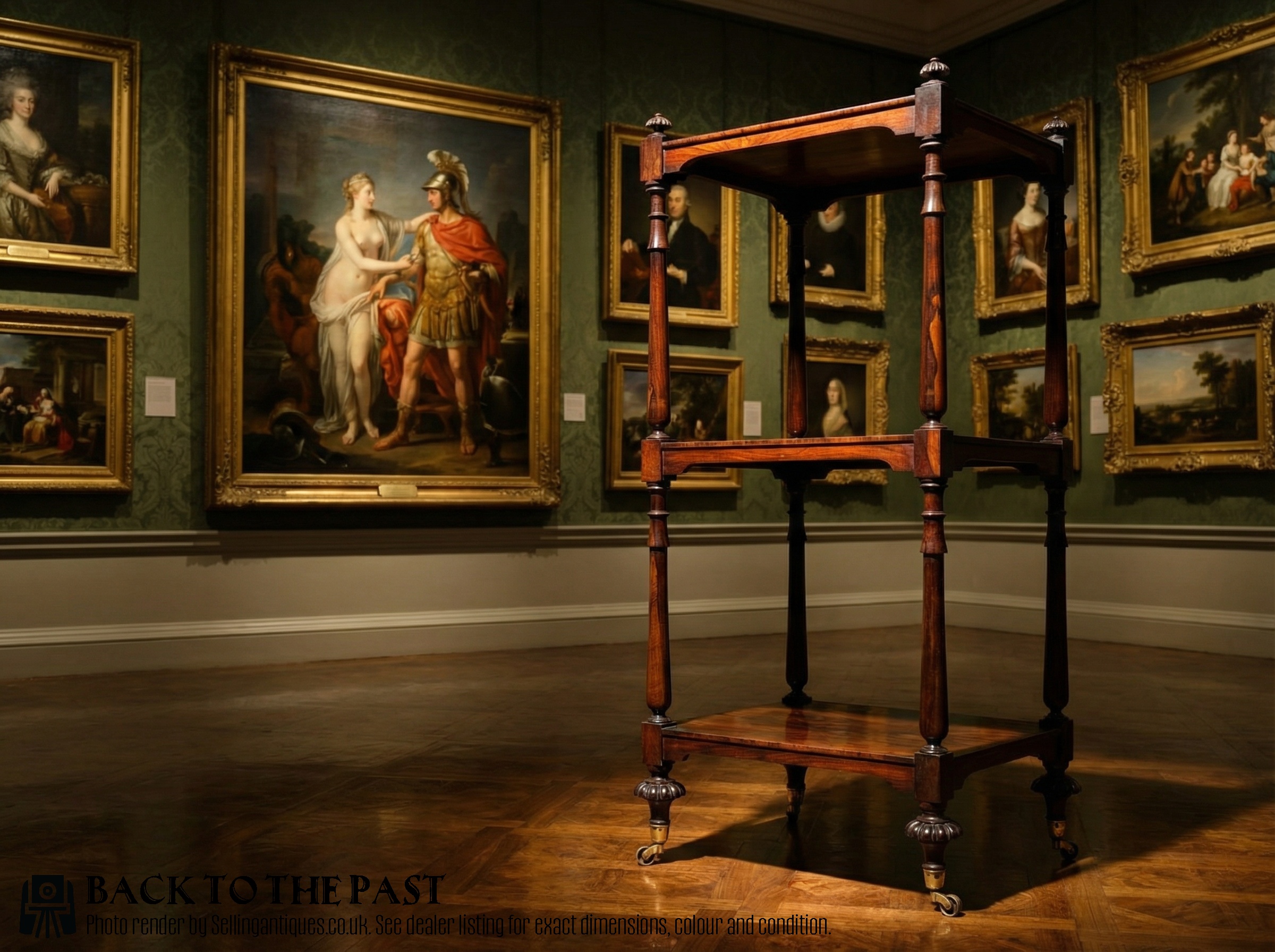
Regency Rosewood Whatnot
A regency rosewood whatnot is a multi-tiered piece of freestanding shelving designed for display and utility in formal interiors. The form emerged strongly during the Regency and Georgian eras, continuing into the William IV and Victorian periods.
Most examples found here present three or four open tiers supported by upright columns or slender pillars. Variations include versions fitted with lower drawers, music stands, reading slopes, or plant stands.
Makers of the period utilised dense exotic hardwoods to create these display shelves, etageres, and bookcases. Surviving pieces range from compact proportions to pairs of matched stands.
Assessing quality and proportion
Quality rests in the selection of the rosewood veneer and the crispness of the turning on the upright columns. Tighter grain patterns and balanced proportions distinguish superior examples from standard production pieces.
Integration of secondary functions, such as drawers, marble tops, or reading mechanisms, alters the execution level. The refinement of brass mounts and the joinery of the tier corners indicate the workshop standard.
Listings span the 19th Century, Regency, Georgian, and 1850 periods, constructed in rosewood, brass, ormolu, and mahogany.
Gillows
The Regency Rosewood Whatnot Glossary
- Whatnot
- A movable set of open shelves for displaying small ornaments, books, or collections. The form became popular in the late eighteenth century and persisted through the nineteenth century.
- Etagere
- A piece of furniture consisting of a set of open shelves for displaying valuables or china. It shares similarities in form and purpose with the whatnot.
- Ormolu
- Gilded bronze applied as a decorative mount on furniture. It provides bright metallic highlights against dark woods like rosewood and mahogany.
- Simulated rosewood
- Painted or stained timber mimicking the distinctive grain pattern of genuine rosewood. This technique was common in Regency period cabinetmaking.
Regency Rosewood Whatnot: Frequently Asked Questions
What is a regency rosewood whatnot used for?
These pieces served as practical display furniture in principal rooms for holding books, ceramics, and decorative objects. They kept items accessible while adding architectural height to room corners or wall spaces.
Today, they function similarly in domestic settings, holding books, plants, or collections while showcasing nineteenth-century cabinetwork.
How many tiers do they typically have?
Most examples feature three or four open shelves supported by vertical columns. Three-tier and four-tier formats dominate the surviving record from the Regency and William IV periods.
Some variations include an enclosed drawer beneath the lower shelf or specialised attachments like reading stands and jardiniere troughs.
How do I distinguish Regency from Victorian pieces?
Regency and Georgian pieces generally display restrained classical proportions, delicate brass accents, and fine timber selection. Uprights tend to be slender and sharply turned.
Later Victorian and 1850 examples often present heavier proportions and coarser turning, reflecting changing aesthetic preferences in the mid-nineteenth century.
Where should I place a whatnot at home?
These open shelving units suit corners, beside seating groups, or against plain wall expanses where their profile remains visible. Because shelves are accessible from multiple sides, placement should allow clear movement around the piece.
Avoid positioning them in direct sunlight to protect the rosewood finish and any polished brass mounts from fading.