
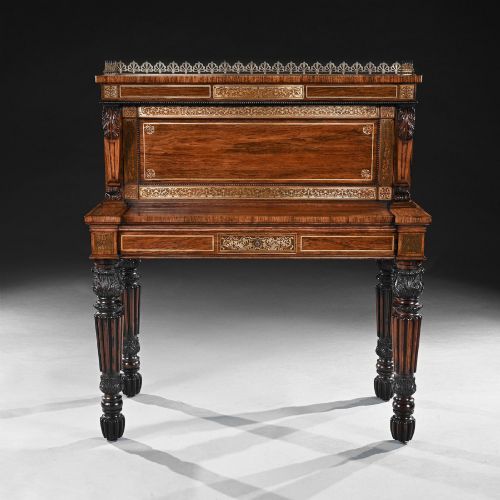
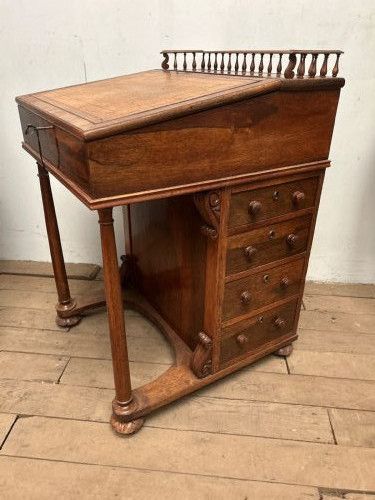
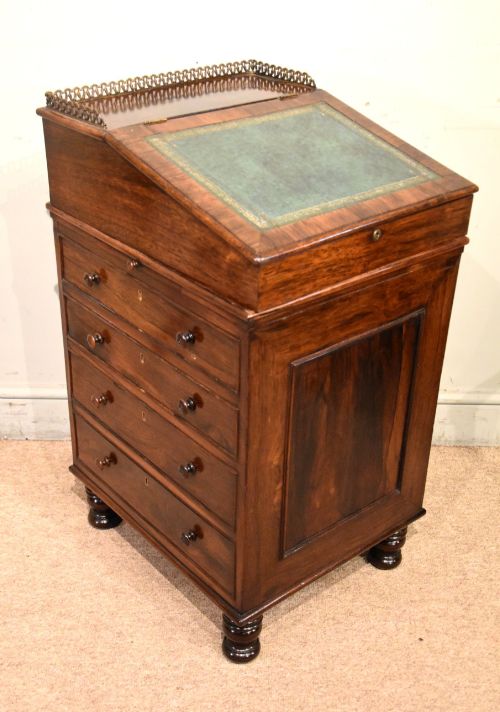


Regency Rosewood Davenport Desk
These regency rosewood davenport desk pieces are compact writing companions prized for their rich timber and clever compartmentalised storage.
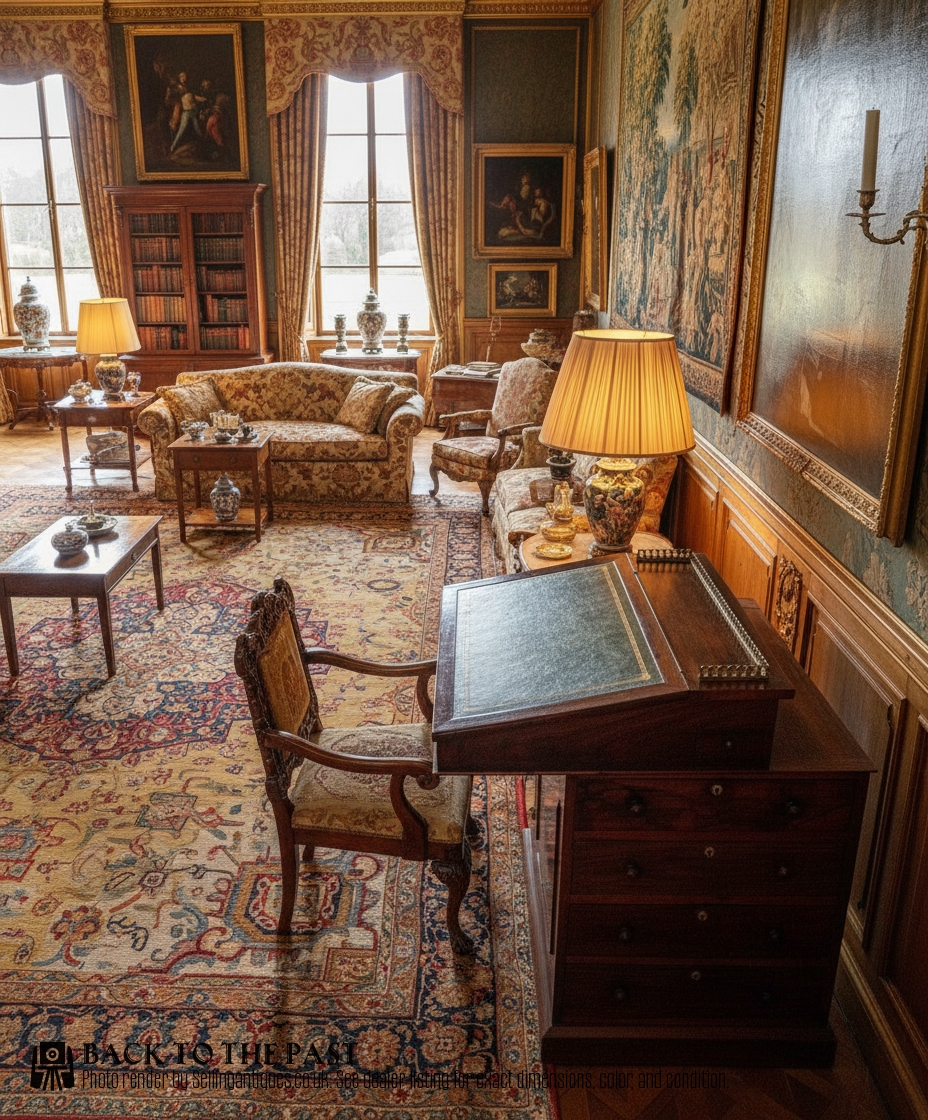
Regency Rosewood Davenport Desk
A regency rosewood davenport desk offers a compact and structured writing surface built for domestic study and correspondence during the nineteenth century. Most examples found here originate from the Regency period, though William IV and Victorian iterations also appear in the records.
The standard form comprises a sloped writing box fitted above a pedestal of drawers, often incorporating sliding tops and dedicated compartments for ink and pens. Alongside traditional davenports, related writing tables and desks complete the selection seen on this page.
How They Were Made
Cabinet makers constructed these pieces primarily using dense rosewood and palisander veneers, frequently embellished with contrasting brass inlay to accent the primary surfaces. Interiors and working elements often feature secondary hardwoods alongside fitted leather writing panels.
Structural additions include turned feet, bun feet, and castors to facilitate movement, while drawers are arranged with turned handles and integrated ink compartments for practical utility.
Archival records show past inventory focused on sliding top davenports fitted with tooled leather surfaces and bun feet on castors.
What Varies in Quality
The distinction between standard examples and the finest works rests upon the selection of timber figure, the precision of the brass inlay, and the sophistication of the mechanical sliding top. Attribution to established workshops like Gillows elevates a piece through superior cabinet work and refined proportions.
Fine quality items display meticulous attention to secondary details such as turned drawer handles, well-tooled leather inserts, and robust structural joinery that maintains smooth operation across sliding mechanisms and deep drawer sets.
Gillows Oxford Street Workshop
The Regency Rosewood Davenport Desk Glossary
- Davenport desk
- A compact box desk featuring a sloping, hinged writing lid mounted over a pedestal of drawers. This form was originally commissioned for small studies and tight spaces.
- Palisander
- A dense, dark timber closely related to rosewood, often used interchangeably in nineteenth-century cabinet making for its rich grain and colour.
- Regency
- A design period spanning the early nineteenth century defined by classical restraint, architectural lines, and decorative brass work.
- William IV
- A transitional style bridging the Regency and Victorian eras characterised by robust proportions and substantial timber framing.
Regency Rosewood Davenport Desk: Frequently Asked Questions
What is a regency rosewood davenport desk?
A regency rosewood davenport desk is a compact nineteenth-century writing cabinet featuring a sloping lid and a pedestal of drawers.
These pieces combine decorative rosewood timbers with practical storage compartments designed for domestic correspondence.
How were these desks used originally?
Owners utilised them as dedicated writing stations in studies, drawing rooms, or bedrooms where floor space was limited.
The sloping lid held paper for letter writing, while side drawers and internal compartments stored pens and ink.
What woods are used in these desks?
Cabinet makers relied heavily on rosewood and palisander for their dark, figured grain patterns and durable qualities.
Accents of brass inlay and leather writing surfaces were routinely incorporated to complete the decorative scheme.