
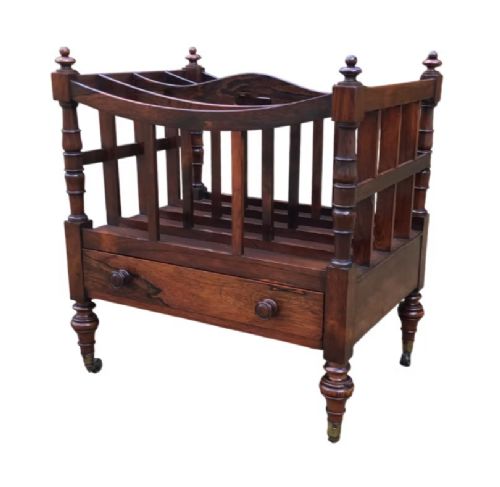


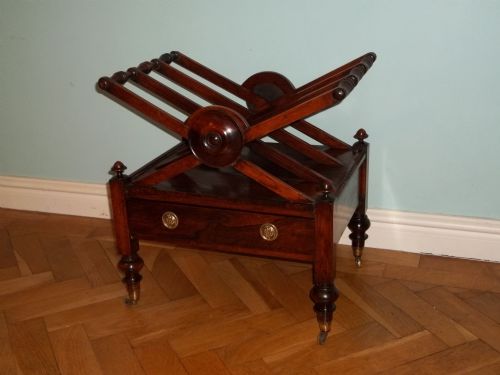


Regency Rosewood Canterbury
A regency rosewood canterbury organises journals and sheet music with characteristic grace, bringing distinctive timber grain and compartmented convenience to a traditional sitting room.
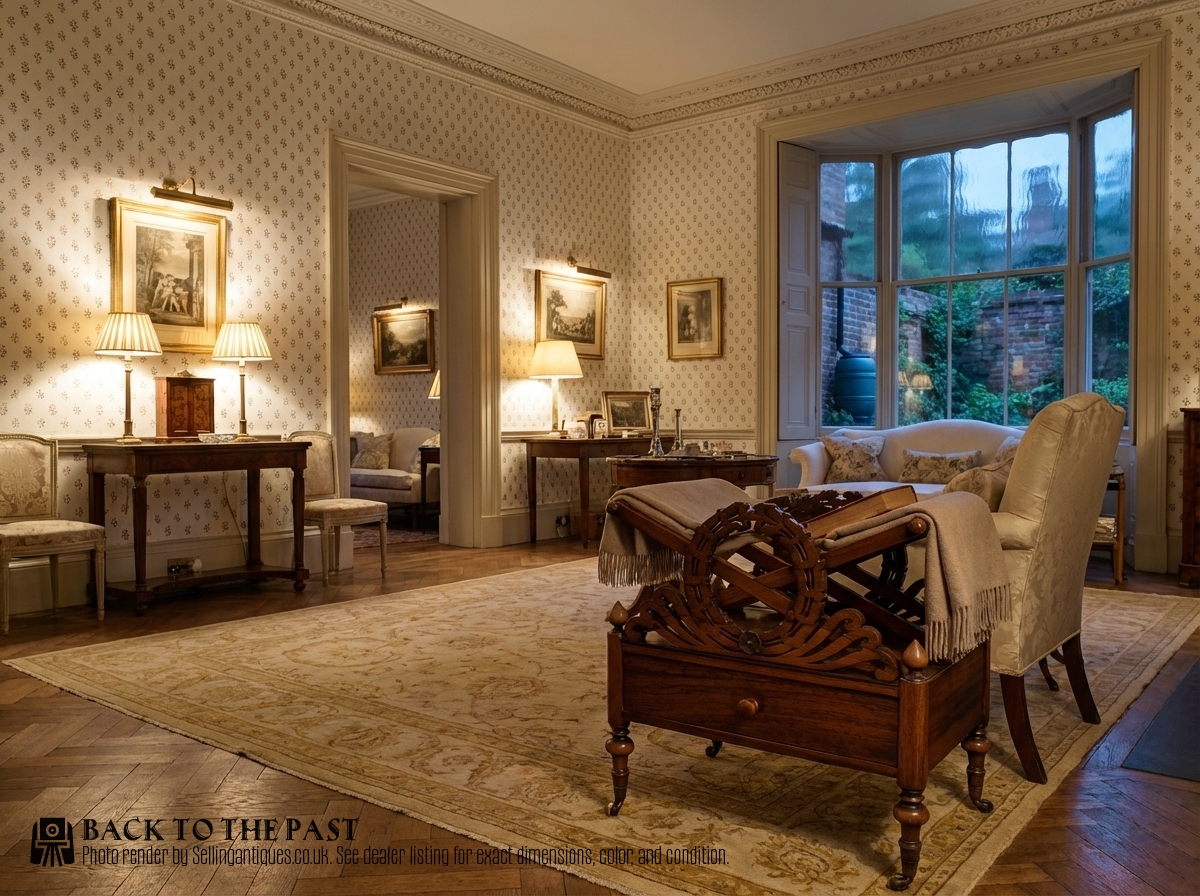
Regency Rosewood Canterbury
A regency rosewood canterbury is a compartmented stand designed for holding folios, newspapers, and sheet music near a parlour seating area. Most examples span the Regency and William IV periods, crossing into George IV and early Victorian production.
The standard form comprises three or four slatted divisions above a low drawer, though boat-shaped models, double-size pieces, and X-frame supports appear with regularity. These stands often incorporate carrying handles and rest upon short turned legs fitted with brass castors.
Materials and Construction
Cabinetmakers utilised dense, dark rosewood for its rich figuring, frequently selecting solid timber and matched veneers to cover the upright slats and plinth bases. Brass details such as castors and carrying handles provide structural accent.
Joinery techniques include finely turned spindle uprights and pegged framing, while decorative touches range from simple carved rails to detailed motifs like Prince of Wales feathers.
Regency Rosewood Canterbury Retail Price Guide 2026
Typical asking prices for regency rosewood canterbury among the pieces listed under this phrase on Sellingantiques today, from the lower quarter to the upper quarter. They describe what is for sale here now, not the wider market.
One double-size model offers enough space to swallow the morning broadsheets of an entire Victorian household without spilling a single sheet.
Distinctions in Execution
Quality rests in the crispness of the turning on the dividers and the choice of rosewood veneer, where dense graining elevates the visual impact. Superior examples exhibit balanced proportions and integrated drawers that operate smoothly within the lower plinth.
Maker attribution alters the standing of a piece, with designs following patterns by Loudon or bearing the signature style of Gillows commanding particular attention for their refined joinery.
Gillows
The Regency Rosewood Canterbury Glossary
- Canterbury
- A low stand with upright partitions used originally for holding music folios or periodicals. The name derives from the Archbishop of Canterbury, who supposedly commissioned the first such piece.
- Rosewood
- A heavy, durable timber prized for its dark purple-brown grain and polished finish. It served as a primary cabinet wood during the Regency era.
- Whatnot
- An open set of multi-tiered shelves used for displaying ornaments or holding books. Several recorded pieces combine this display function with a lower canterbury section.
- X-frame
- A structural arrangement where the side supports cross in an oblique X shape. This configuration appears frequently on distinctive music stands and folio holders.
- Folio stand
- A larger pivoting or fixed rack intended for holding oversized art prints and bound volumes. These pieces share a direct lineage with standard compartmented newspaper racks.
Regency Rosewood Canterbury: Frequently Asked Questions
What is a canterbury used for?
These pieces served in nineteenth-century drawing rooms to hold sheet music, newspapers, and unbound literary journals near a piano or seating area. They kept loose papers tidy and accessible.
Today, owners utilise them for contemporary magazines, art folios, or vinyl records beside armchairs. The compartmentalised structure keeps items upright and sorted.
How do I date a rosewood canterbury?
Dating relies on stylistic shifts between Regency, George IV, and William IV designs, moving from delicate curved slats to heavier carved uprights. Turning patterns on the spindle legs offer further clues.
Examining the construction of the base drawer and the brass castors helps confirm the period. Earlier examples often show finer joinery and lighter proportions than mid-nineteenth-century pieces.
Did Gillows make canterburys?
The notable Lancaster and London firm produced distinctive canterburys characterised by exceptional timber selection and precise turning. Attributed pieces often display superior cabinet work.
Design pattern books from the era, such as those by J.C. Loudon, also influenced independent workshops across the country to produce similar compartmented stands.
Are these stands sturdy enough for daily use?
Most examples remain structurally robust, built from heavy rosewood with pegged joints designed to support the weight of books and paper. The brass castors allow them to be moved across carpets easily.
Care should be taken not to overload individual compartments with excessive weight, as the vertical slats rely on secure housing into the base plinth.