


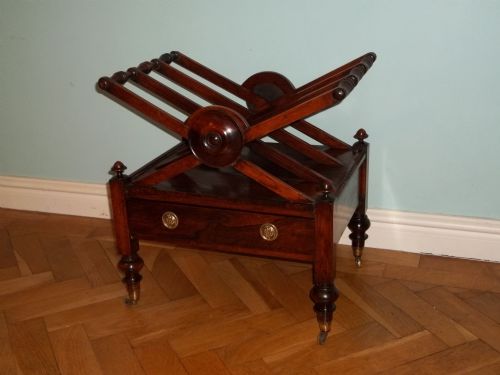


Antique Periodical Stand
An antique periodical stand keeps your daily papers and journals tidy while adding period character to a room.
Antique Periodical Stand
When you search for an antique periodical stand, you encounter a practical item designed to hold magazines, newspapers, and journals in domestic spaces. These pieces take several forms, including revolving stands, standing racks, and partitioned compartments known as canterburys.
The versions most commonly found on this page span the nineteenth and early twentieth centuries. They appear in styles such as Regency, Victorian, Edwardian, and Arts and Crafts, reflecting the changing interior tastes of those eras.
Makers and designers from the past adapted these stands for everyday reading needs, incorporating divisions for papers and carrying handles for ease of movement. Each piece demonstrates how previous generations managed their printed material.
How they were made
Cabinet makers utilised dense hardwoods such as mahogany, rosewood, walnut, oak, and satinwood to construct the frames and partitions. Inlaid details, carved decorative motifs like Prince of Wales feathers, and turned spindle supports frequently appear on these wooden examples.
Metal components play a major role in construction, particularly brass for revolving mechanisms, castors, handles, and tubular frameworks. Some pieces incorporate metal wire or wire mesh to form the sides of the racks.
Listings feature mahogany, oak, rosewood, and walnut alongside brass and wire mesh.
What varies in quality
The distinction between standard items and superior examples lies in the choice of timber figure and the precision of the joinery. Finely grained mahogany or rosewood paired with crisp carving elevates a piece significantly.
Hardware also marks the difference, as heavy cast brass fittings and smooth-running revolving mechanisms require greater skill to produce than simple fixed wire compartments.
Howard and Sons of London
The Antique Periodical Stand Glossary
- Revolving bookcase
- A rotating wooden tier designed to hold books and journals accessibly on all sides. It usually sits upon a brass or wooden spindle stand.
- Inlay
- A decorative technique where contrasting woods or materials like boxwood are inserted into depressions in the base wood to form patterns.
- Castor
- A small wheel fitted to the legs of furniture to allow easy movement across floor surfaces. They are frequently made of brass on these stands.
Antique Periodical Stand: Frequently Asked Questions
What is a canterbury?
A canterbury is a specific type of low stand divided into compartments for holding papers, music, or books. They often include a carrying handle at the top.
Originating in the late eighteenth century, the design remained popular throughout the Victorian and Edwardian periods.
How do I date an oak rack?
Dating an oak piece involves looking at the construction methods, handle styles, and overall aesthetic details. Items from the Arts and Crafts period often show simple, sturdy craftsmanship.
Later pieces from the nineteen-thirties display cleaner, more utilitarian lines compared to heavily ornamented Victorian items.
Where should I place a revolving stand?
A revolving stand works best beside a reading chair or sofa where access from multiple angles is useful. The rotating action allows you to reach different publications easily.
Ensure there is enough clearance around the piece for the tiers to spin freely without striking nearby furniture.
Are brass and mahogany stands Victorian?
Many brass and mahogany revolving stands date from the Victorian era. Manufacturers combined polished mahogany woodwork with bright tubular brass to create striking contrasts.
Later Edwardian versions continued this tradition, often lightening the timber tones or incorporating inlay work.