





Regency Reclined Armchair
A regency reclined armchair offers deep comfort paired with ingenious mechanical ingenuity, making it a prized seating choice for any serious library.
Regency Reclined Armchair
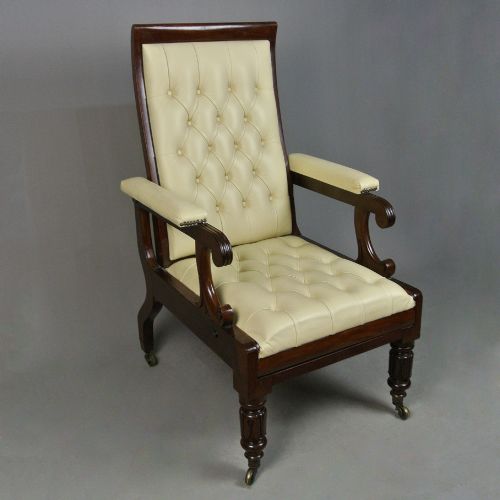
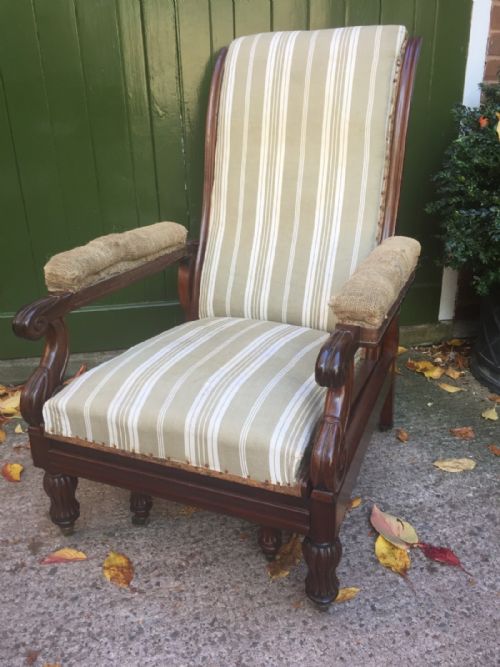
A regency reclined armchair sits comfortably within the nineteenth century, drawing heavily on Regency, George IV, and William IV design traditions. These seating pieces function primarily as library chairs and reading chairs, engineered for prolonged study and repose.
The selections available here span solid mahogany and rosewood frames, often fitted with mechanical reclining actions patented by makers like Daws and Minter. The forms include X-frame library chairs alongside substantial gentleman's reclining armchairs dating from around eighteen hundred to eighteen fifty.
How they were made
Makers constructed these frames predominantly from dense hardwoods such as mahogany and rosewood, ensuring structural integrity for the complex moving parts. Brass fittings and castors often facilitate the mechanical adjustments required for the reclining action.
Traditional upholstery materials underpin the seating surfaces, utilising leather, horsehair, velvet, hessian, and various woven fabrics. Patent mechanisms were integrated directly into the timber framework to allow users to alter the angle of the backrest securely.
Regency Reclined Armchair Retail Price Guide 2026
Typical asking prices for regency reclined armchair among the pieces listed under this phrase on Sellingantiques today, from the lower quarter to the upper quarter. They describe what is for sale here now, not the wider market.
Patent designs by Robert Daws and Minter appear frequently among these library armchairs, defining the mechanical innovations of the era.
What varies in quality
The sophistication of the mechanical patent marks a clear distinction between standard seating and high-end library chairs. Pieces bearing documented association to makers like Robert Daws or Minter demonstrate superior engineering in their reclining actions.
Timber selection and secondary framing materials also dictate the tier of craftsmanship, with figured mahogany and rosewood representing the upper echelon. The preservation of original patent hardware and period leather upholstery significantly elevates the integrity of an armchair.
Robert Daws·Minter·Gillows
The Regency Reclined Armchair Glossary
- Regency
- A British design period spanning the early nineteenth century defined by classical restraint and inventive seating mechanics. This era produced sophisticated library chairs tailored for domestic studies.
- Patent
- A legally protected mechanical invention applied to furniture design during the nineteenth century. Daws and Minter held notable patents for adjustable reclining chairs.
- X-frame
- A structural furniture support configuration forming an intersecting cross shape beneath the armrests or seat. This geometry provides enhanced stability for reclining library seating.
- Horsehair
- A traditional stuffing material utilised beneath leather or fabric upholstery to provide firm resilient support. It ensures the seat maintains its shape during prolonged use.
- Library chair
- A heavy domestic armchair designed specifically for reading rooms and studies, frequently incorporating adjustable backs or reading desks.
Regency Reclined Armchair: Frequently Asked Questions
What is a regency reclined armchair?
A regency reclined armchair is a nineteenth-century seat designed for libraries and studies, featuring an adjustable backrest.
These pieces utilise mechanical patents to allow the user to alter their seating angle for reading or resting.
How do you operate the reclining mechanism?
The mechanical action typically operates through integrated ratchets or patent hardware concealed within the wooden frame.
Users adjust the backrest position by engaging the specific levers or supports designed by makers such as Daws or Minter.
Which woods were used for these chairs?
Cabinet makers primarily constructed these frames from solid mahogany and rich rosewood.
These dense timbers provided the necessary strength to support both the heavy mechanical actions and the daily wear of a library.
Are these chairs suitable for daily use?
These armchairs were built for serious domestic and library study, combining robust hardwood construction with supportive horsehair and leather upholstery.
Proper care of the historical mechanical components ensures they remain functional seating options.