


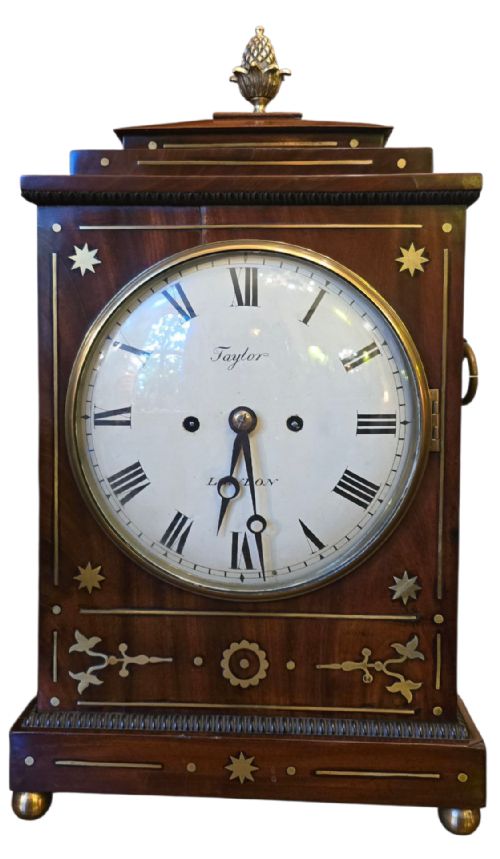


Regency Period Timepiece
A regency period timepiece is a precise domestic clock from the early nineteenth century that brings architectural dignity and mechanical ingenuity to any mantel.
Regency Period Timepiece
A regency period timepiece is a mantel clock or bracket clock originating from the Regency, Georgian, or French Empire periods of the early nineteenth century. These objects combine timekeeping utility with sculptural presence, often taking the form of architectural bracket clocks or figural mantel pieces.
The versions most frequently met on this page are housed in rich woods such as mahogany and rosewood, frequently accented with brass inlay, or cast in ormulu, bronze, and gilt bronze. They span English bracket clocks with fusee movements and continental mantel clocks showing French Empire influence.
Makers recorded in these pieces include Taylor of London, William Hardy London, FB Adams London, Baetens London, and Pons de Paul. Their work demonstrates the high standard of horology and metalwork characteristic of the era.
How they were made
Cases were constructed from dense cabinet timbers like mahogany and rosewood, shaped into architectural forms or chamfer tops and inlaid with precision brass work. Metal cases involved lost-wax casting in bronze and ormolu, followed by mercury gilding or patination to achieve deep surface textures.
Mechanical interiors relied on fusee movements driven by chains or cords to maintain even power delivery as the mainspring unwound. Verge escapements and 8-day movements regulated the rotation of the gear train, paired with white enamel dials and protective glass bezels.
Listings feature mahogany, rosewood, brass, glass, enamel, ormolu, gilt bronze, and bronze across the Regency, Georgian, and French Empire periods.
What varies in quality
Quality rests in the crispness of the bronze chasing and the depth of the cabinetmaker's timber selection. Fine ormolu displays sharp undercutting and varied surface finishes, whilst superior timber cases exhibit carefully matched grain patterns and tight joinery.
Horological distinction depends on the refinement of the movement and the signature on the dial. Signed London and continental makers indicate workshop standards that elevated timepieces from functional objects to works of fine art.
Taylor of London·William Hardy London·FB Adams London·Baetens London·Pons de Paul
The Regency Period Timepiece Glossary
- Fusee
- A conical pulley used in spring-driven clocks to equalise the torque of the mainspring as it unwinds. This mechanism ensures more consistent timekeeping throughout the duration of the wind.
- Ormolu
- Finely ground high-carat gold mercury-gilded onto a bronze base metal. It yields a distinctive warm yellow lustre popular in decorative metalwork of the period.
- Bracket clock
- A portable clock designed to sit on a bracket or shelf, typically featuring a handle on top for movement. They often house complex fusee or striking movements.
- Verge escapement
- An early type of escapement mechanism that controls the release of the wheel train in a clock. It is paired with a balance wheel or pendulum to regulate time.
- Chamfer top
- A sloping edge or cut-away corner detail commonly found on the wooden hoods of bracket clocks. This stylistic choice softens the silhouette of the wooden case.
Regency Period Timepiece: Frequently Asked Questions
How do fusee movements work?
A fusee movement uses a conical drum linked to the mainspring by a chain or cord. As the spring loses tension, the chain rides higher on the wider part of the cone, providing greater leverage.
This clever mechanical compensation ensures that the driving force delivered to the gear train remains constant. It results in significantly more accurate timekeeping across the entire duration of the wind.
Where were these clocks placed?
These clocks were designed to sit prominently upon fireplace mantelpieces, dedicated wall brackets, or library tables in prosperous homes. Their compact proportions allowed them to be moved between rooms as needed.
Because they were both decorative objects and vital timekeepers, they occupied central positions in domestic reception rooms. Their striking mechanisms also served to mark the hours for the household.
How do I identify a Regency clock?
Regency clocks are identified by their adherence to early nineteenth-century design principles, often drawing on classical architecture and French Empire motifs. Look for materials like rosewood, mahogany, ormolu, and gilt bronze combined with characteristic dial signatures.
Movement types also offer clues, with single chain fusee movements and verge escapements pointing directly to this era of British and continental horology. Case details such as brass inlay and figural bronzes further confirm the period.
What is the difference between a bracket clock and a mantel clock?
Bracket clocks originated as portable spring-driven clocks equipped with a carrying handle on top, historically designed to rest on a wall bracket. They typically feature wooden cases and sophisticated fusee movements.
Continental mantel clocks, conversely, frequently utilised cast bronze, ormolu, or marble cases focused on sculptural presence rather than portability. While both terms describe clocks for domestic surfaces, their construction and regional origins often differ.