
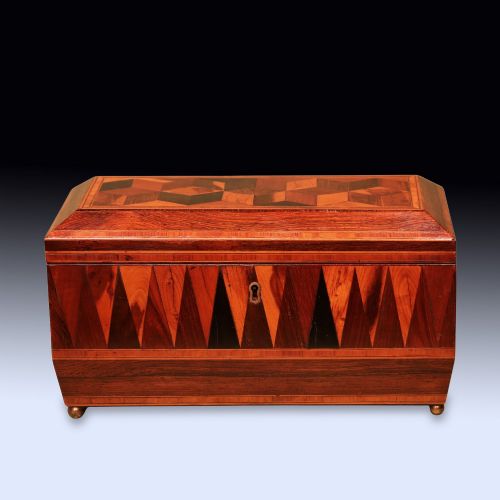
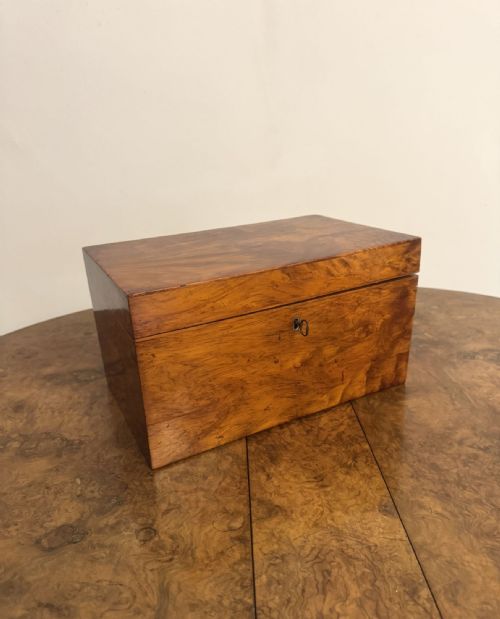


Regency Period Tea Chest
These regency period tea chests are tactile survivors of a formal household ritual, prized for their figured timbers and intricate brass inlays.
Regency Period Tea Chest
A regency period tea chest brings together the refined forms of the early nineteenth century, predominantly taking the shape of tea caddies, teapoys, and boxes. These containers held costly leaves under lock and key, reflecting the high status of tea in Georgian and Regency society.
The pieces listed on this page span the Regency, Georgian, and William IV eras, capturing an aesthetic of geometric restraint and rich grain. Most examples follow classical proportions, whether rectangular, octagonal, or bow-fronted.
Buyers will most frequently encounter rosewood and mahogany carcasses, alongside yew and walnut, often embellished with contrasting veneers or stringing. These woods showcase the cabinetmaker's skill in handling dense tropical and native timbers.
How they were made
Cabinetmakers constructed these chests using solid secondary woods faced with choice veneers of rosewood, mahogany, and walnut, applying parquetry and penwork to create surface pattern. The surfaces often received meticulous hand-polishing to bring out the depth of the grain.
Brass inlay and stringing form a hallmark of the period, let directly into the wood and engraved with delicate motifs. Tortoiseshell and mother-of-pearl appear on select items, applied with precise adhesives and pinned into position.
Interior fittings frequently include twin lidded canisters and a central glass or metal mixing bowl, demonstrating the high standard of interior joinery. Escutcheons and lion-mask ring handles in cast brass complete the construction.
Listings feature rosewood, mahogany, walnut, and yew alongside decorative touches of tortoiseshell, bone, and mother-of-pearl.
What varies in quality
The grade of timber selection dictates the visual impact, with continuous grain wrapping around the corners setting finer chests apart. Cabinets built from dense, heavily figured rosewood or properly matched tortoiseshell panels command greater attention.
Execution of the brass inlay reveals the maker's hand, where tight joints and crisp hand-engraving distinguish superior work from coarser production. Interior completeness, including original crystal mixing bowls and matching inner lids, elevates the integrity of the piece.
The Regency Period Tea Chest Glossary
- Teapoy
- A freestanding tea container mounted on a central pillar with tripod or platform feet, used in the drawing room during the Regency era.
- Penwork
- A decorative technique utilising black ink on light wood to draw intricate neoclassical or botanical scenes before varnishing.
- Parquetry
- Geometric mosaic woodwork formed by fitting small wooden tiles together to create repeating patterns on the exterior surface.
- Escutcheon
- A protective brass plate surrounding the keyhole, often shaped as a shield or diamond to complement the box design.
Regency Period Tea Chest: Frequently Asked Questions
What is a regency tea chest?
A regency tea chest is a secure wooden box designed to store high-value tea leaves securely in the principal rooms of a grand house.
These pieces typically feature hinged lids, internal compartments, and locking mechanisms to protect the contents from domestic staff.
How do I spot a real period piece?
Examine the construction methods, timber choice, and interior hardware to confirm age. Period examples show hand-cut dovetails, older secondary woods, and traditional hand-engraved brass work.
Inconsistencies in the patination or modern adhesives point to later alterations or reproduction work.
Why are some boxes called teapoys?
The term teapoy refers to a larger chest supported on a pedestal rather than sitting flat on a table. They often incorporate internal mixing bowls and compartments for multiple varieties of tea.
How should I care for tortoiseshell?
Tortoiseshell requires stable humidity and protection from direct sunlight to prevent warping and cracking. Dust gently with a dry microfibre cloth and avoid chemical polishes.