




Georgian Penwork Box
A georgian penwork box brings delicate monochrome detail and intricate hand-drawn motifs straight into any room.
Georgian Penwork Box
A georgian penwork box encompasses various lidded containers decorated primarily through meticulous ink drawing on a prepared wooden surface. These pieces range from compact snuff boxes and tea caddies to larger games boxes, jewellery boxes, table cabinets and sewing boxes.
The versions most commonly met on this page date from the Regency period and the wider Georgian era, often displaying distinct chinoiserie or classical architectural scenes rendered in fine black ink lines.
How they were made
Makers constructed the foundation using wood, applying paint, lacquer and varnish to create a smooth pale ground suitable for detailed illustration. Artisans then executed the decoration using ink and a fine pen, building up complex pictorial scenes, borders and motifs.
Many examples incorporate secondary materials such as bone and brass for hinges, escutcheons, feet or internal fittings, combining structural utility with decorative refinement.
The pieces span the Georgian, Regency and nineteenth-century periods, showing consistent use of chinoiserie and classical design motifs.
What varies in quality
Quality rests principally on the precision and fineness of the penwork itself, distinguishing hurried commercial output from highly skilled illustrative execution. The density and complexity of the motifs, ranging from simple geometric borders to elaborate chinoiserie landscapes, define the upper tier.
The overall condition of the protective varnish layer and the underlying painted or lacquered ground significantly influences visual appeal. Well-preserved surfaces retain the crisp contrast between the dark ink and the pale background.
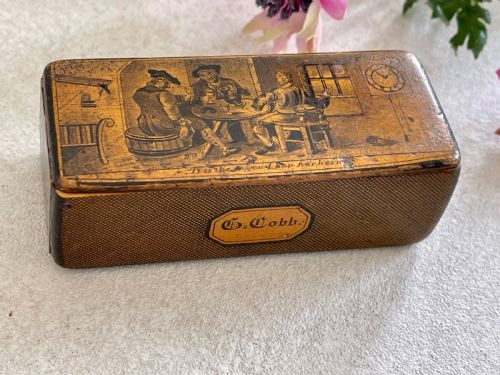
G Cobb
The Georgian Penwork Box Glossary
- Penwork
- A decorative technique using fine ink lines on a painted or lacquered wooden surface to simulate inlaid ivory or elaborate engraving. It demands steady hands and considerable draughtsmanship.
- Chinoiserie
- A European artistic style reflecting Chinese motifs and imaginative interpretations of East Asian landscapes. This aesthetic frequently appears in Regency decorative arts.
- Tea Caddy
- A lidded container originally designed to store loose tea leaves securely. These boxes often feature internal compartments and fitted lids.
- Escutcheon
- A small protective plate surrounding a keyhole, usually fashioned from brass on these pieces. It adds both durability and a metallic accent to the woodwork.
Georgian Penwork Box: Frequently Asked Questions
What were georgian penwork boxes used for?
These boxes served practical domestic functions to store valuable items such as tea leaves, writing implements, sewing tools, snuff or jewellery. Their decorative exteriors meant they sat openly on tables and desks in principal rooms.
Owners appreciated them both for their utility in keeping small possessions organised and as fashionable decorative objects that displayed refined taste to visitors.
How do you date a penwork box?
Dating relies on examining the overall form, the specific cabinet-making details, and the stylistic vocabulary of the ink drawings. Regency and Georgian examples often feature characteristic furniture proportions and architectural or chinoiserie motifs specific to those decades.
Comparing the secondary materials, such as brass hinges and internal paper linings, also helps narrow down the period of manufacture.
Are all penwork boxes black and white?
While the defining characteristic is fine black ink work on a light background, many examples incorporate subtle tints of paint or wash. Artisans occasionally added muted watercolours to enhance specific elements of the pictorial scenes.
The primary visual impact, however, remains dependent on the sharp contrast of the pen lines against the prepared wooden ground.
How should I care for a penwork box?
These pieces require gentle handling and protection from direct sunlight, which can fade the ink and discolour the varnish or paint. Keeping them in a stable environment away from excessive humidity prevents the wood from warping and protects the delicate surface.
Dusting should be done lightly with a soft, dry cloth without applying modern cleaning sprays or polishes.