



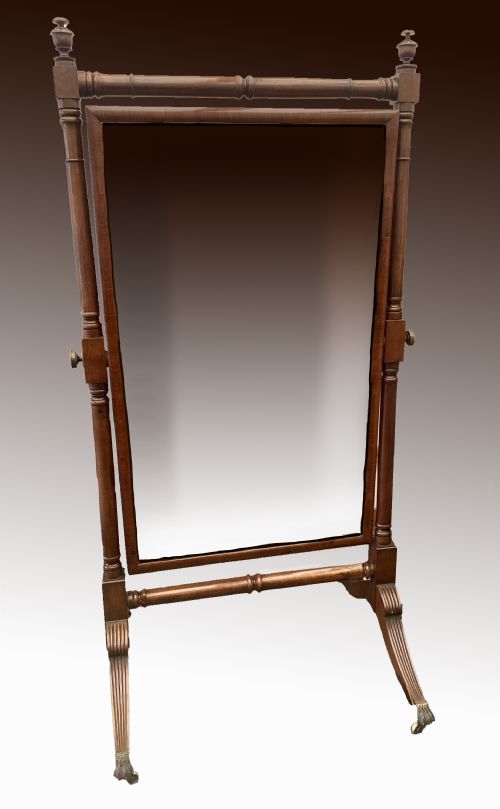

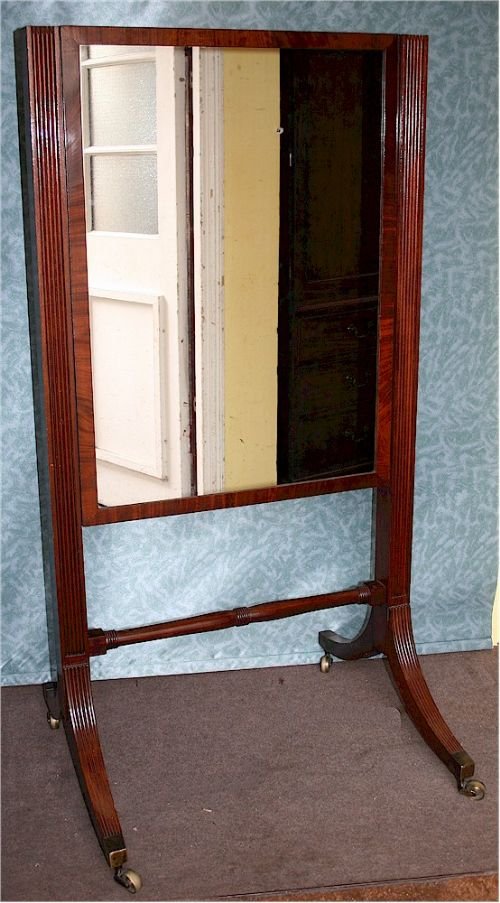
Regency Freestanding Mirror
A regency freestanding mirror brings grace to a room, offering full-length reflection through pivoting glass framed in rich timber.
Regency Freestanding Mirror
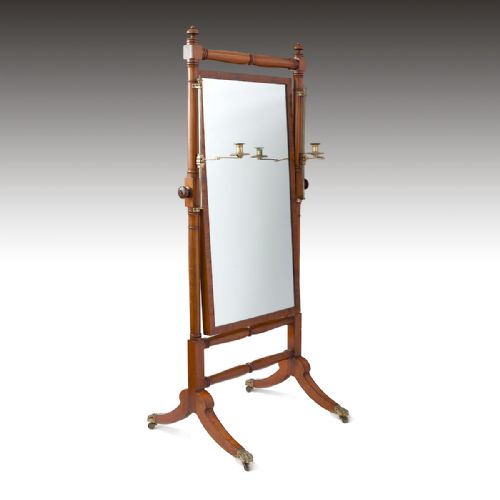
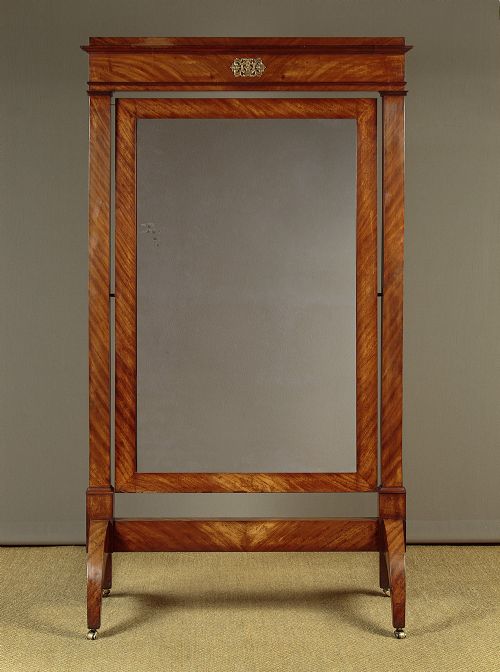
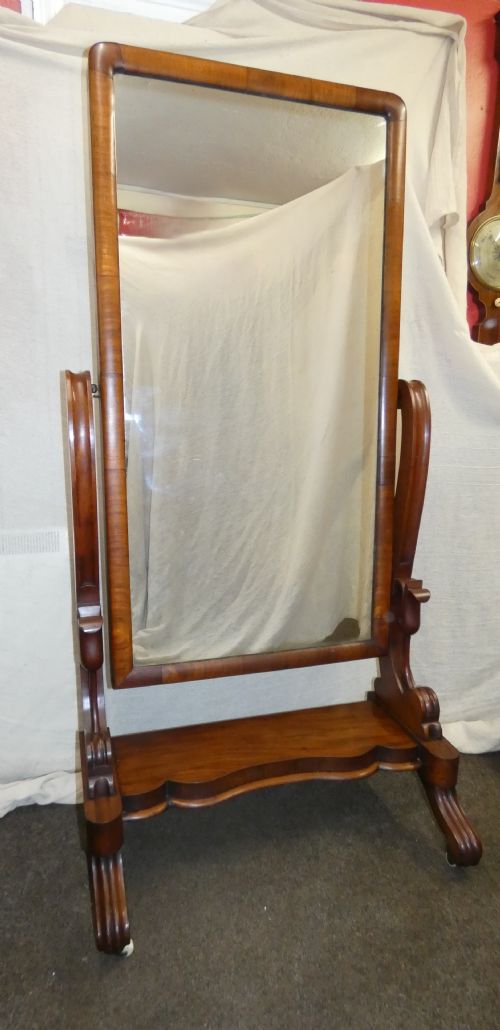
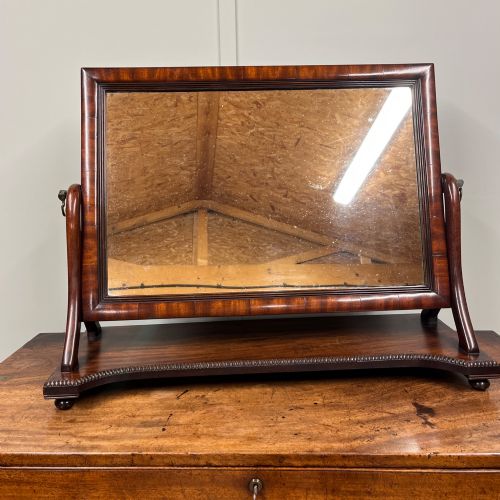
A regency freestanding mirror is typically a large cheval glass designed to stand independently on the floor, allowing a full-length view for dressing. These pieces appear in substantial country house proportions as well as more compact dressing table formats.
The core of this selection spans the Regency era alongside the subsequent William IV and Victorian periods, leaning heavily on mahogany frames. Most examples pivot between upright posts, anchored by sturdy legs with brass details.
Materials and technique
Makers relied primarily on solid and veneered mahogany, complemented occasionally by walnut and highlighted with applied gold leaf. Timber frames were turned or carved with care to support the pivoting glass.
Brass hardware plays a structural and decorative role, visible in socket castors, sabots on sabre legs, and articulated candle holders attached to the frame. The glass itself swings on adjustable pivots fixed to the upright standards.
Regency Freestanding Mirror Retail Price Guide 2026
Typical asking prices for regency freestanding mirror among the pieces listed under this phrase on Sellingantiques today, from the lower quarter to the upper quarter. They describe what is for sale here now, not the wider market.
Listings feature mahogany predominantly, alongside walnut timber, brass hardware, and gold leaf accents across the nineteenth century.
What separates the grades
Proportion and timber selection dictate the standing of a piece, with finer examples displaying well-figured mahogany grain and balanced architectural frames. Secondary woods and simpler turned uprights separate standard utility pieces from grander country house furniture.
The sophistication of the brass mountings, from plain fittings to cast sabots and original candle arms, marks the ambition of the original workshop. Integration of thoughtful details like smooth-working tilt mechanisms separates the finer output.
Gillow
The Regency Freestanding Mirror Glossary
- Cheval mirror
- A large floor-standing mirror suspended within a frame on pivots so it can swing freely. This design became popular for full-length dressing during the nineteenth century.
- Sabre leg
- A curved, outwardly tapering leg of classical derivation that sweeps outward from the frame. It often terminates in a brass shoe or castor.
- Sabot
- A metal sleeve, usually brass, fitted to the foot of a furniture leg for protection and decoration. These appear frequently on sabre-legged frames.
- Toilet mirror
- A smaller mirror designed to sit upon a dressing table or chest of drawers, often fitted with small drawers in the base.
- Tilt dressing glass
- A mirror plate mounted on pivots that allows the user to angle the reflection. This mechanism sits between upright supports on a stable base.
Regency Freestanding Mirror: Frequently Asked Questions
Where should I place a cheval mirror?
These mirrors require adequate floor space and a solid wall or corner where they can stand securely without blocking walkways. Position them to capture natural light from a window to brighten the surrounding room.
Because they offer full-length reflection, bedrooms and dressing rooms remain the traditional placement. Ensure the floor is level so the pivoting frame hangs straight and functions smoothly.
How do I adjust the swing mirror?
The glass hangs on lateral pivot screws or pins set into the upright posts. Tightening or loosening these fixings controls the tension of the tilt.
Support the glass with both hands while making adjustments to protect the antique frame and glass plate from sudden stress. Regular checking keeps the mechanism stable.
Are brass candle holders original?
Some surviving examples retain articulated brass candle arms mounted to the upright frame. These were used to illuminate the person dressing before electric lighting.
Their presence adds utility and confirms the original domestic context of the piece. Inspect the fixings to ensure they match the period construction of the frame.