
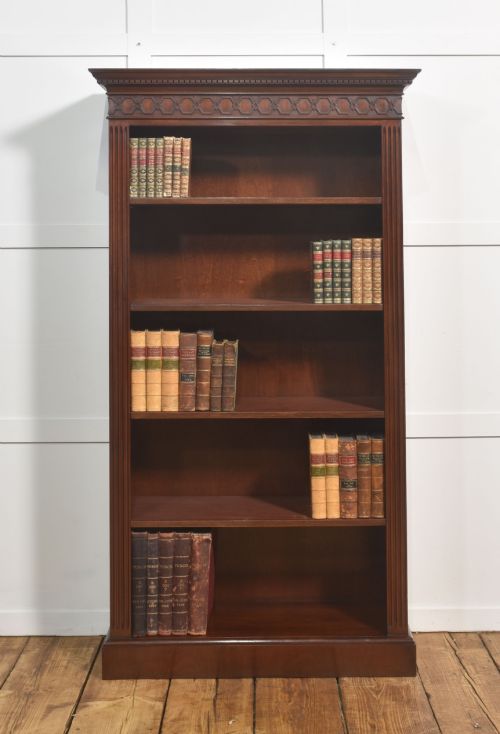
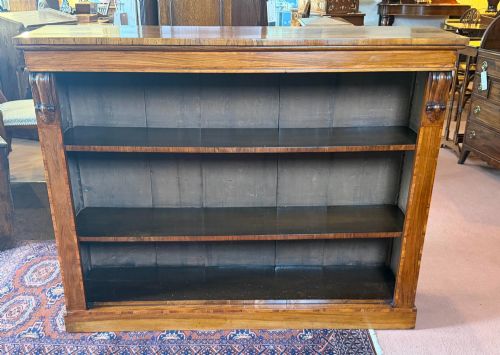
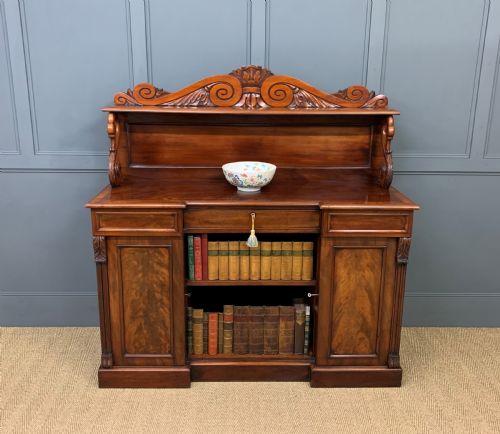
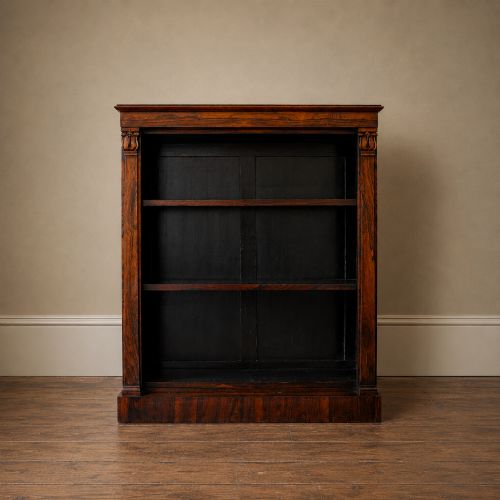
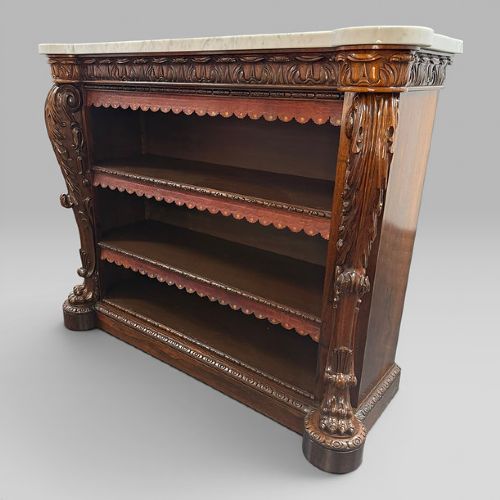
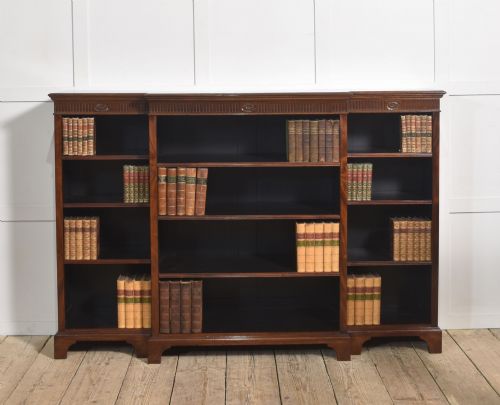
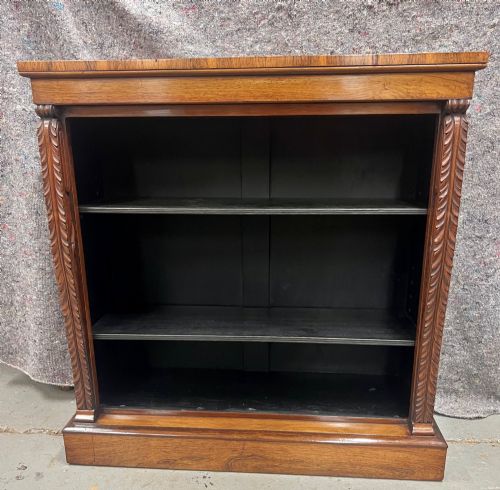
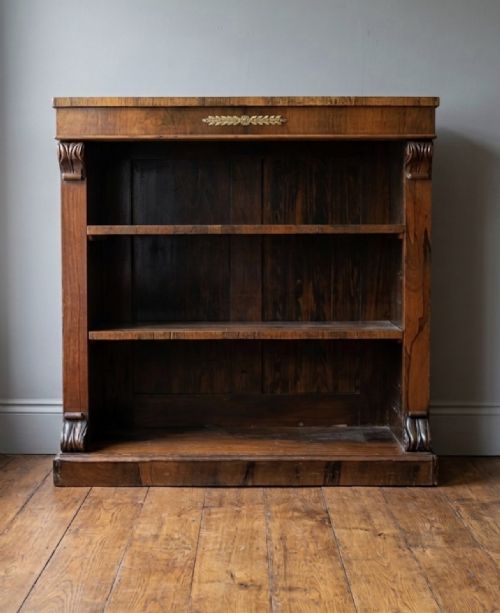


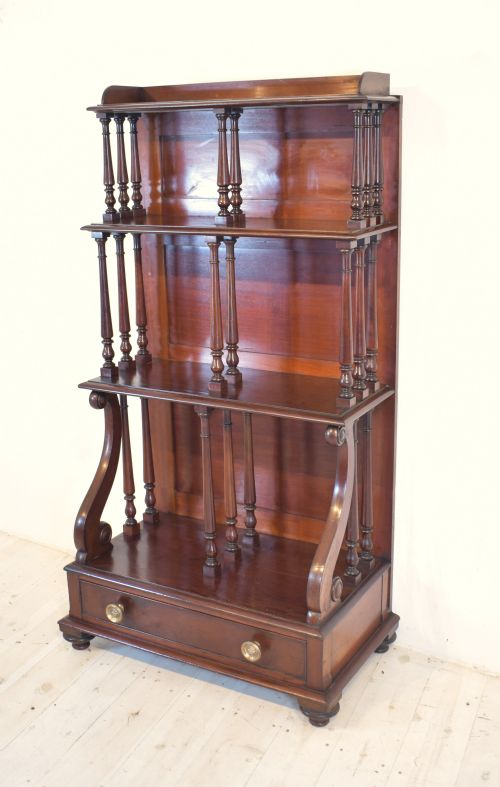


Regency Carved Open Bookcase
A regency carved open bookcase brings architectural dignity to a room, offering open display alongside period timberwork.
Regency Carved Open Bookcase
A regency carved open bookcase is typically encountered in rich woods like rosewood and mahogany, often featuring adjustable shelving or a low breakfront profile. The pieces span the nineteenth century, including Georgian, Regency, William IV, and later stylistic revivals.
Buyers will find both compact examples and large library bookcases, occasionally incorporating marble tops, brass galleries, or waterfall tiers. These variants reflect both formal Regency design and the subsequent Victorian adaptations of the style.
The form functions primarily to display volumes and decorative objects while anchoring a room with substantial nineteenth-century cabinet work.
Materials and construction
Cabinet makers utilised dense hardwoods, notably mahogany and rosewood, sometimes applied as flame veneers over secondary timbers such as oak.
Decorative embellishments often included brass details, marble inserts, and carved wooden motifs executed within the neoclassical or Regency idiom.
Periods represented range from the Georgian era and Regency through to the mid and late nineteenth century, with twentieth-century revivals.
Assessing craftsmanship
Quality rests upon the selection of timber veneers and the crispness of any carved detailing, distinguishing standard production from finer workshop output.
The integration of functional elements, such as adjustable shelving mechanisms and brass galleries, marks the distinction in tier and execution.
Gillows·William Trotter
The Regency Carved Open Bookcase Glossary
- Breakfront
- A cabinet design where the central section projects forward from the flanking wings. This architectural arrangement creates depth and shadow across the front elevation.
- Waterfall bookcase
- A set of open shelves that steps back progressively from the bottom to the top. The profile resembles cascading water.
- Flame mahogany veneer
- Timber sliced to reveal a distinctive, flamelike grain pattern applied over a solid core. It provides a highly decorative surface.
- Chiffonier
- A low cabinet, frequently fitted with shelving or a superstructure on top. It serves for storage and display in reception rooms.
- Gonçalo Alves
- A dense exotic hardwood with striking contrasting grain patterns sometimes utilised in high-status nineteenth-century cabinetry. It offers a distinct visual texture compared to standard mahogany.
Regency Carved Open Bookcase: Frequently Asked Questions
How do I style a regency carved open bookcase?
These bookcases suit studies and drawing rooms where their open shelves accommodate rows of books and decorative objects.
Position them against substantial walls to let the timber grain and carved details command the space.
Are the shelves usually adjustable?
Many examples feature adjustable shelving systems to accommodate books of varying heights.
This practical interior arrangement marks better quality nineteenth-century construction.
What woods were commonly used?
Rosewood and mahogany predominate, often enhanced by flame veneer or contrasting inlay.
Oak and walnut also appear among the listed nineteenth-century examples.
How do I identify a Regency period piece?
Look for neoclassical proportions, specific timber choices like rosewood, and carved details aligned with the early nineteenth century.
Later Victorian interpretations often adopt similar stylistic markers but differ in construction weight and secondary woods.