
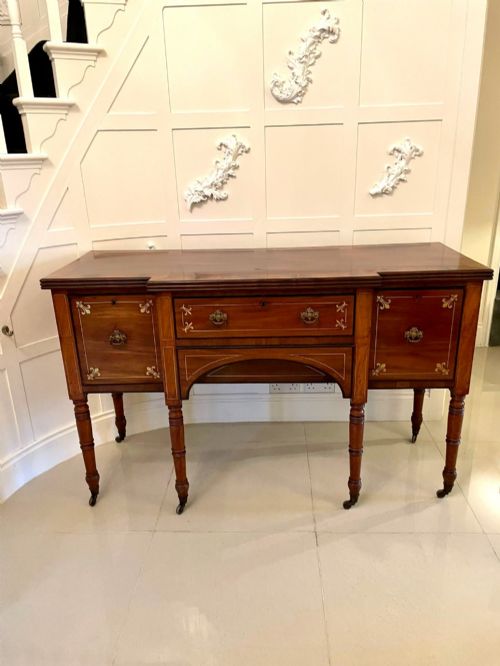
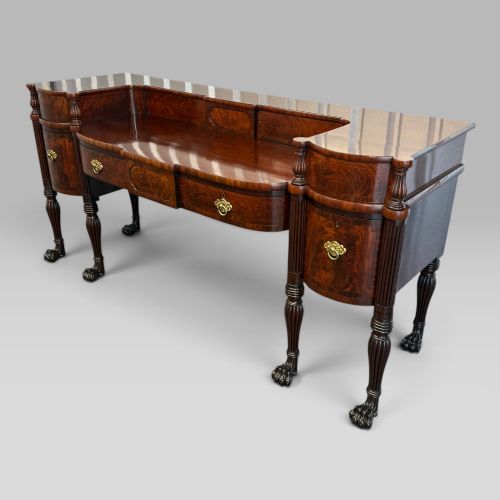
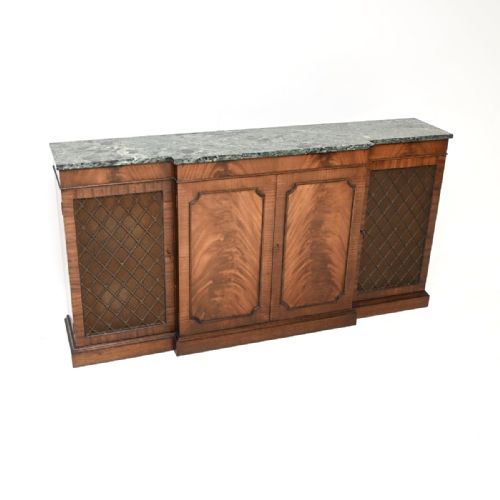
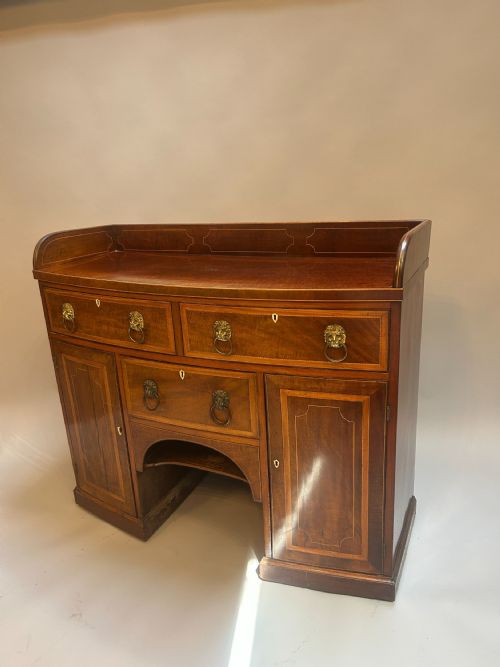


Regency Breakfront Credenza
These regency breakfront credenza pieces combine architectural presence with disciplined storage, offering a sophisticated focal point for a formal interior.
Regency Breakfront Credenza
A regency breakfront credenza centres on a protruding central section flanked by slightly recessed side compartments, creating a structured silhouette found in sideboards, side cabinets, and bookcases.
The pieces appearing on this page span the Regency, George IV, and William IV periods, alongside later Victorian and Revival interpretations dating into the twentieth century.
Most examples emerge in rich timbers like mahogany and rosewood, frequently incorporating brass inlay, grill fronts, or glazed doors to serve dining rooms and libraries.
How they were made
Cabinetmakers utilised dense native and exotic hardwoods, notably flame mahogany and rosewood, applying figured veneers over robust secondary woods to build structured carcases.
Decorative enrichment relied upon precision brass inlay, parcel gilding, and carved details such as lion paw feet or subtle mouldings.
Interiors often combined adjustable wooden shelving with fabric-backed mesh or glass panels, securing functional longevity alongside visual symmetry.
The archive and active inventory record specialised forms including grill-front cabinets, library bookcases, and low chiffoniers with brass inlay.
What varies in quality
The calibre of a piece rests upon the selection and matching of wood veneers, where symmetrical flame patterns or striking grain figures elevate the overall composition.
Execution of brass stringing and inlay demonstrates the joiner's precision, distinguishing standard production from exceptional cabinet work.
Structural integrity reveals itself in the seamless alignment of the projecting central breakfront and the stability of the mounted doors or drawers.
The Regency Breakfront Credenza Glossary
- Breakfront
- A cabinet design where the central section projects forward from the flanking outer sections. This architectural arrangement creates depth and shadow across the front elevation.
- Credenza
- A low-profile storage cabinet historically used for serving or displaying objects. In later periods, the term overlaps with sideboards and low bookcases.
- Chiffonier
- A compact sideboard or cabinet featuring shelves or a raised back. Regency examples frequently incorporate fabric panels or brass grilles.
- Flame mahogany
- Timber cut to expose a distinctive flamed or feathered grain pattern. Cabinetmakers prized this veneer for its dramatic visual movement.
- Ormolu
- Gilded bronze mounts applied to furniture for decorative contrast. This technique highlights key architectural lines and corners.
Regency Breakfront Credenza: Frequently Asked Questions
Where should I place a breakfront credenza?
These cabinets suit principal reception rooms or dining spaces where a strong architectural anchor is required against a long wall.
Their substantial depth and linear presence mean they function best out of heavy traffic paths, allowing the projecting centre to draw the eye.
How do I care for rosewood and mahogany surfaces?
Maintain the timber by dusting regularly with a dry cloth and avoiding direct sunlight that can bleach rich veneers over time.
Occasional application of appropriate wax polish preserves the sheen without building up a heavy, obscuring film.
What is the difference between a sideboard and a credenza?
Sideboards traditionally served dining rooms for storing silver and serving food, often featuring deep cupboards and drawers.
Credenzas typically present a lower, more enclosed profile with doors running across the base, leaning towards display and general storage.
How can I distinguish Regency pieces from later revivals?
Original Regency and George IV pieces display construction methods, timber weights, and patination consistent with early nineteenth-century workshop practices.
Revival pieces from later decades often utilise standardised fixings, different secondary woods, and cleaner, less variable finishes.