




Green Marble Credenza
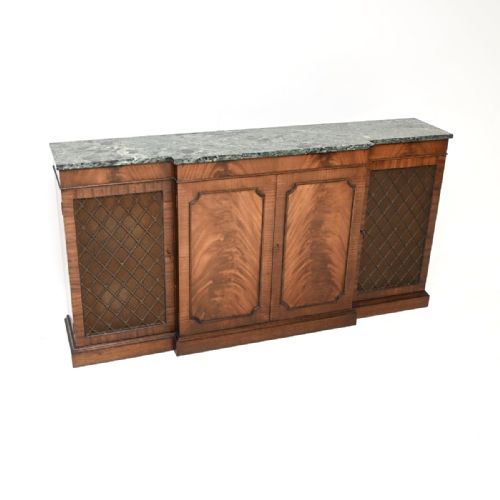
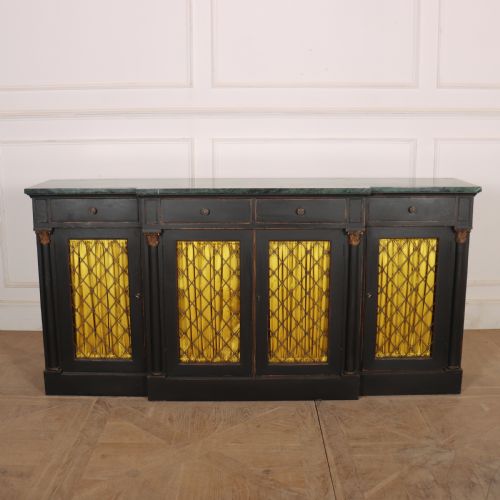
A green marble credenza brings a heavy slab of cool stone atop richly figured timber to a room, offering both display space and deep storage.
Green Marble Credenza
A green marble credenza covers a broad family of heavy timber storage pieces topped with stone, ranging from Regency rosewood cabinets to later mahogany sideboards. When you search for a green marble credenza, you meet low side cabinets, breakfront dressers, and tall chiffoniers drawn from the eighteenth century up through the nineteen-thirties. These forms serve primarily to ground a dining room or formal hallway while holding plate, linen, or books behind panelled doors.
The domestic storage items on this page span the Regency period, the Victorian era, and revival phases including Louis XIII and Dutch Neoclassical styles. Makers deployed rosewood, walnut, mahogany, and painted wood beneath their marble tops, often adding brass mounts or grill fronts to the timber framework. Each piece relies on the weight and colour of its upper stone surface to balance the dark wood grain beneath.
How they were made
Cabinet makers built these carcasses from sturdy timbers such as mahogany, walnut, and rosewood, frequently applying fine veneers of kingwood in marquetry and parquetry patterns. Surfaces often incorporate brass mounts, silver mounts, or delicate fabric inserts behind wire grill doors to soften the heavy timber construction.
The defining element rests squarely on top: a heavy slab of polished marble, typically cut to follow the breakfront, demi-lune, or straight profile of the wooden base below. Carved details appear across the revival pieces, particularly in the deep walnut mouldings and structural framing typical of mid-nineteenth-century workshops.
Listings feature periods from the eighteenth century through the nineteen-thirties, utilising materials including rosewood, walnut, brass, and marble.
What varies in quality
Quality rests in the precision of the timber veneer work and the integration of the marble top with the cabinet carcass below. Pieces featuring complex breakfront shapes, intricate marquetry, or finely cast brass and silver mounts demonstrate a higher level of workshop skill than plain painted or simpler domestic examples.
The selection of the marble slab and the depth of the timber carving further separate standard utility items from exceptional cabinet work. Heavier architectural mouldings and sophisticated grain matching in the rosewood or walnut elevate the presence of the whole piece.
The Green Marble Credenza Glossary
- Credenza
- A flat-topped cabinet or sideboard used for serving food or storing glassware. It sits low against the wall and provides a broad upper surface.
- Breakfront
- A cabinet design where the central section projects forward from the flanking outer sections. This architectural arrangement creates depth and shadow across the front elevation.
- Demi-lune
- A half-moon shape used for table and cabinet tops that fit flat against a wall. It provides a curved profile that softens room angles.
- Marquetry
- The art of forming decorative patterns by fitting together small pieces of wood veneer of different colours and grains. It decorates the flat door and drawer surfaces of finer cabinets.
- Chiffonier
- A tall, narrow sideboard or chest of drawers featuring a shelf or small superstructure on top. It offers compact vertical storage for smaller rooms.
Green Marble Credenza: Frequently Asked Questions
What is a green marble credenza used for?
These cabinets serve as substantial storage furniture in dining rooms, living spaces, and grand hallways. Their stone tops provide a durable, heat-resistant surface for serving food or displaying decorative objects.
Behind the timber doors, deep shelves accommodate tableware, linens, and household items. The flat surface also functions well as a sideboard for lamps and ornaments.
How do I care for the marble top?
Marble requires gentle cleaning with warm water and a soft cloth, avoiding acidic household cleaners that etch the polished stone surface. Using coasters and mats prevents liquid rings and scratches from jars or glasses.
Applying a specialist stone wax periodically helps protect the polish against everyday wear. Take care to lift heavy items rather than sliding them across the stone.
How can I tell the period of the cabinet?
Dating relies on examining the timber species, construction methods, and decorative styles visible across the piece. Regency and nineteenth-century examples often use solid rosewood or mahogany, while revival pieces display distinct architectural carvings.
Door hinges, drawer linings, and the cut of the wood provide further clues to workshop practices of the era. Compare the overall proportions and mount designs against established stylistic periods.
Will a heavy marble top remove for transport?
Many marble tops rest loose upon the wooden base, held in place entirely by their own substantial weight. This design allows the heavy stone to be lifted off separately to make moving the wooden carcass manageable.
On older fitted pieces, however, the marble may be secured with mortar, glue, or wooden framing. Check how the stone meets the timber before attempting to separate the components for transit.