


Regency Bottle Coasters
Regency bottle coasters protect the dining table in style, holding wine and decanters securely during evening service.
Regency Bottle Coasters
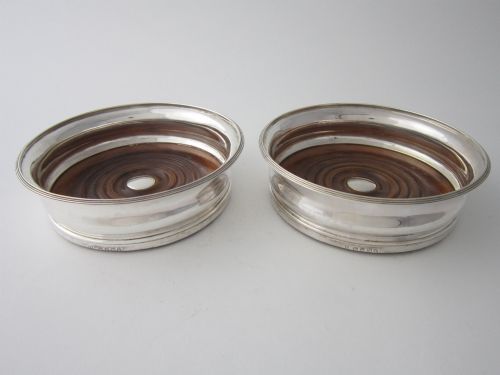
When you search for regency bottle coasters, you enter a sphere of dining room accessories designed to slide across mahogany surfaces without scratching the polished wood. These pieces protect the table from moisture and rings left by wine bottles during long dinners. The selection includes examples in sterling silver, Old Sheffield plate, papier-mâché, and turned woods.
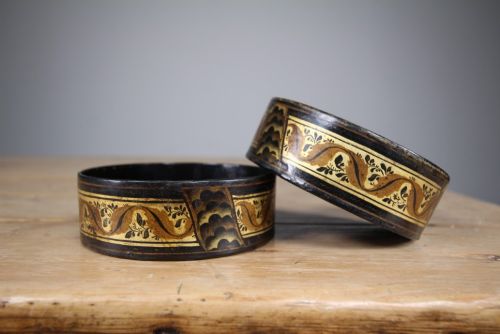
You are most likely to meet pairs or sets of Old Sheffield plated coasters dating from the early nineteenth century, alongside black papier-mâché versions with gilded decoration. The forms range from standard wine coasters to very large bottle stands and ships decanter holders. Georgian and Regency periods dominate the listings, showing the classic circular profiles used for serving port and claret.
Materials and construction
Makers utilised heavy silver plate over copper, known as Old Sheffield plate, alongside solid sterling silver bearing hallmarks from assay offices like Sheffield. Wood versions feature turned mahogany and rosewood, often paired with carved details or felt-lined bases. Papier-mâché pieces rely on layered paper pulp treated with lacquer and finished with hand-gilded motifs.
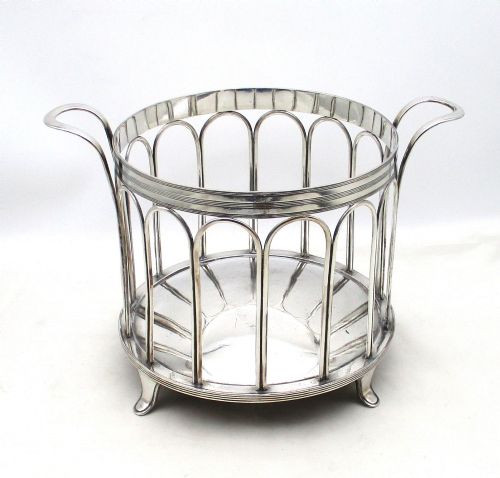
Silver and plated examples employ pierced galleries, gadrooned rims, and wooden inserts at the base to cushion the glass. Cabinetmakers turned mahogany on lathes to create deep wells, occasionally attributing larger pieces to known workshops. Lacquer and papier-mâché constructions required precise moulding to achieve rigid circular walls capable of holding heavy decanters.
Some nineteenth-century drinkers favoured heavy ships decanter coasters designed with extra-wide bases so the port stayed upright during a gale.
Judging quality in bottle coasters
The distinction between ordinary and superior examples rests on the crispness of the chased or pierced metalwork and the weight of the piece in the hand. Fine Old Sheffield plate shows careful application where the silver layer remains intact over the copper margins, while lesser pieces exhibit excessive wear or clumsy repairs. Sterling silver items rely on clear maker marks and well-preserved armorial engravings to prove their pedigree.
In papier-mâché and wood, quality is told by the stability of the structure and the preservation of the original gilded or polished surfaces. Heavier turned mahogany and rosewood examples display tight grain patterns and substantial turned bases without warping. The integrity of the interior baize or velvet lining also indicates how carefully a coaster has been maintained over generations.
Matthew Boulton·John and Thomas Settle·James Mein of Kelso
The Regency Bottle Coasters Glossary
- Old Sheffield Plate
- A composite material made by fusing a thin sheet of silver to a thicker copper base, common in nineteenth-century tableware. This technique preceded modern electroplating and leaves a characteristic edge where the copper shows.
- Papier-mâché
- A durable composite material formed from paper pulp mixed with glue and resin, then pressed and dried into rigid shapes. Coasters in this medium often feature deep black lacquer and hand-applied gilt decoration.
- Gadroon
- A decorative carved or embossed banding featuring convex curves, frequently used along the rims of silver and plated coasters. This classical motif echoes architectural details popular during the Regency period.
- Armorial
- A design displaying a family coat of arms, engraved onto the silver mount or base of a coaster. Such heraldic markers indicate the piece was commissioned for a specific aristocratic dining room.
- Gallery
- The upright pierced or solid wall surrounding the base of a coaster to keep the bottle upright. Pierced galleries often feature geometric or floral fretwork patterns.
Regency Bottle Coasters: Frequently Asked Questions
What were regency bottle coasters used for?
These coasters held wine bottles and decanters as hosts passed them around the dining table after the meal. They prevented condensation and spills from staining the polished wood surface.
Servants placed them on the table so guests could slide the bottles easily from person to person without lifting heavy glass containers.
How do I care for antique coasters?
Keep silver and plated pieces clean with a soft cloth and gentle polish, avoiding harsh abrasives that wear down the plating. For wooden and papier-mâché versions, dust gently and protect them from excessive moisture.
Store them in stable room conditions away from direct sunlight to preserve the lacquer, gilding, and wood finish over time.
Are coasters sold in pairs?
Many listings feature matching pairs or sets of three and four, which reflected how dining rooms operated in the period. Hosts used multiple coasters to serve different wines simultaneously.
Singular pieces do appear, particularly larger formats designed for magnum bottles or ships decanters that required a wider base.
How can I tell silver from silver plate?
Solid sterling silver pieces bear official hallmarks indicating the assay office, standard, and date letter. Old Sheffield plate lacks these standard assay marks and often reveals a thin line of copper along the cut edges.
Examining the underside under a strong light helps identify the subtle colour differences between solid metal and plated copper composites.