
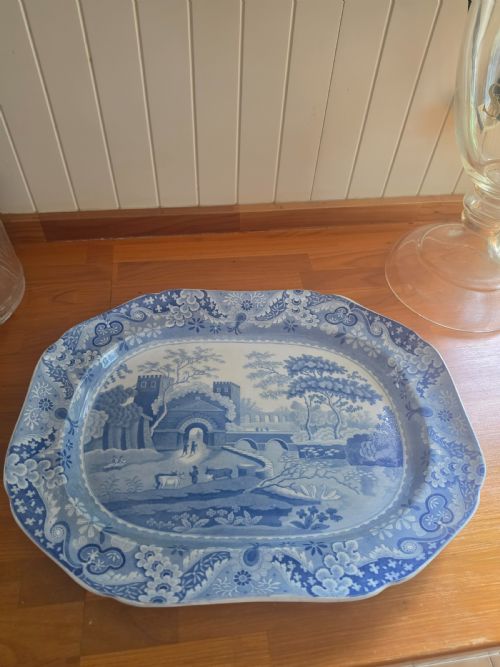
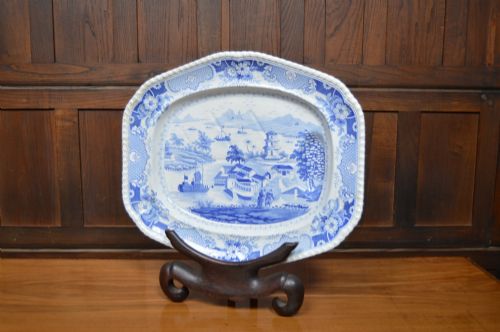


Regency Blue White Charger
These large ceramic chargers and platters bring bold transfer-printed scenes to the table, offering a striking display of early nineteenth-century artistry.
Regency Blue White Charger
A regency blue white charger is a large serving dish or decorative plate decorated with cobalt blue transfer prints on a pale ceramic body. Buyers seeking this phrase typically find large meat platters, compotes, and deep chargers produced during the Georgian, Regency, and early Victorian periods.
The pieces on this page span from the early nineteenth century into the Victorian era, embracing styles such as Regency Chinoiserie and standard British earthenware. Common subjects include topographical views, maritime battles, literary series, and botanical themes rendered in deep blue monochrome.
Originating largely from Staffordshire potteries, these chargers served both functional roles on large dining tables and decorative purposes on sideboards. The forms range from wide flat dishes to substantial compotes bearing maker marks or series titles.
Materials and production methods
Potters built these chargers using earthenware and pearlware bodies, which provided a smooth white or pale blue-tinged surface ideal for receiving pigment. The ceramic paste was shaped, fired, and then coated in a clear glaze before a secondary kiln firing.
The iconic blue designs were applied using transfer printing, a technique where an engraved copper plate transferred a paper-backed ink impression onto the biscuit fired clay. Cobalt oxide was the primary pigment used, yielding the deep blue tones characteristic of the era.
Bees feature prominently on at least one nineteenth-century plate, immortalising an obscure insect keeper named The Beemaster in blue ink.
Judging quality in early ceramic chargers
Quality rests heavily on the clarity and registration of the transfer print, where sharp lines and well-aligned pattern repeats distinguish superior work. Fainter prints or blurred edges indicate a worn copper plate or hurried application during production.
The richness of the cobalt glaze and the uniformity of the ceramic body also determine value, as kiln flaws and warping detract from the piece. Maker attribution, through printed or impressed marks, often elevates an item alongside the complexity of the pictorial series.
Spode·Minton·Copeland and Garrett·William Adam
The Regency Blue White Charger Glossary
- Transferware
- Pottery decorated by applying a design from an engraved copper plate via tissue paper to the ceramic surface. This technique allowed intricate pictorial scenes to be replicated consistently across multiple plates.
- Pearlware
- A refined earthenware developed in the late eighteenth century featuring a subtle bluish glaze that made the ceramic base appear whiter. It served as the direct precursor to many nineteenth-century blue and white wares.
- Charger
- An extra-large plate traditionally used for ceremonial dining or as a base beneath smaller courses. In nineteenth-century contexts, these functioned primarily as grand serving platters or display pieces.
- Compote
- A raised bowl or dish mounted on a central foot, used for serving fruit or sweets at the table. These pieces often matched the decorative schemes of large dinner services.
- Earthenware
- Porous pottery fired at lower temperatures than stoneware or porcelain, requiring a glass glaze to become impermeable. It forms the structural body of nearly all the chargers catalogued here.
Regency Blue White Charger: Frequently Asked Questions
What is a regency blue white charger?
It is a large earthenware serving dish or plate decorated with cobalt blue transfer-printed patterns during the early nineteenth century.
These pieces typically feature scenic views, literary themes, or maritime subjects produced by prominent Staffordshire potteries.
How were these chargers used originally?
They functioned as substantial serving platters for meat or as decorative display pieces on dining room sideboards.
Larger compotes and chargers held fruit or served as centrepieces during formal nineteenth-century meals.
How do I care for an antique ceramic charger?
Wash the piece gently by hand using warm water and mild soap, avoiding dishwashers and harsh abrasive sponges.
Display the charger securely on a padded plate stand to protect the glazed earthenware body from chipping.
How can I tell the period of a plate?
Examine the ceramic body for the characteristic blue-tinted glaze of pearlware versus standard nineteenth-century earthenware.
Maker marks, series titles stamped on the reverse, and stylistic clues like Regency Chinoiserie help narrow down the date of manufacture.