


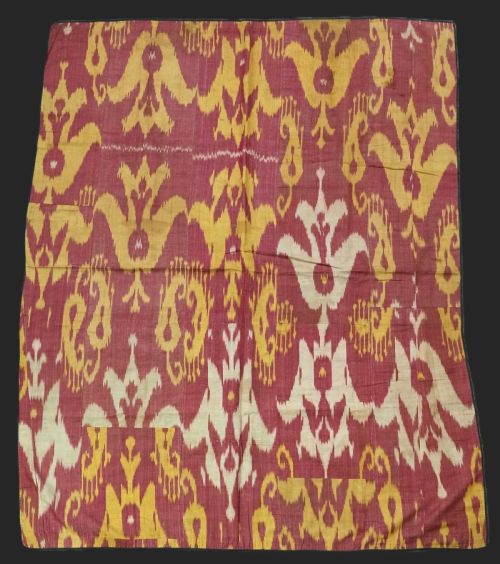


Red Woven Tapestry
When you search for a red woven tapestry, you find tribal weavings, flatweaves and wall coverings created to bring rich colour and texture into an interior.
Red Woven Tapestry
A red woven tapestry encompasses traditional flatweaves, tribal storage bag faces, wall panels and rugs produced across Central Asia, the Caucasus, Persia and Europe.
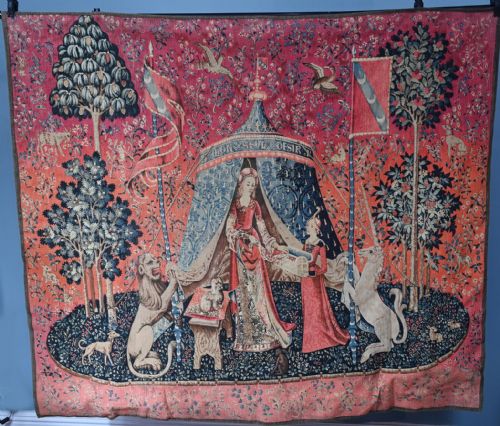
Buyers seeking a red woven tapestry encounter pieces originating from nomadic and village traditions, alongside European wall coverings spanning the late nineteenth and early twentieth centuries, with several dating back further.
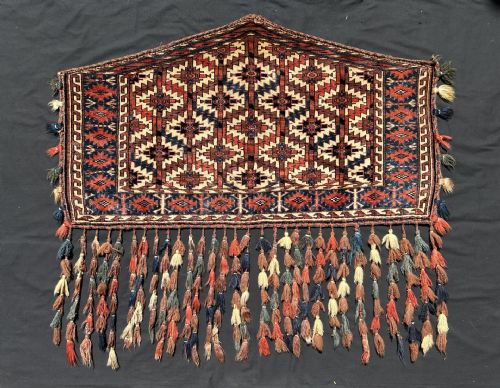
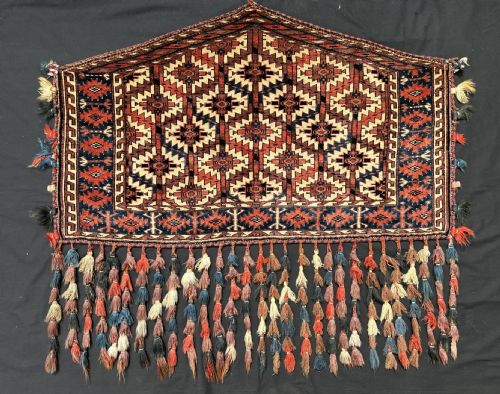
The selection ranges from Yomut and Tekke Turkmen chuvals to Qashqai kilims and Pirot or Sarkoy weaves, each displaying distinct regional patterns and handling of the colour red.
Materials and construction
These textiles rely principally on wool, cotton and silk fibres, spun and dyed by hand before being woven into dense flatweaves, pile rugs or multi-strip panels.
Nomadic and village makers employed slit-tapestry and various knotted or flat-faced techniques, occasionally incorporating metal threads or backing materials like leather and hardwood for support.
Listings feature pieces spanning the mid nineteenth century through to the 1940s, utilising wool, cotton, silk, textile, leather and hardwood.
Assessing quality and execution
Quality rests on the tightness of the weave, the precision of the tribal motifs such as guls or chevron bands, and the depth achieved in the natural or early synthetic red dyes.
Pieces showing higher structural integrity retain their original borders, hanging loops or complete storage bag backs, demonstrating superior handwork by the weaver.
The Red Woven Tapestry Glossary
- Chuval
- A large tent storage bag produced by Turkmen tribes, typically featuring rows of guls on the face. These pieces were often cut down for use as wall hangings or rugs.
- Kilim
- A flatwoven carpet or rug made without a pile, produced across Anatolia, the Caucasus, Persia and the Balkans. The technique creates sharp geometric patterns.
- Gul
- A medallion or repeating octagonal motif used in Turkmen carpet and textile design. Each tribal group utilised specific forms to denote lineage.
- Sofreh
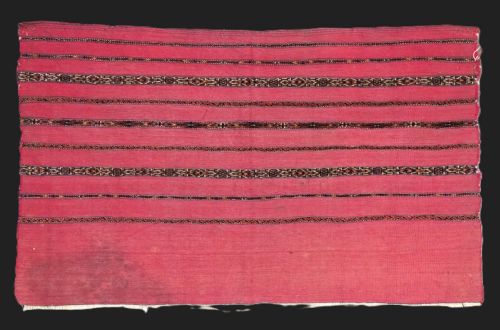
- A woven eating cloth or spread used by nomadic and village communities in Central Asia and Persia. They are typically flatwoven and geometric in layout.
- Asmalyk
- A pentagonal trapping hung on the flanks of a camel during Turkmen wedding processions. They display elaborate field designs and intricate borders.
Red Woven Tapestry: Frequently Asked Questions
How were these tapestries used?
Many of these textiles served practical functions within nomadic and village dwellings, acting as storage bags, floor coverings, eating cloths or camel trappings during migrations and daily life.
European examples and certain flatweaves were created specifically as wall coverings or decorative panels to insulate stone rooms and enrich domestic interiors.
How do I hang a textile on the wall?
Hanging a textile safely involves distributing the weight evenly across the top edge rather than piercing the fabric with direct nails. Conservation-grade Velcro stitching or a custom sleeve sewn to the reverse allows a flat bar to support the piece.
Ensure the display wall avoids direct, strong sunlight to protect the wool and silk dyes from fading over time.
How do I tell tribal regions apart?
Regional attribution relies on identifying the specific structural geometry, colour palette and repeating motifs characteristic of each group. Turkmen weavings frequently display octagonal guls in deep madder reds, while Qashqai and Shahsavan pieces often incorporate bolder geometric borders and livelier polychrome accents.
Pirot and Sarkoy kilims from the Balkans exhibit distinct flowering tree or banded designs executed with soft tonal transitions.
How do I care for antique wool textiles?
Routine maintenance requires gentle surface vacuuming through a mesh screen on a low suction setting to remove dust without pulling loose fibres. Professional cleaning by a specialist in antique textiles remains necessary for deeper interventions.
Keep the environment dry and well-ventilated to prevent moisture accumulation and insect damage in the natural fibres.