


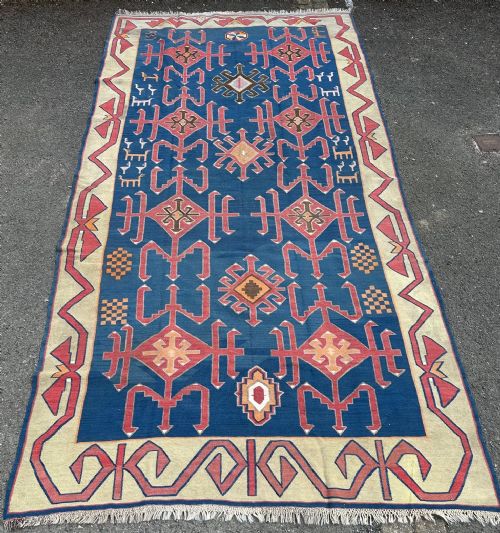


Red Wool Kilim Runner
When choosing a red wool kilim runner, you are selecting a flat-woven tribal textile designed for narrow spaces.
Red Wool Kilim Runner
A red wool kilim runner represents a flat-woven textile produced by nomadic and village weavers across Persia, Turkey, Central Asia, and the Caucasus. These narrow pieces appear in regional forms such as Senneh Bijar, Malatya Konya, and various tribal groups.
Makers utilised traditional geometric motifs and banded layouts to structure the elongated formats required for corridors and hallways. The palette relies on madder and other botanical shades that settle into muted tones over decades.
Originating from tribal and village traditions between the mid-nineteenth century and the mid-twentieth century, these runners reflect distinct regional weaving practices. Each piece carries the structural characteristics of its specific weaving group, from Anatolian workshops to Afghan borderlands.
Materials and Construction
Weavers constructed these runners using hand-spun wool for the surface pile or flat weave, often combined with cotton foundations in specific regional traditions. Natural dyes derived from plants and minerals provide the characteristic red coloration seen across the pieces.
The technique relies on slit-tapestry weaving, where weft threads are looped back at the boundary of each colour block, creating small vertical slits in the fabric. Some examples incorporate supplementary weftwork and multi-strip construction methods to achieve greater structural width or length.
Listings span the period from 1860 to 1940, utilising hand-spun wool and natural dyes within Anatolian, Persian, and Central Asian tribal traditions.
Evaluating Quality and Execution
Quality in these runners rests on the tightness of the weave and the precision of the geometric design execution. Finer tension in the wool creates a firmer handle and greater durability under foot traffic.
The depth and variation of natural dye lots separate standard production from superior examples, particularly where madder red tones display nuanced tonal shifts. The integrity of the selvedges and the proportional balance of the banded layouts also indicate the maker's skill level.
The Red Wool Kilim Runner Glossary
- Kilim
- A flat-woven textile produced without a pile by tightly interweaving warp and weft strands. This technique creates a lightweight, reversible fabric with crisp geometric patterns.
- Sofreh
- A type of spread or cloth used traditionally for dining or food preparation in Persian and regional households. These utilitarian textiles frequently feature striking tribal iconography and banded arrangements.
- Warp
- The stationary vertical threads stretched across a loom that form the structural foundation of the textile. Weft threads are passed horizontally through these warp threads to create the pattern.
- Weft
- The horizontal threads packed tightly across the warp threads to build the visible design and colour fields of the rug. In flat-weaves, the weft entirely conceals the foundation warp.
- Palas
- A traditional term for a flat-woven utility cover or rug produced by nomadic groups. These pieces often employ durable wool construction for heavy domestic use.
Red Wool Kilim Runner: Frequently Asked Questions
Where were these runners made?
The pieces originate from tribal and village communities across Persia, Turkey, Central Asian regions, and the Caucasus.
Weavers working within specific groups such as the Qashqai, Baluch, and Uzbek produced these textiles using local materials and traditional methods.
How do I care for a flat weave?
Regular gentle vacuuming without a rotating brush roll prevents dust accumulation within the tight weave structure. Professional textile cleaning suited to antique wool ensures the longevity of natural dyes.
Keeping the runner away from direct, continuous sunlight protects the madder red hues from fading unevenly over time.
What is a two-part kilim?
Certain regional weavers constructed wider formats by joining two separate long panels together down the centre.
This technique allowed nomadic looms of limited width to produce substantial rugs and runners for domestic interiors.
How are different regional styles told apart?
Distinctions emerge through the specific geometry of the motifs, the structural strip counts, and the exact shade of the wool.
Caucasian pieces often display sharp, highly angular medallions, while Anatolian and Persian tribal runners utilise softer botanical palettes and distinct border arrangements.