


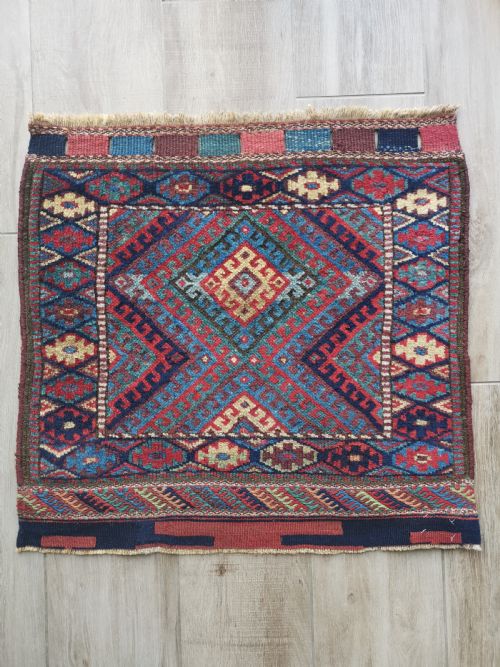


Red Wool Carpet Fragment
When you search for red wool carpet fragment, you are looking at remnants of tribal weaving, primarily Turkmen torbas, chuvals, and bag faces created across the nineteenth century.
Red Wool Carpet Fragment
A red wool carpet fragment on this page is most frequently a surviving portion of a nineteenth-century Turkmen torba, chuval, or bag face from Central Asia. These items originate from specific tribal groups such as the Tekke, Ersari, Saryk, and Yomut, representing nomadic household and utilitarian weaving.
The inventory also includes Caucasian, Kurdish, Shahsavan, and Persian tribal remnants, along with Kyrgyz tent bands and Mughal fragments. Pieces take the form of isolated bag faces, runner remnants, and larger carpet sections dating from the eighteenth century to around nineteen hundred.
How they were made
These textiles rely primarily on hand-spun wool foundations and pile, combined with natural and vegetable dyes to achieve deep red and crimson tones. Cotton and linen frequently appear in the structural warps and wefts, while silk is occasionally utilised for specific highlights and design details.
Weaving techniques encompass tribal pile knotting alongside Soumak flatweave structures and ikat designs. Artisans employed traditional gul motifs, curled leaf patterns, and tribal geometric drawing executed on fine or coarse foundations.
Red Wool Carpet Fragment Retail Price Guide 2026
Typical asking prices for red wool carpet fragment among the pieces listed under this phrase on Sellingantiques today, from the lower quarter to the upper quarter. They describe what is for sale here now, not the wider market.
The inventory records Turkmen, Caucasian, Persian, Kurdish, and Shahsavan tribal traditions originating from Central Asia and the Middle Amu Darya region.
What varies in quality
Quality in these fragments is defined by the density of the weave, the precision of the tribal drawing, and the vibrancy of the natural dyes. Pieces with very fine weaves and crisp execution of complex gul motifs sit at the upper end of the spectrum.
The integrity of the surviving textile structure and the retention of original colour hues also dictate the standing of a piece. Intact design symmetry within a partial format separates superior survivals from standard remnants.
The Red Wool Carpet Fragment Glossary
- Torba
- A small Turkmen bag used for storage inside a nomadic tent. These pieces often feature prominent gul motifs and decorative borders.
- Chuval
- A large tent storage bag produced by Turkmen tribes. They typically display multiple guls and wide functional lower panels.
- Gul
- A medallion or repeated octagonal motif used in Central Asian carpet design. Each tribal group traditionally utilised distinct gul patterns.
- Soumak
- A flatweave technique involving wrapping weft threads around warp threads in a herringbone pattern. This method creates a durable structure without pile.
- Mafrash
- A rectangular storage bale face used for bedding or household goods. They are frequently encountered as separated fragments.
Red Wool Carpet Fragment: Frequently Asked Questions
What were these fragments originally used for?
Nomadic tribes utilised these woven textiles as functional storage bags, tent bands, and animal trappings within daily domestic life.
Items such as torbas and chuvals held household goods, clothing, and blankets inside portable dwellings across Central Asia.
How do you display a carpet fragment?
Collectors commonly mount these textile remnants onto stretched linen or display them flat behind protective museum glass.
Smaller bag faces and runners also function well when secured to wall surfaces using conservation-grade hanging methods.
How are nineteenth-century pieces identified?
Dating relies on assessing the chemical composition of natural and vegetable dyes alongside specific tribal design conventions.
Material analysis of the hand-spun wool, cotton, and linen foundations further assists in placing pieces within the eighteenth and nineteenth centuries.
Why are these items sold as fragments?
Nomadic tribal weavings suffered heavy wear from centuries of practical use, leading to the deterioration of surrounding structures.
Only hardy sections containing dense wool pile or robust Soumak weave survived the passage of time intact.