


Red Turkish Prayer Rug
When you search for a red turkish prayer rug, you encounter hand-knotted woven works designed for personal devotion across Anatolia.
Red Turkish Prayer Rug
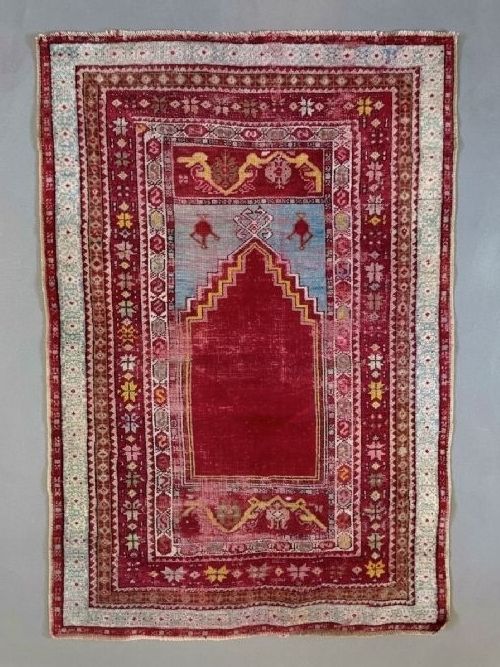
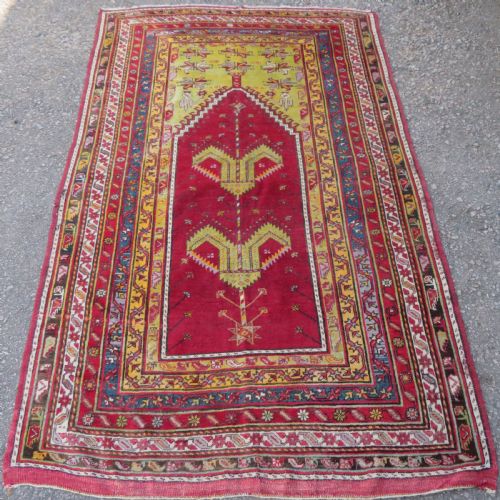
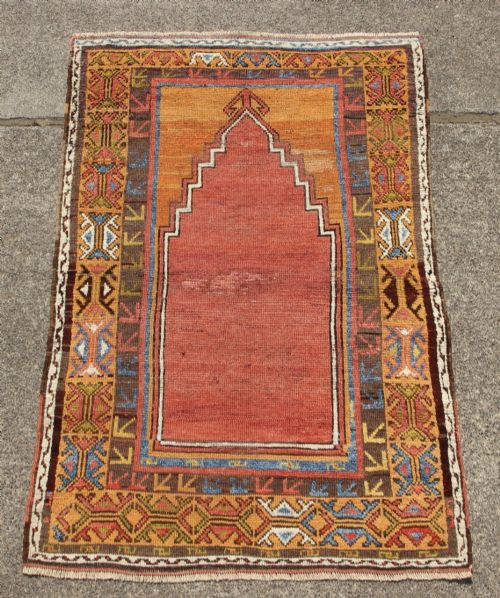
A red turkish prayer rug serves as a portable space for ritual devotion, typically defined by a distinct architectural niche or mihrab shape pointing towards Mecca. These floor coverings emerge from regional weaving traditions spanning central and western Anatolia, encompassing village workshops and nomadic camps alike. The examples gathered here range from nineteenth-century village pieces to older examples originating in the eighteenth century.
Most pieces meeting this description display deep madder red grounds, often contrasted with secondary tones of ivory, blue, or yellow within the borders and spandrels. Regional attribution reveals specific design vocabularies, from the column motifs of Ladik pieces to the floral geometries found in Kirsehir and Konya weaving. Buyers encounter formats suited for smaller domestic spaces, combining practical utility with centuries of traditional symbolism.
Materials and construction methods
The foundation of these textiles relies on sturdy wool or cotton warps and wefts, upon which weavers knotted dense pile using hand-spun wool or occasional silk. Artisans sourced colouring agents from natural dyes and vegetable extracts, achieving rich tones that developed subtle abrash variations over decades of exposure and use.
Weaving techniques varied by locale, employing symmetric or asymmetric knots tied tightly across vertical looms. Village makers incorporated local materials directly from their flocks, ensuring each rug maintained structural integrity alongside its decorative character.
Some weavers cleverly integrated tiny comb motifs into the pile, wishing for tidy wool and orderly households.
Distinctions in weaving standard
Quality in these textiles rests upon the precision of the knotting, the saturation and depth of the natural dyes, and the clarity of the mihrab design. Superior examples exhibit balanced proportions within the border systems and maintain a supple handle despite dense packing.
Condition and age further influence the standing of individual pieces, where minimal pile loss and intact original selvedges preserve the maker's original intent. The handled warmth of the wool and the harmonious ageing of vegetable colours distinguish finer historical production from standard regional work.
Tuduc
The Red Turkish Prayer Rug Glossary
- Mihrab
- The arched architectural niche depicted on a prayer rug, symbolising the direction of prayer towards Mecca. Its apex is oriented toward the user during ritual practice.
- Abrash
- A visible tonal variation within a single colour field, caused by changes in dye batches or hand-spun wool characteristics over time. This natural occurrence confirms traditional dyeing methods.
- Spandrel
- The triangular spaces situated directly above the arched mihrab on a prayer rug. Weavers frequently fill these areas with floral motifs or geometric symbols.
- Warp
- The vertical foundation threads stretched tightly on the loom before knotting begins. Weft threads are subsequently passed horizontally between them to secure the pile.
- Saf
- A multi-niche prayer rug featuring a horizontal series of arches designed for multiple worshippers to use simultaneously. These expansive formats are exceptionally uncommon.
Red Turkish Prayer Rug: Frequently Asked Questions
How do I identify a prayer rug?
A prayer rug is immediately distinguished by the architectural arch, known as the mihrab, woven into one end of the field to direct the user's focus. Additional indicators include compact dimensions intended for individual placement and symbolic motifs positioned within the spandrels.
These textiles were created specifically for personal devotion rather than general floor covering. Their portable nature meant they were rolled up and stored between daily prayer times.
Where were these rugs made?
These pieces originate primarily from Anatolia, encompassing historic weaving centres such as Konya, Kirsehir, Ladik, Ghiordes, and Milas. Each region developed distinct colour palettes and geometric or floral vocabularies that help pinpoint their geographical source.
Village weavers and nomadic groups in these areas adapted traditional local patterns across generations. The resulting diversity reflects the rich cultural tapestry of Western and Central Turkey.
How should I care for an antique rug?
Preserving an antique textile requires gentle maintenance, starting with regular low-suction vacuuming without a rotating brush roll. Keeping the piece out of direct sunlight prevents the natural vegetable dyes from fading prematurely.
Professional cleaning tailored to antique wool and silk should be utilised sparingly. Allowing the rug to breathe and using a quality breathable underlay protects the foundation fibres from unnecessary wear.
How do I date an old rug?
Dating relies on analysing structural traits, such as wool characteristics, hand-spun consistency, and the composition of natural dyes. Stylistic evolution in the mihrab design and border motifs also provides reliable chronological markers for the eighteenth and nineteenth centuries.
Comparing knot counts and weave tightness against known regional exemplars helps narrow down the period of production. Subtle irregularities often point towards traditional village hands rather than later commercial output.