


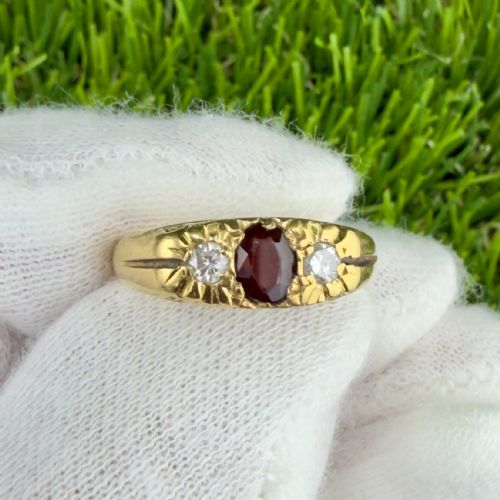


Red Garnet Ring
A red garnet ring brings deep crimson fire to the hand, drawing on centuries of goldsmithing from Georgian clusters to mid-century modern designs.
Red Garnet Ring
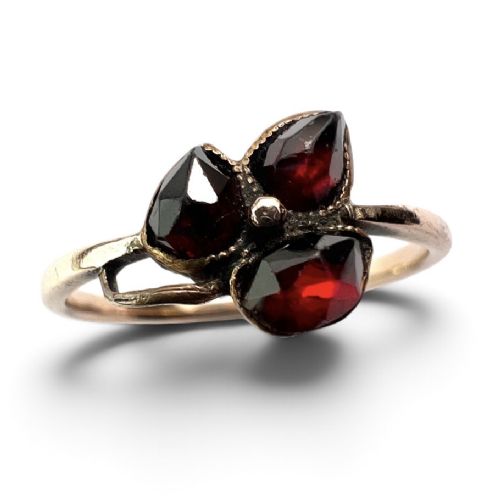
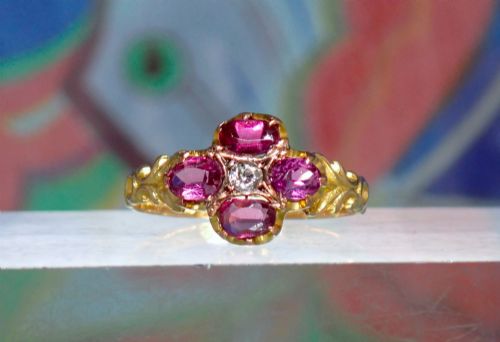
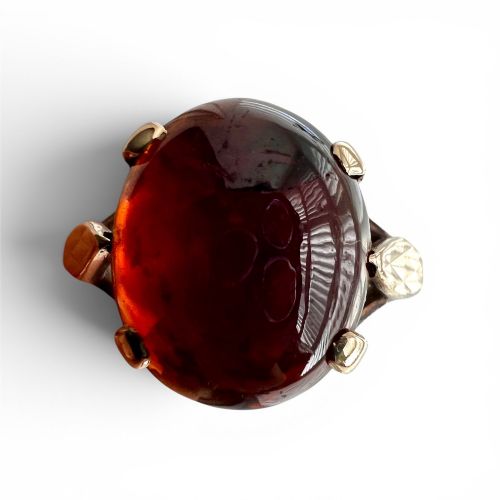
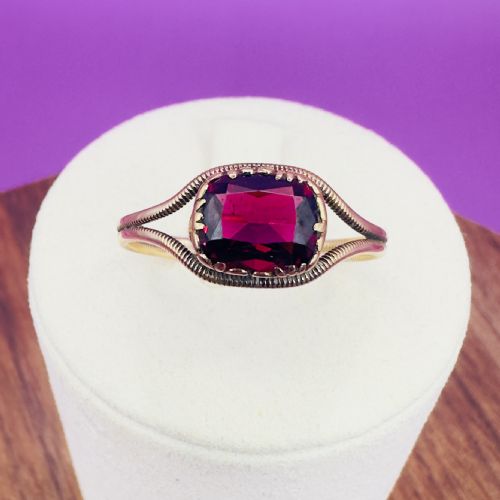
A red garnet ring is a finger ornament set with the rich red gemstone, appearing in styles spanning from the Georgian and Victorian eras through the Edwardian period to the 1940s and 1960s. The listings here show these rings configured as solitary stones, floral clusters, trefoil arrangements, and trilogy settings.
The versions most commonly met on this page range from Victorian and Edwardian cluster designs to mid-century gold pieces. These span across multiple decades of jewellery production, showing how jewellers repeatedly turned to the deep red stones for everyday wear and formal dress alike.
How they were made
Makers set garnets into gold of varying purities, including 9ct, 15ct, and 18ct yellow and white gold, alongside platinum. Stones were cut by hand in older eras using old mine cuts or cabochon shapes, whilst later pieces incorporated structured cluster arrangements alongside diamonds and seed pearls.
Techniques relied on secure bezel or prong settings to hold the deep red stones firmly within the metalwork. Jewellers often framed the central garnet with diamonds or pearls to accentuate the dark red hue.
One vintage ring secretly houses an emerald paste alongside diamonds, proving that past owners loved a colourful surprise just as much as we do.
What varies in quality
Quality rests upon the depth of the stone's colour and the precision of the metalwork surrounding it. Fine examples display rich almandine tones paired with high-grade gold or platinum mounts that show crisp detail in floral and cluster motifs.
Heavier gold weights and the inclusion of supporting diamonds or seed pearls distinguish finer dress rings from simpler, lighter settings. The integrity of the stone's surface polish and the secure retention of the gems mark the distinction between ordinary and exceptional pieces.
The Red Garnet Ring Glossary
- Almandine Garnet
- A dark red variety of garnet rich in iron and aluminium. It provides the deep crimson hues seen in many antique cluster rings.
- Cabochon
- A gemstone cut with a smooth, rounded, convex upper surface rather than faceted edges. This style highlights the natural depth of the stone.
- Old Mine Cut
- An early diamond or gemstone cut featuring a square shape with rounded corners, a high crown, and a small table. It is typical of Georgian and Victorian pieces.
- Seed Pearl
- A very small natural or cultured pearl, often used in historic jewellery to create delicate floral borders around central gemstones.
- Trilogy Ring
- A ring set with three stones arranged in a row, traditionally symbolising the past, present, and future.
Red Garnet Ring: Frequently Asked Questions
How do I date a red garnet ring?
Dating depends upon the metal purity marks, the cutting style of the gemstones, and the overall structural motif of the setting. Georgian and Victorian pieces often utilise closed-back settings or hand-cut stones, whereas mid-century examples show different mounting techniques.
Examining the shank and any hallmarking helps place the ring within periods such as the Edwardian era or the 1940s.
What is an almandine garnet?
Almandine is a specific species of garnet known for its deep red, sometimes purplish-red colour. It was widely utilised by Victorian and Edwardian jewellers due to its striking saturation.
Its rich tone contrasts effectively against yellow gold and bright diamond accents.
Why are pearls often paired with garnets?
Victorian and Edwardian designers frequently paired small seed pearls with red garnets to create floral and cluster motifs. The luminous white of the pearls complements the deep crimson of the central stone.
This stylistic combination was characteristic of high-period craftsmanship and symbolic jewellery design.