

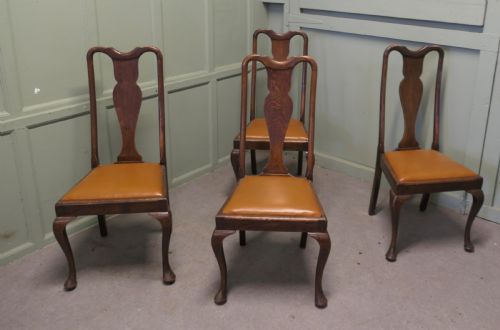
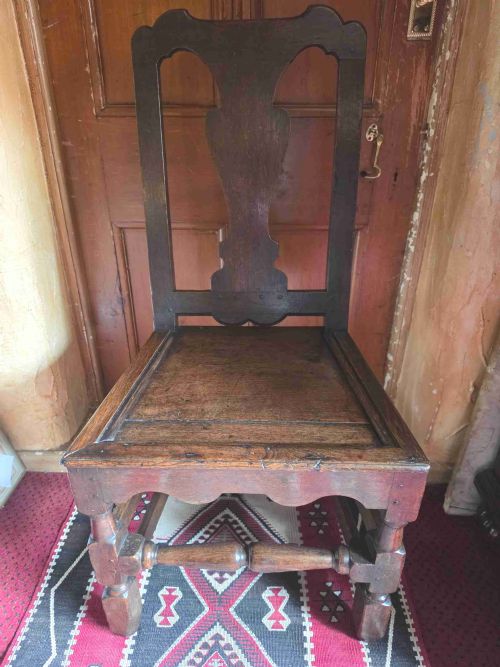


Queen Anne Oak Chairs
Queen anne oak chairs bring substantial timber forms and curved lines into a room, combining early Georgian restraint with domestic utility.
Queen Anne Oak Chairs
When you search for queen anne oak chairs, you encounter seating spanning the early eighteenth century alongside later revival periods from the nineteenth and twentieth centuries. The form encompasses dining chairs, side chairs, armchairs, high back chairs, and wingchairs.
The selection here ranges from authentic period pieces dated around seventeen hundred to Edwardian and Victorian revivals. Many items appear as matched sets or pairs, constructed primarily in solid oak with occasional elm or walnut additions.
Materials and Construction
Makers utilised solid oak alongside secondary timbers such as elm, shaping frames through traditional joinery techniques. Surfaces often display natural grain, though historical examples occasionally reveal japanned finishes or carved decoration.
Upholstered variants incorporate materials like leather, fabric, calico, hessian, and textile, secured with brass detailing or traditional webbing. Carver chairs and armchairs integrate curved wooden supports alongside these textile elements.
Listings incorporate items dated from the seventeenth century through the Edwardian era, utilising oak alongside elm, walnut, leather, and brass.
Evaluating Quality and Period
Distinction between pieces rests upon the integrity of the timber, the depth of historical age, and the precision of the carving. Original period examples from the early eighteenth century carry greater scarcity than later revival interpretations.
The harmony of matched sets and the condition of original upholstery elements influence the character of each piece. Construction heft and timber selection differentiate provincial country workshops from urban production.
The Queen Anne Oak Chairs Glossary
- Queen Anne Style
- A design movement characterised by curved lines, spooned backs, and cabriole legs, originating in the early eighteenth century and frequently revived later.
- Carver Chair
- An armchair designed to match a set of dining chairs, typically positioned at the head of a table.
- High Back Chair
- A seating form featuring an extended vertical backrest, common in early eighteenth-century designs.
- Japanned
- A European imitation of East Asian lacquerwork, applied as a decorative surface finish on historical furniture.
- Wingchair
- An upholstered armchair with side panels designed to shield the occupant from draughts.
Queen Anne Oak Chairs: Frequently Asked Questions
How do I date an oak chair?
Dating relies on timber wear, construction methods, and stylistic indicators. Early eighteenth-century examples display hand-tooled joints and period specific proportions.
Revival pieces from the Victorian and Edwardian eras often show machine processing and standardised dimensions despite adopting older aesthetic forms.
Are these chairs comfortable for daily use?
Most dining chairs and side chairs provide upright support suited to formal seating. High back variations and armchairs offer different ergonomic experiences depending on the frame geometry.
Upholstered versions with leather or fabric pads add cushioning, though historical padding may require careful handling during routine seating.
What is the difference between revival and period pieces?
Period pieces originate from the historical era of production around the seventeen hundreds. They carry the marks of contemporary tool use and natural ageing.
Revival pieces date from later centuries, such as the Victorian or Edwardian periods, recreating earlier aesthetic conventions using the manufacturing standards of their own time.
How do I care for antique oak furniture?
Maintenance involves keeping timber away from direct heat sources and sudden humidity shifts. Regular dusting with a dry cloth preserves the polished surface.
Applying specialised wax sparingly helps maintain the condition of the oak without building up heavy residues over time.