


Qing Dynasty Hall Table
These qing dynasty hall table examples bring functional historic form to an interior, built in timber to serve ceremonial or domestic rooms.
Qing Dynasty Hall Table
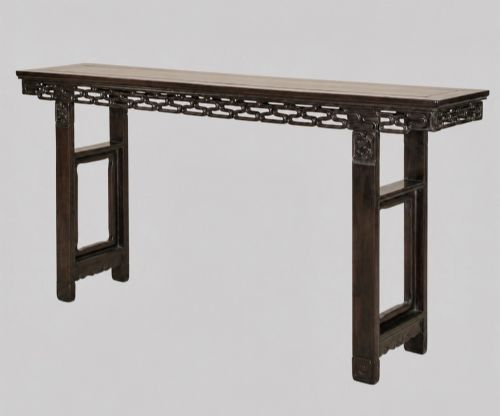
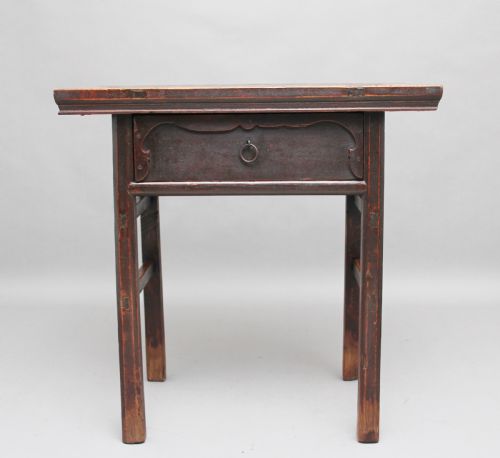
When you search for qing dynasty hall table, you encounter console tables, altar tables, side tables, and writing desks originating across the nineteenth and early twentieth centuries. These forms served various functional and ritual purposes within traditional settings, adapted for modern placement as display or surface furniture.
You are most likely to meet elm and hardwood examples from the nineteenth century on this page, often built as long console tables or altar tables. Elm pieces tend to present simpler provincial lines, whereas dense hardwoods carry the carved ornament associated with the Qing period.
The selection ranges from narrow altar tables designed to stand against walls to demi-lune console tables and occasional side tables. Each variant displays specific proportions suited to its original placement in a hall or reception space.
Judging quality in the range
The distinction between pieces rests upon the crispness of the carved detail and the density of the chosen timber. Hardwoods like hongmu and rosewood allow for sharper, deeper relief carving than softer timbers like elm.
Proportion and the integrity of the original surface finish dictate the standing of an individual table. Examples that retain their historic lacquer or polished hardwood patination show greater visual cohesion than those altered by later stripping.
Some demi-lune tables are discovered living double lives as solo wall units, unaware they are actually half of an estranged circular couple.
The Qing Dynasty Hall Table Glossary
- Altar table
- A tall, narrow table traditionally placed against a wall for ceremonial displays or ancestral tablets. These pieces feature elongated proportions and often upturned flange ends.
- Console table
- A table designed to stand against a wall, frequently supported by two legs rather than four. Demi-lune versions have a half-moon shape suited to tighter spaces.
- Hongmu
- A translation meaning red wood, used to describe dense tropical hardwoods prized for dark colour and heavy weight. Furniture built from this material holds fine carved detail.
- Elm
- A domestic timber utilised widely in Chinese provincial furniture for its tough, interlocking grain. It accepts simple forms and develops a rich patina over time.
- Demi-lune
- A half-circle form applied to tables designed to sit flush against a wall. Pairs of these tables can be joined to form a single circular centre table.
Qing Dynasty Hall Table: Frequently Asked Questions
Where should I place a hall table?
These tables suit narrow circulation spaces like entrance halls, corridors, and landings where surface area is required without blocking movement.
Their shallow depth allows them to sit flat against walls while providing a platform for lamps, ceramics, or decorative objects.
How do I care for hardwood furniture?
Maintain the timber by keeping pieces away from direct heat sources and sudden humidity shifts that cause wood to split.
Dust with a dry cloth and avoid harsh chemical polishes that can degrade the historic surface finish over time.
What is the difference between elm and hongmu?
Elm is a lighter, domestic timber typically found on provincial tables with simpler lines and visible grain patterns. Hongmu is a heavy, dense tropical hardwood capable of holding intricate, deep-relief carvings.
Both materials were utilised during the Qing dynasty but served different aesthetic and structural requirements.
Can these tables be used as desks?
Certain forms within this category, such as writing desks and wider console tables, offer adequate knee clearance and surface depth for working.
Checking the height and drawer configuration ensures the piece functions practically for daily use.