



Putti Candelabra
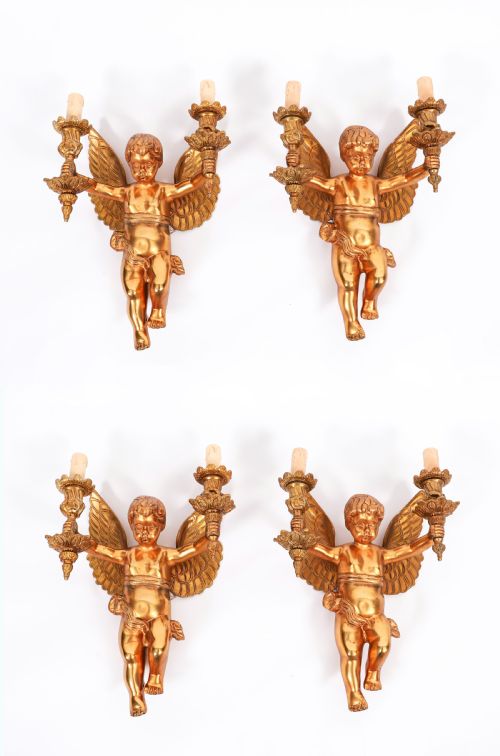
Putti candelabra bring sculptural figures of winged infants together with functional branch lighting, originating chiefly in nineteenth-century French and Italian workshops.
Putti Candelabra
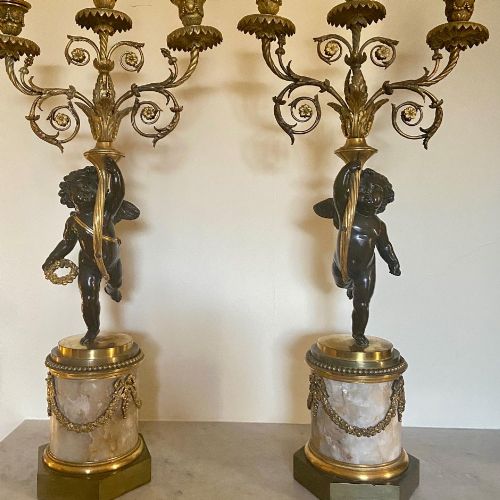
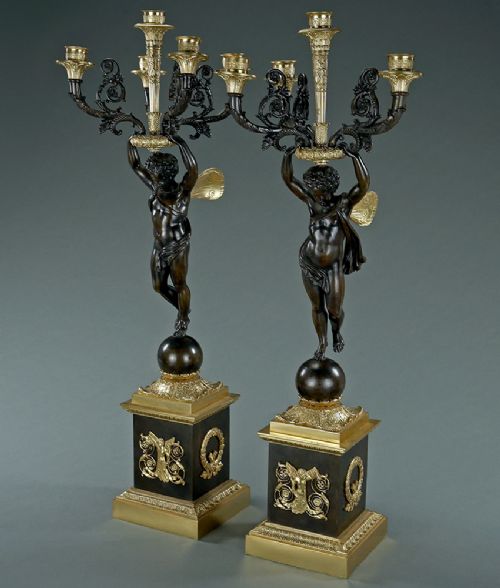
Putti candelabra combine figural bronze or porcelain sculpture with multi-branch candle holders, often appearing as matched pairs designed to anchor a mantelpiece or sideboard. When searching for putti candelabra, a buyer encounters predominantly nineteenth-century French productions, spanning styles from Rococo Revival to Louis XVI and Second Empire.
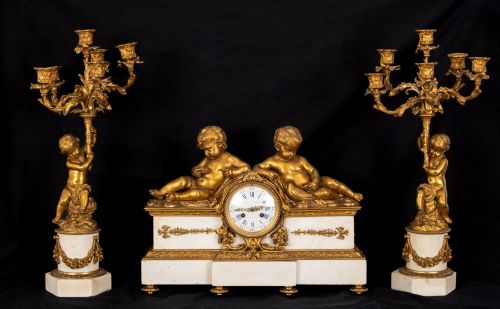
The sculptural elements depict winged cherubs or cupids supporting candle arms, occasionally forming part of larger clock garnitures alongside matching mantel clocks. These pieces frequently incorporate sturdy bases of white marble or porphyry to support the weight of the metal branches above.
How they were made
Foundries produced these works using traditional casting methods for bronze, brass, and spelter, often finishing the metal surfaces with fire-gilding known as ormolu or applying dark patination. Artisans combined these cast metal figures with carved white marble bases, enamel details, and porcelain components sourced from factories like Meissen.
Complex pieces required assembling numerous separate cast elements, from the individual arms of the candelabra to the detailed wings and garlands draping the putti figures. Gilders and bronziers then chased the surfaces by hand to create textural contrasts between polished highlights and matte areas.
Bronze putti appear perpetually busy, wrestling with heavy candle branches or plotting mischief from atop cold marble.
What varies in quality
The crispness of the bronze chasing and the depth of the ormolu gilding separate finer workshops from mass-market production. Superior examples display sharply defined facial expressions and feather details on the putti, whereas lesser pieces show soft edges from worn moulds.
The choice of base materials also indicates tier, with dense white marble or porphyry supporting high-end bronzes, while simpler iterations utilise lighter metals or standard patinated spelter.
Francois Redmond·Claude Clodion·Meissen
The Putti Candelabra Glossary
- Putto
- A plump, naked male child figure, frequently winged, derived from classical art and commonly seen supporting candelabra branches. These figures form the central sculptural motif of the category.
- Ormolu
- Finely ground high-carat gold applied to a bronze base through a mercury amalgamation process, yielding a rich golden finish. This technique defines high-end French decorative metalwork.
- Garniture
- A set of matching decorative objects, typically comprising a central mantel clock flanked by two matching candelabra or vases. These sets created a balanced arrangement for nineteenth-century interiors.
- Spelter
- A zinc-based alloy utilised as a less expensive alternative to bronze for sculptural castings. It often received a bronze-coloured finish to mimic more costly metals.
Putti Candelabra: Frequently Asked Questions
Were these candelabra converted to electricity?
Many nineteenth-century examples underwent conversion into table lamps during later periods to suit modern interior lighting needs. Buyers frequently find pieces retaining original candle sockets alongside those adapted for wiring.
Inspect the candle nozzles and central columns to determine whether wiring passes through original apertures without altering the antique bronze structure.
What is a clock garniture set?
A clock garniture pairs a central mantel clock with matching side pieces such as candelabra or vases. These matched sets provided a unified decorative scheme for nineteenth-century drawing rooms.
The side candelabra typically mirror the sculptural motifs and materials of the central clock case.
How do I distinguish Louis XVI style from Rococo Revival?
Louis XVI style pieces feature symmetrical designs, straight lines, classical urns, and architectural restraint. They reflect the neoclassical revival popular during the nineteenth century.
Rococo Revival works embrace asymmetrical curves, C-scrolls, naturalistic foliage, and exuberant movement. These fluid forms draw inspiration from earlier eighteenth-century French designs.