


Marble Gilt Candelabra
These marble gilt candelabra combine cool stone and warm metal to anchor a mantelpiece or side table with classical symmetry.
Marble Gilt Candelabra
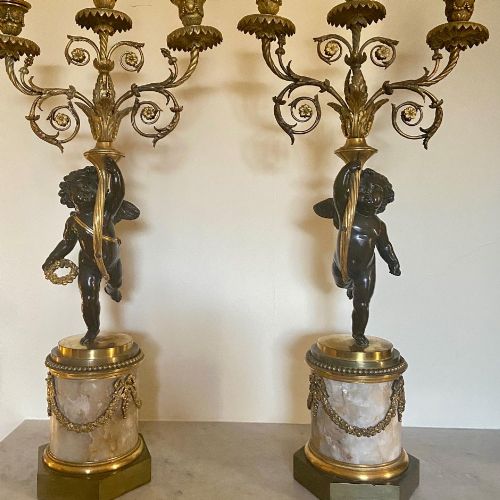
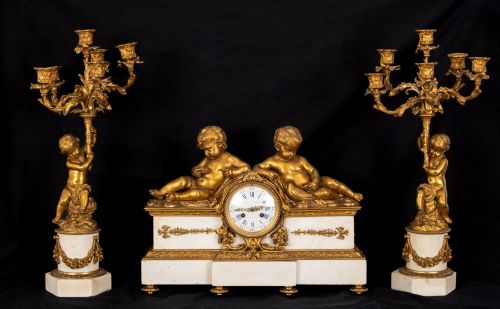
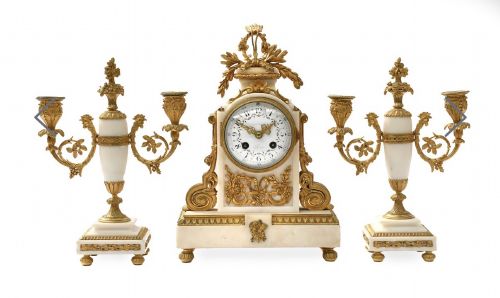
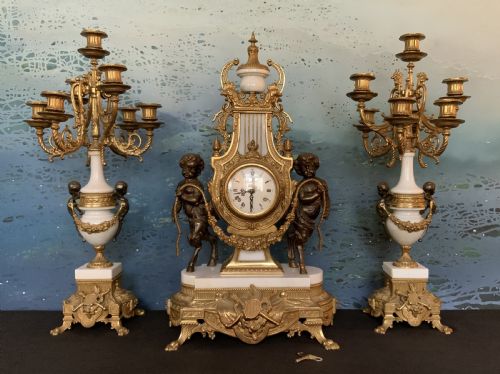
When you search for marble gilt candelabra, you are looking at nineteenth-century decorative lighting and mantel furniture designed to reflect classical revival tastes. The pieces on this page appear predominantly as pairs of candelabras or as central components of three-piece clock garniture sets.
Most examples originate from French workshops adhering to Louis XVI and Second Empire styles, combining architectural stone bases with branched metal holders. They incorporate figurative elements such as putti, cherubs, and maidens alongside traditional foliate motifs.
How they were made
The construction relies on the union of turned or carved stone bodies with cast metal mounts. Makers utilised white marble, patinated bronze, and ormolu, applying mercury gilding or modern electroplating techniques to achieve the characteristic golden finish.
Individual arms, drip pans, and figurative elements were cast via the lost-wax or sand-casting methods, then chased by hand to sharpen details before being pinned or screwed into the heavy stone bases.
White marble and ormolu dominate the material record, though several pieces incorporate patinated bronze and porphyry bases.
What varies in quality
Quality rests in the crispness of the metal chasing and the density of the stone. Superior pieces display deeply carved or cast figures with expressive faces and clean drapery, whereas lesser versions rely on shallow, soft casting.
The integrity of the marble matters significantly, with top-tier examples showing uniform colour, precise turning, and heavy brass or bronze mounts that fit flush against the stone without visible gaps or excessive adhesive.
Francois Redmond·H Luppens Paris·Claude Clodion
The Marble Gilt Candelabra Glossary
- Ormolu
- Gilded bronze produced by applying a mercury-gold amalgam to a bronze base and heating it until the mercury vaporised. This historic technique leaves a rich, matte golden surface that resists tarnishing.
- Garniture
- A set of matching decorative objects, typically a central clock flanked by two matching candelabras or urns. These sets were designed to sit harmoniously across a mantelpiece.
- Putti
- Depictions of chubby male infants, frequently winged, used widely as sculptural supports in classical and revival decorative arts. They often appear holding candle nozzles or balancing branches.
- Patinated bronze
- Bronze that has been treated with chemical solutions to alter its surface colour to brown, green, or near-black. This dark finish provides a visual contrast against bright ormolu mounts and white marble.
Marble Gilt Candelabra: Frequently Asked Questions
How do I clean antique gilt bronze?
Clean gilt bronze gently with a soft, dry microfibre cloth to remove dust. Avoid chemical dips, abrasive polishes, or water, as these can strip the historic ormolu surface.
For stubborn grime in recessed areas, use a soft natural-bristle brush without pressure. Preserving the original surface patina maintains the historical integrity of the piece.
Were these candelabra wired for electricity?
Original nineteenth-century candelabra were manufactured exclusively for wax candles. Many surviving pairs were subsequently converted into electric lamps during the twentieth century by running cords through the central column.
When evaluating a set, check whether the original candle drip pans remain unaltered. Unconverted examples retain their historic function and original components.
How do I spot a clock garniture set?
A clock garniture set pairs a large mantel clock with two matching side pieces, such as candelabras or urns. They share identical materials, styles, and decorative motifs like cherubs or scrolling foliage.
Matching sets were created together to unify the decor of a room. Finding a complete, undamaged set from the nineteenth century is increasingly uncommon.
What is the difference between Louis XVI and Empire styles?
Louis XVI style pieces emphasise delicate neoclassical restraint, featuring slender fluted columns, ribbons, and playful putti. The forms lean towards lightness and classical symmetry.
Empire style items, by contrast, draw on heavier Roman and Egyptian military motifs with robust patinated bronzes and imposing architectural proportions. Both styles frequently utilised marble and gilt mounts.