


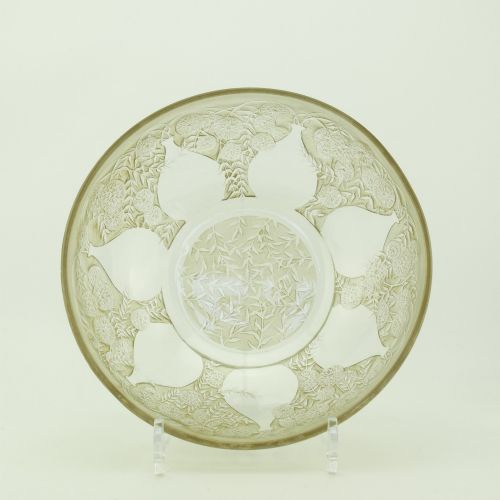


Pressed Glass Dish
These pressed glass dish examples bring tactile period texture to a room, shifting light across opalescent and frosted surfaces.
Pressed Glass Dish
A pressed glass dish encompasses decorative bowls, plates, and tazzas originating from the Victorian, Edwardian, 1920, and 1930 periods. You will regularly encounter French Art Deco creations alongside English Victorian pressings as you browse these forms.
The selection ranges from footed bowls and charger plates to cake stands and sweetmeat dishes. Makers such as René Lalique, G Vallon, Jobling, Etling, Davidson, and Sabino dominate the forms seen here.
Assessing quality in pressed glass
The crispness of the moulded relief dictates visual strength, where sharper botanical or animal motifs show greater fidelity to the original design. Depth in the opalescence, particularly the milky blue fire within the glass, separates standard pressings from superior examples.
Signatures, registered numbers, or factory ciphers etched into the base provide clear attribution, while the weight and clarity of the glass itself reveal the standard of the batch.
Pressed Glass Dish Retail Price Guide 2026
Typical asking prices for pressed glass dish among the pieces listed under this phrase on Sellingantiques today, from the lower quarter to the upper quarter. They describe what is for sale here now, not the wider market.
Dogs chase hares across nineteenth-century plates, while stylized cherries and fish populate the later Art Deco bowls.
Rene Lalique·G Vallon·Jobling·Etling·Davidson·Sabino
The Pressed Glass Dish Glossary
- Opalescent Glass
- Glass containing agents that cause it to appear milky white with blue or amber highlights when lit from the front. This effect shifts depending on the angle of view and the background illumination.
- Tazza
- A shallow ornamental bowl raised upon a stem and foot, used historically for serving small items. The form appears in Victorian pressings and Art Deco glass.
- Sepia Stain
- A brownish pigment applied to the recesses of moulded glass designs to create contrast and depth. It highlights details such as foliage or animals against a frosted ground.
- Pearline
- A trade name used by Davidson for patent pressed glassware exhibiting shaded colour effects, often seen in blue during the Victorian era.
- Moulded Glass
- Glass shaped by being pressed into a metal or wooden matrix rather than blown freehand. This technique allowed intricate decorative patterns to be produced in commercial quantities.
Pressed Glass Dish: Frequently Asked Questions
How do I identify a Lalique piece?
Look for crisp moulding and characteristic opalescence that glows blue in transmitted light. Signatures are typically etched or moulded into the base.
Check for the specific model names and catalogue numbers recorded across the period production.
How should I display these dishes?
Place them where natural light can pass through the body to activate the opalescent or frosted qualities. Open shelving near a window allows the blue and amber tones to show properly.
Ensure the support is stable, particularly for footed bowls and tazzas.
Are all these items French?
The selection includes significant French Art Deco output alongside English Victorian and Edwardian examples. Makers from France, such as Lalique, Sabino, and Etling, sit alongside English factories like Jobling and Davidson.
Each region utilises distinct stylistic markers tied to its decade of manufacture.