



Porcelain Mantel Garniture
Porcelain mantel garniture sets bring symmetry and colour to a room, pairing a central clock or urn with matching side vases.
Porcelain Mantel Garniture
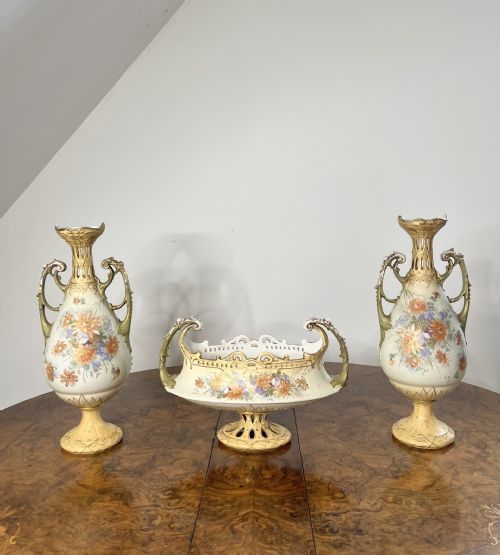
A porcelain mantel garniture typically comprises a central clock or large centrepiece accompanied by two or more matching side vases or urns, designed to sit together on a fireplace mantel or shelf. The selection includes French Rococo Revival clock sets, Sevres style pieces mounted in ormolu, and large vases originating from the nineteenth century.
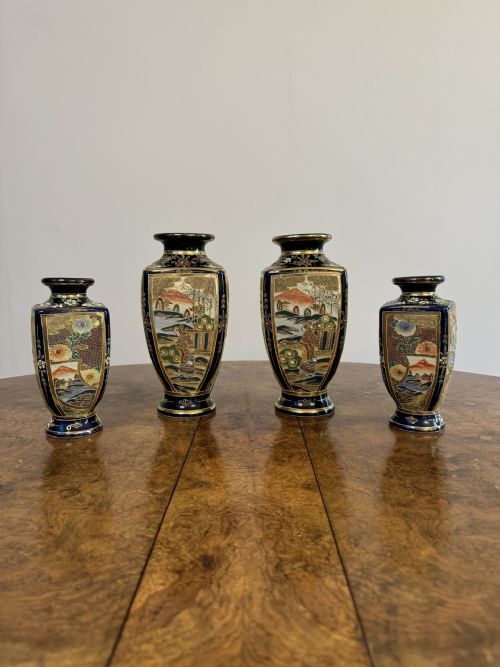
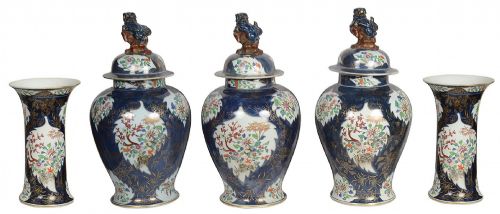
The version most commonly met on this page is the nineteenth-century French clock garniture, combining painted porcelain panels with gilt bronze or ormolu mounts. Alongside these European works, the listings feature Japanese Satsuma and Imari vases grouped as sets, as well as English porcelain from factories such as Worcester, Minton, and Mason's.
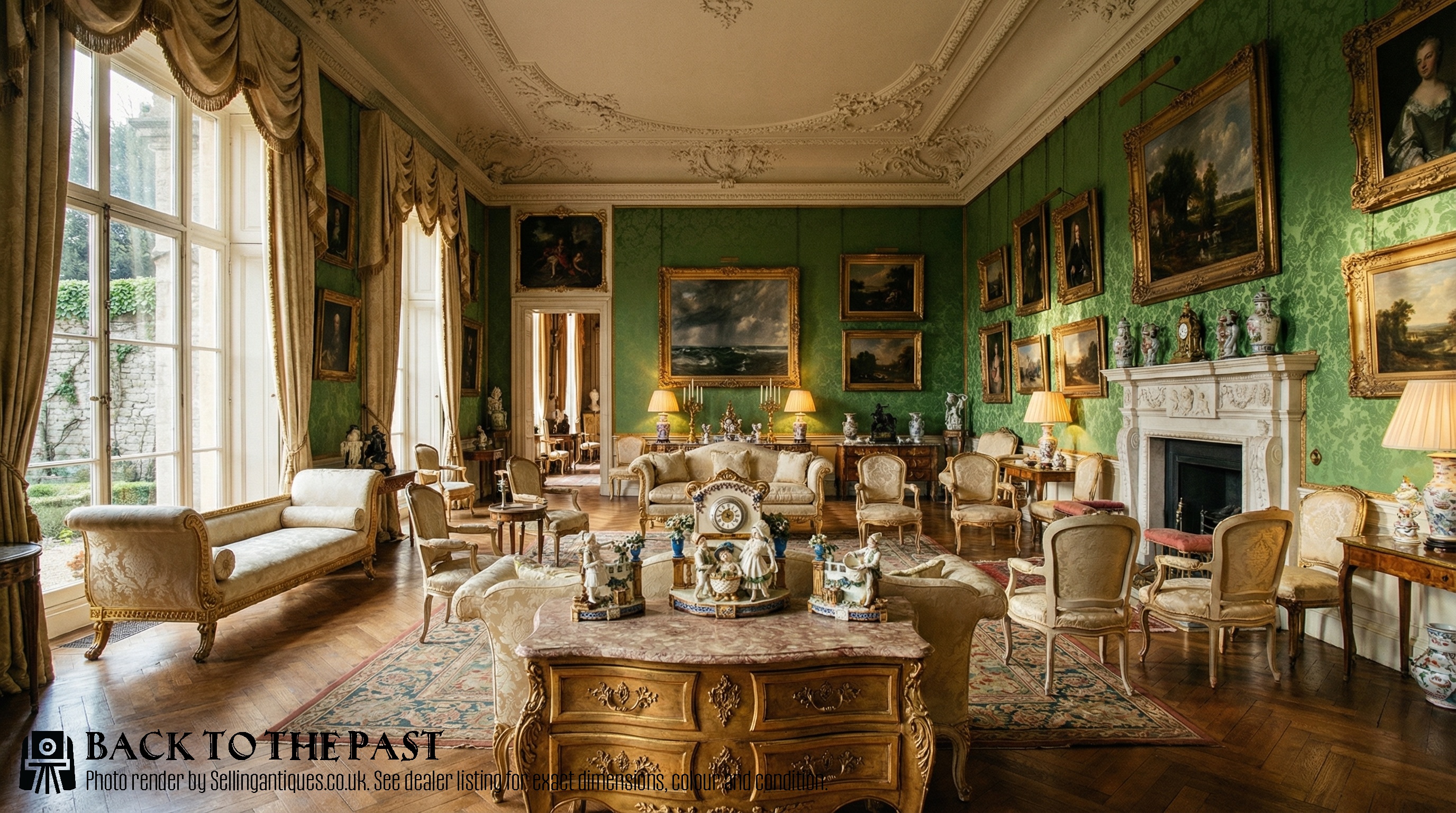
These matched arrangements were created to decorate drawing rooms and salons, providing a balanced visual anchor for the chimney breast. The pieces rely on shared motifs, colour palettes, and framing to maintain visual harmony across the set.
How they were made
The foundation of these objects is hard-paste or soft-paste porcelain, shaped by throwing, moulding, or casting, then hand-painted with enamels and gilding before being fired in a kiln. Many bodies incorporate cobalt blue grounds, such as bleu de roi or bleu celeste, serving as a rich field for reserved painted panels depicting landscapes, figures, or floral sprays.
Metalwork mounts in ormolu, gilt bronze, and gilt metal were cast separately and hand-chased to frame the porcelain bodies, providing structural support and decorative handles, bases, or bezels. Glass domes frequently accompany the French clock sets to protect the delicate gilding and mechanism from dust and atmospheric tarnishing.
Several clock sets come preserved under original glass domes, keeping Victorian dust firmly at bay for over a century.
What varies in quality
The standard of a porcelain mantel garniture is determined by the crispness of the bronze casting and the depth of the hand-chasing in the ormolu mounts. Superior examples exhibit finely detailed floral or scrollwork mounts that fit the porcelain contours precisely, rather than generic commercial castings.
Painting execution defines the upper tier of the range, distinguishing spontaneous brushwork and subtle tonal shading in ceramic decoration from mechanical transfer printing. The quality of the porcelain body itself, alongside the richness and burnishing of the gold leaf application, marks the difference between standard production pieces and masterworks.
Flight Barr and Barr·KPM Berlin·Meissen·Minton·Royal Vienna·Sevres·Vincenti of Paris
The Porcelain Mantel Garniture Glossary
- Garniture
- A matched set of ornamental vessels or a clock accompanied by side vases, designed to be displayed together on a mantelpiece.
- Ormolu
- Gilt bronze created by applying a mixture of mercury and gold to a bronze object and heating it until the mercury evaporates, leaving a durable golden coating.
- Bleu de Roi
- A deep, rich cobalt blue ceramic ground colour developed at the Sevres factory and widely adopted across nineteenth-century European porcelain.
- Imari
- Japanese export porcelain decorated in underglaze blue, iron red, and gold, named after the port from which the wares were shipped.
- Lyre Clock
- A mantel clock featuring a case shaped like the musical instrument, often executed in porcelain with ormolu mounts and glass pendulum viewports.
Porcelain Mantel Garniture: Frequently Asked Questions
What is a porcelain mantel garniture?
A porcelain mantel garniture is a matching set of decorative objects, typically consisting of a central clock flanked by two matching vases or urns, created for display on a mantelpiece.
The arrangement provides decorative symmetry and unified artistic themes, often featuring hand-painted ceramic panels framed by gilt metal mounts.
How were garniture sets used?
These sets were placed on fireplace mantels in formal reception rooms and parlours during the nineteenth century to project refinement and taste.
The central clock kept time while the flanking vases or urns balanced the visual weight of the chimney breast and completed the decorative scheme.
How do I care for a clock set?
Keep the set away from direct sunlight and extreme temperature fluctuations to protect the painted porcelain surfaces and prevent the gilding from degrading.
Dust the ormolu mounts gently with a soft, dry brush and avoid using chemical cleaning agents on the ceramic body or metal fittings.
How can I tell periods apart?
Earlier pieces from the Regency period often display classical revival forms and refined neo-classical motifs, while late nineteenth-century sets frequently embrace busier Rococo Revival or Sevres styles.
Examining the manufacturing marks on the base of the porcelain and the style of the metal casting helps narrow down the decade of production.