
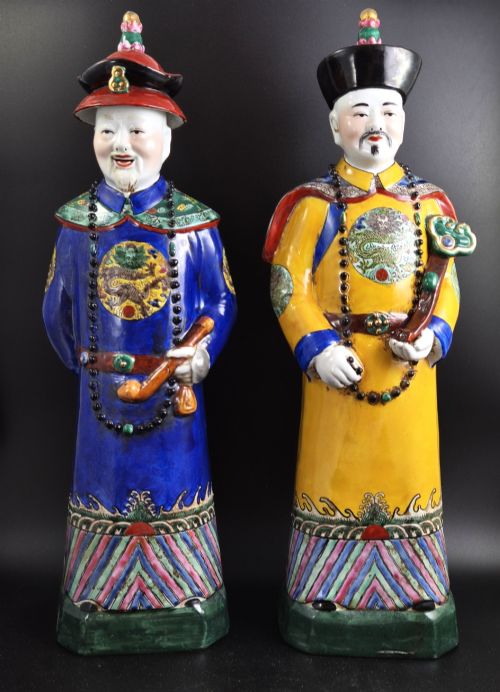


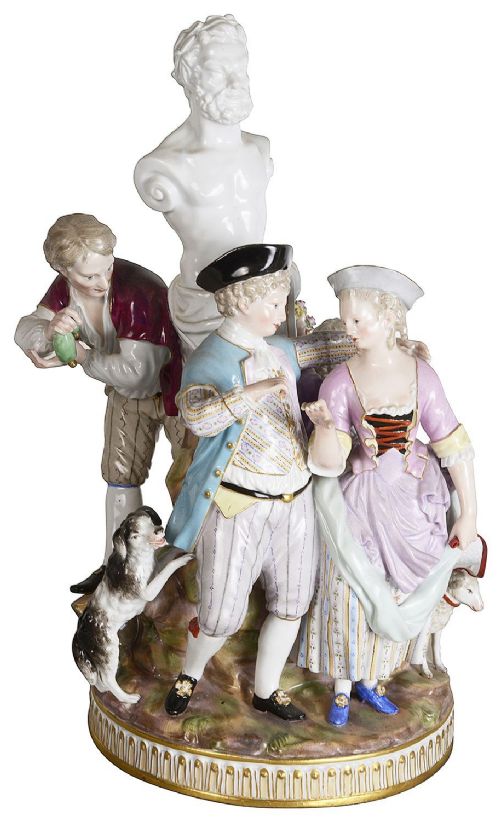
Porcelain Court Figures
Porcelain court figures bring the theatrical elegance of elite interiors into a room through finely modelled ceramic bodies and painted detail.
Porcelain Court Figures
When you search for porcelain court figures, you encounter a varied group of decorative objects spanning the eighteenth to the twentieth centuries, originating from European and Asian workshops. These pieces depict aristocratic subjects, romantic companions, and formal personages in elaborate attire.
The versions you meet most frequently on this page include nineteenth-century French pairs, German porcelain groups from factories like Volkstedt and Meissen, and occasional Chinese or Japanese pieces incorporating courtly themes. Forms range from freestanding figurines and sculptural groups to table lamps and vases decorated with enamel scenes.
Makers represented in the listings extend across traditional European ceramic centres and Asian kilns, showing how diverse the interpretation of courtly subjects became over successive periods. Collectors select these works for their sculptural presence and the fidelity of their period dress.
Materials and manufacture
Makers relied on hard-paste porcelain and bisque porcelain, shaped by hand or cast in moulds to achieve crisp facial expressions and intricate drapery. Bisque porcelain provided an unglazed, marble-like matte surface favoured for detailed nineteenth-century figures.
Decoration involved hand-painted enamels, gilding, and applied gold leaf to accentuate the rich garments of the figures. Some pieces incorporated delicate elements such as porcelain lace, formed by dipping real fabric into liquid slip before firing.
Some figures hold tiny harps or play courtly instruments, freezing eighteenth-century musicians in permanent silence.
Assessing quality in the medium
The application of gilding and the integration of secondary elements, such as musical instruments or classical busts, indicate the skill of the workshop. Pieces that retain their original colour saturation and structural integrity command closer attention from collectors.
Bourdois and Bloch Paris·Letu and Mauger Paris·La Coutille Factory·Triebner Ens and Co·Ludwigsburg porcelain
The Porcelain Court Figures Glossary
- Bisque porcelain
- Unfired-looking unglazed porcelain with a matte texture, often used for nineteenth-century figures. This surface highlights fine sculptural detail without the distraction of a glossy finish.
- Hard-paste porcelain
- A durable ceramic composition fired at high temperatures using kaolin and petuntse. It forms the robust body typical of many European and Asian pieces.
- Enamel
- Vitreous coloured decoration applied over the glaze or directly to the ceramic body before firing. It supplies the bright reds, blues, and greens seen on court garments.
- Gilding
- The application of gold leaf or gold powder to highlights on garments and bases. This technique emphasises decorative richness.
- Porcelain lace
- Real textile dipped in liquid porcelain slip and fired until the fabric burns away, leaving a ceramic mesh. It creates convincing ruffs and cuffs on period figures.
Porcelain Court Figures: Frequently Asked Questions
How do I clean porcelain figures?
Dust gently with a soft, dry brush to prevent accumulation in recessed folds and delicate painted areas. Avoid submerging antique pieces in water, particularly those with applied lace or delicate gilding.
For stubborn marks, use a slightly damp cloth with mild soap, testing an inconspicuous area first. Ensure the piece dries completely before returning it to display.
Are these pieces fragile?
Porcelain is inherently brittle, and figures with extended limbs, musical instruments, or lace ruffs require careful handling. Display them away from high-traffic zones and unstable surfaces.
When moving a piece, support it from the base rather than lifting it by projecting arms or delicate accessories.
How do I identify a reproduction?
Examine the base for factory marks, wear patterns, and the consistency of the glaze. Older pieces often show age-related crazing and minor wear on unglazed foot rings.
Compare the painting style and weight of the ceramic body with authenticated examples from the same period and workshop.
Where should I display them?
Place figures in enclosed cabinets or stable shelving where they are protected from accidental knocks and direct sunlight. Adequate lighting helps reveal the fine enamel work and facial expressions.
Keep them away from direct heat sources to protect any adhesives used in historic repairs.