


French Bisque Statues
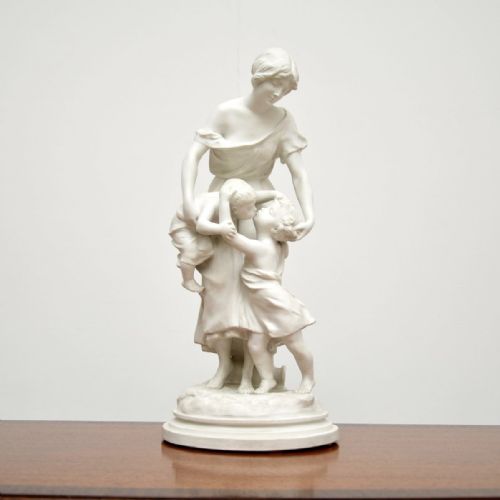
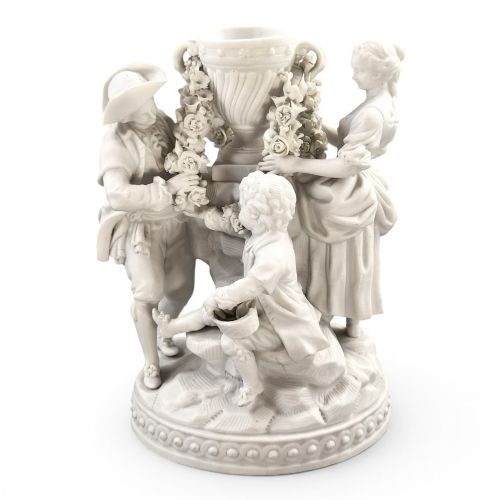
French bisque statues are unglazed porcelain figures and busts embodying neoclassical and rococo revival tastes from the nineteenth century.
French Bisque Statues
French bisque statues encompass nineteenth century porcelain figures, sculptural groups, and portrait busts produced across the Victorian era. These pieces draw heavily on neoclassical and French rococo revival styles, depicting romantic couples, historical figures like Napoleon and Marie Antoinette, and fisher folk.
Most examples originate from Parisian factories and makers active around eighteen fifty to nineteen hundred. The forms range from cabinet figurines to large sculptural groups complete with floral garlands or hand-painted enamel details.
Materials and production methods
These works utilise bisque porcelain and biscuit porcelain, which are fired without a final glaze to produce a matte, marble-like finish. Parian porcelain also appears, offering a fine-grained texture favoured for detailed portrait busts.
Nineteenth century fortune-tellers and eighteenth century courtiers share cabinet space with porcelain sheep.
Factors of quality and execution
The presence of factory marks, factory attribution, or known sculptors elevates an object from a generic decorative piece to a documented work of nineteenth century porcelain art.
Sèvres·Vieux Paris·Letu & Mauger·Luca Madrassi·Vion et Baury·Chantilly
The French Bisque Statues Glossary
- Bisque porcelain
- Unglazed ceramic material fired once to vitrify the body and leave a matte, porous surface resembling marble. It is also known as biscuit porcelain.
- Parian porcelain
- A fine type of biscuit porcelain developed in the nineteenth century specifically for figures and busts. It mimics the appearance of Parian marble.
- Rococo revival
- A nineteenth century design style reviving the asymmetrical curves, scrolls, and ornamentation of the eighteenth century French rococo movement.
- Neoclassical
- A style inspired by the classical art and architecture of ancient Greece and Rome, prioritising symmetry, restraint, and classical drapery.
- Biscuit porcelain
- Alternative term for bisque porcelain denoting unglazed ceramic ware fired to a hard, matte state.
French Bisque Statues: Frequently Asked Questions
What is bisque porcelain?
Bisque porcelain is unglazed ceramic ware that has been fired once to create a matte, porous surface with a texture similar to marble. This finish allows the fine details of sculptural work to remain sharp and unmasked by glossy glaze.
Makers utilised this technique extensively in nineteenth century France for figures, busts, and decorative groups where subtle modelling was paramount.
How do I date these statues?
Dating relies on stylistic markers, factory marks, and the specific material composition used by Parisian workshops during the nineteenth century. Victorian pieces often incorporate romantic subjects and elaborate bases characteristic of the eighteen fifties to eighteen nineties.
Comparing the modelling style to known works from makers such as Vion et Baury or Sèvres helps narrow down the period of production.
Where were these statues made?
The majority of these statues originated in France, particularly around Paris, which served as a major centre for porcelain manufacturing in the nineteenth century. Prominent factories and studios produced both marked and unmarked pieces for domestic and international markets.
Regional workshops and established porcelain houses utilised local sculpting talent to create neoclassical and rococo revival figures.
How should I clean bisque porcelain?
Cleaning unglazed bisque porcelain requires care because the matte surface can absorb dust and oils easily. Dry dusting with a soft brush is generally recommended to preserve the delicate finish without introducing moisture or cleaning agents into the porous ceramic.
Avoid harsh scrubbing or soaking, as these actions can damage hand-painted enamel or gold leaf highlights.