
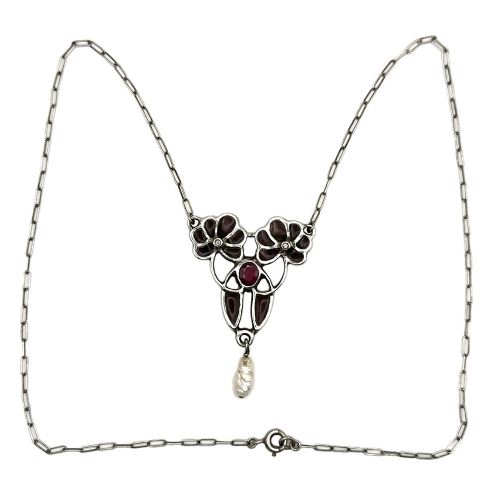
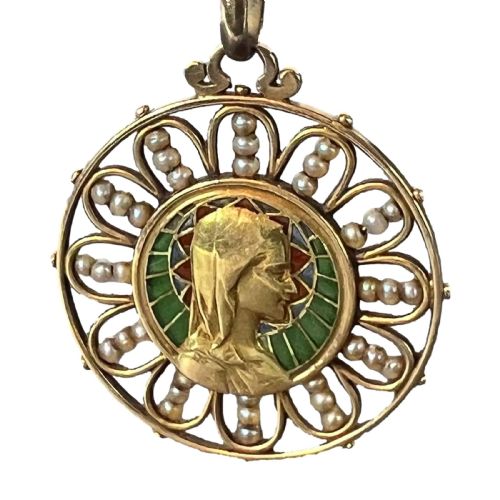


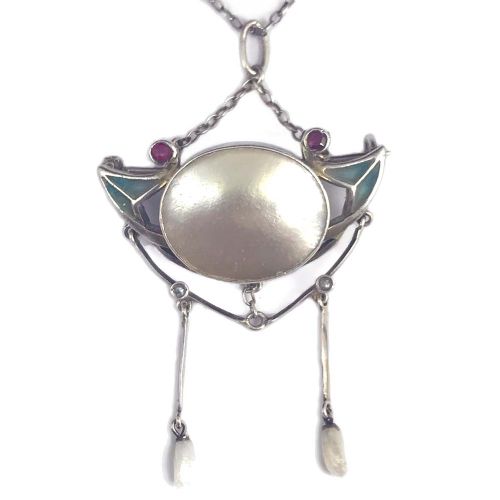

Plique a Jour Necklace
These delicate works of translucent enamel catch the light like stained glass, bringing together precious metals and floral motifs.
Plique a Jour Necklace
A plique a jour necklace centres on translucent enamel work where the absence of a backing allows light to pass directly through the coloured glass cells. You are looking at pendants and necklaces chiefly from the early twentieth century, spanning Art Nouveau and Arts and Crafts designs.
The pieces on this page most commonly take the form of silver or yellow gold pendants featuring floral, insect, or devotional subjects. French devotional medals and English naturalist motifs dominate the selection, often incorporating seed pearls or coloured gemstones alongside the enamel.
How they were made
Craftsmen built open wire frameworks in silver, silver gilt, or 18K and 15K yellow gold to form the outlines of wings, petals, or windows. Enamel paste was then applied within these tiny cells without a backing plate, relying entirely on surface tension during firing to hold the translucent material in place.
Gems such as amethyst, peridot, chrysoprase, and citrine were set alongside pearls to complement the vitreous colours. The resulting metalwork combines delicate wirework with sturdy gold or silver bezels to support the fragile enamel panels.
Plique a Jour Necklace Retail Price Guide 2026
Typical asking prices for plique a jour necklace among the pieces listed under this phrase on Sellingantiques today, from the lower quarter to the upper quarter. They describe what is for sale here now, not the wider market.
Listings feature yellow gold, silver, and silver gilt settings combined with translucent enamel.
What varies in quality
Quality rests upon the precision of the wire framework and the clarity of the fired enamel cells. Finer examples display even translucency across every cell without cloudiness or heavy metal thickening at the joins.
The choice of accompanying gemstones and the intricacy of the metal design dictate the standing of a piece. Maker attribution and the complexity of the pierced gold or silver work further elevate the standing of individual jewels.
Heinrich Levinger·Eduard Loss·Martin Mayer·Theodor Fahrner·Meyle and Meyer·Liberty and Co
The Plique a Jour Necklace Glossary
- Plique-a-jour enamel
- A French term meaning letting in daylight, describing vitreous enamel fired in open cells without a backing. This technique produces a stained glass effect in miniature jewellery.
- Silver gilt
- Silver that has been coated with a thin layer of gold. This treatment provides the warm tone of gold while utilising a silver base structure.
- Seed pearl
- A very small natural or cultured pearl, often half-drilled and threaded. These tiny pearls frequently accent the borders of early twentieth-century pendants.
- Art Nouveau
- An international style of art and architecture prominent around nineteen hundred, characterised by organic forms and curved lines. It heavily influenced the design of translucent enamel jewellery.
- Arts and Crafts
- A design movement advocating traditional craftsmanship and simple forms. It appears here in British silverwork paired with natural stones.
Plique a Jour Necklace: Frequently Asked Questions
How do I care for plique a jour enamel?
Store your pendant safely away from hard objects to protect the unbacked enamel cells from pressure or impact. Avoid ultrasonic cleaners and harsh chemicals, using only a soft damp cloth for gentle cleaning.
Because the enamel lacks a metal backing plate, it remains more vulnerable than standard enamelling. Handle the piece by its metal frame rather than pressing directly against the translucent panels.
Are these pieces fragile to wear?
The open-cell construction requires mindful wear to prevent bending the fine gold or silver wirework. Daily use is entirely possible if you avoid sharp impacts or catching the pendant on clothing.
Most surviving examples have endured a century precisely because their owners treated them with care. Regular gentle checking of the chain and jump rings ensures safe fastening.
What periods do these necklaces come from?
The selection spans the early decades of the twentieth century, with a heavy concentration around nineteen hundred. This era encompasses the height of the Art Nouveau movement and the British Arts and Crafts period.
Later pieces extend into the nineteen twenties and thirties, showing slight shifts in subject matter while retaining the characteristic enamel technique.