



Jugendstil Silver Pendant
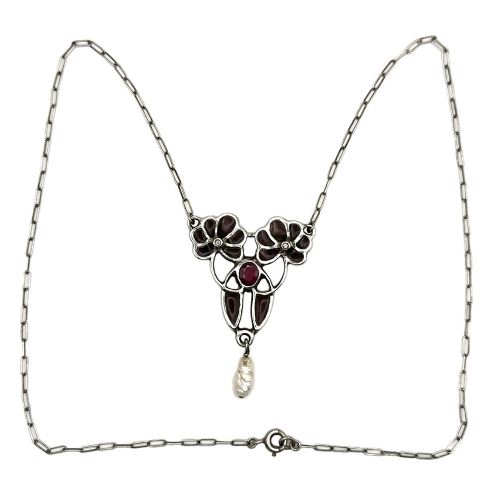
A jugendstil silver pendant brings the fluid botanical lines of early twentieth-century design directly to the neckline.
Jugendstil Silver Pendant
A jugendstil silver pendant is an Art Nouveau jewel defined by organic forms, sinuous curves and naturalist motifs produced around nineteen hundred. These pieces draw heavily on floral, insect and serpent themes, executed in silver or silver gilt.
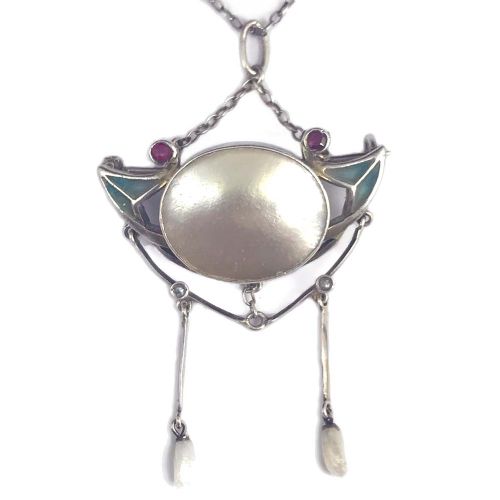
Most items on this page combine silver frameworks with translucent enamel work and suspended stones or pearls. The selection spans from simple silver mounts with paste stones to intricate multi-stone compositions set with citrine, amethyst, chrysoprase, hematite and amazonite.
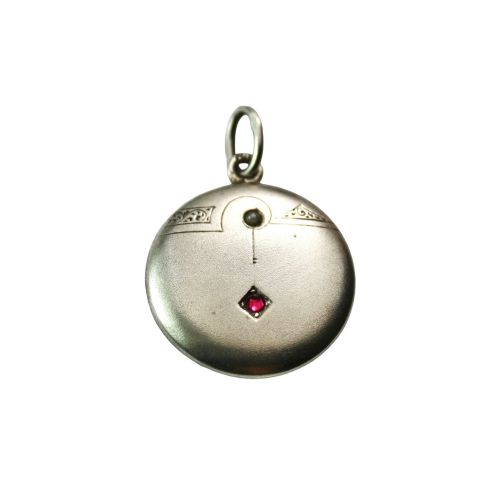
Buyers will encounter both standard pendants and convertible pendant brooches, often featuring mirrored locket backs or delicate seed pearl drops. The prevailing aesthetic mirrors the continental European secessionist movements contemporary with British Art Nouveau.
Materials and construction methods
Craftsmen utilised silver and silver gilt as the primary structural metals, shaping them into asymmetrical frames and stylized botanical wirework. Plique-a-jour enamel appears frequently, creating stained-glass effects without metal backings to let light pass through the transparent coloured glass.
Makers integrated natural elements such as baroque pearls, seed pearls and landscape enamel alongside faceted and cabochon stones like citrine, amethyst, chrysoprase, hematite and amazonite. Enamelling techniques ranged from standard opaque applications to detailed pictorial landscape scenes.
Jugendstil Silver Pendant Retail Price Guide 2026
Typical asking prices for jugendstil silver pendant among the pieces listed under this phrase on Sellingantiques today, from the lower quarter to the upper quarter. They describe what is for sale here now, not the wider market.
Snakes, butterflies and beetles feature among the botanical flora, proving that turn-of-the-century designers loved a creepy-crawly just as much as a water lily.
Distinctions in execution and design
Quality in a jugendstil silver pendant rests upon the ambition of the enamelwork and the precision of the metal chassis. Plique-a-jour requires immense skill from the jeweller to suspend translucent enamel safely across open wire cells without cracking.
The choice of stones and the integration of subsidiary elements like seed pearl drops or articulated insect wings elevate individual pieces. Named workshop output often displays sharper finishing in the silver gilt and more complex stone settings compared to anonymous workshop output.
Wilhelm Fuhner·Levinger & Bissinger·Otto Prutscher·Meyle & Mayer·Heinrich Levinger·Eduard Loss·Martin Mayer·Ludwig Knupfer·Theodor Fahrner
The Jugendstil Silver Pendant Glossary
- Jugendstil
- The German artistic movement spanning the late nineteenth and early twentieth centuries, corresponding to Art Nouveau. This style emphasised youthful innovation, rejection of historicism, and dynamic linear rhythms inspired by natural plant and animal forms.
- Plique-a-jour
- An enamelling technique where enamel is applied in cells similar to cloisonne, but with no backing in the final product, leaving the enamel transparent to light like a miniature stained-glass window.
- Silver Gilt
- Silver that has been coated with a thin layer of gold over its surface, often giving the metal a warm, rich tone that complements coloured enamel and warm-hued gemstones.
- Cabochon
- A gemstone polished to a smooth, rounded convex top rather than faceted with flat geometric planes, frequently utilised for opaque stones like chrysoprase, hematite and amazonite in period pieces.
Jugendstil Silver Pendant: Frequently Asked Questions
What is a jugendstil silver pendant?
A jugendstil silver pendant is a piece of continental European jewellery from the Art Nouveau era, typically featuring organic motifs, silver or silver gilt settings, and colourful enamels.
These jewels often incorporate pearls and semi-precious stones, reflecting the turn-of-the-century fascination with natural and flowing botanical designs.
How do you wear these pendants?
These pendants are traditionally hung from fine metal chains to sit against the collarbone, serving as prominent decorative focal points.
Certain examples feature dual mountings that allow the jewel to be worn interchangeably as a brooch or a pendant.
How are periods identified?
Periods are determined through characteristic design markers, maker marks, and the specific use of decorative techniques like plique-a-jour enamel and landscape painting.
The aesthetic vocabulary of the pieces ties them firmly to the late nineteenth and early twentieth centuries.
What stones are used?
Makers set these pieces with pearls, seed pearls, paste stones, and a variety of coloured gems including citrine, amethyst, chrysoprase, hematite and amazonite.
These stones were chosen for their colour harmonies with the surrounding enamelwork and the warm tones of silver gilt.