
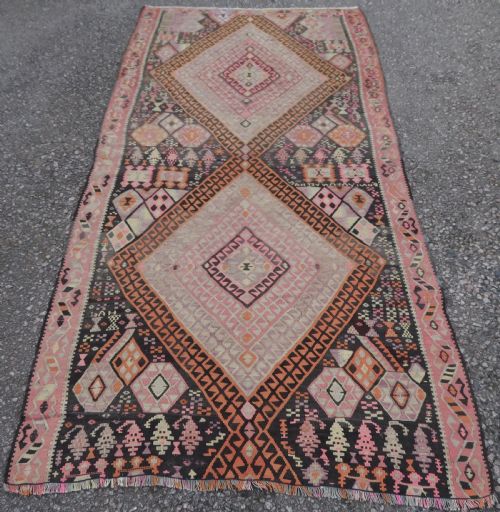
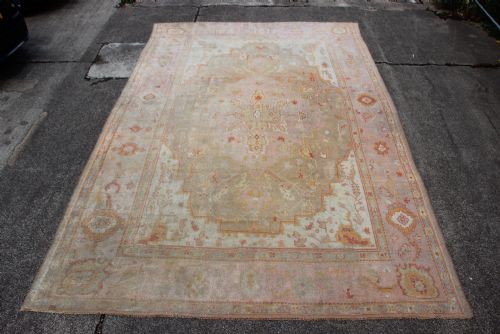
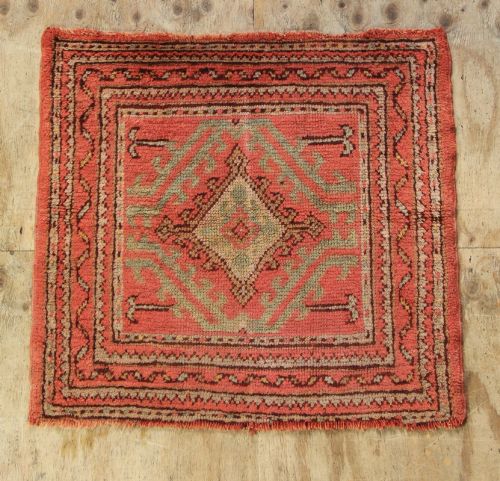


Pink Turkish Carpet
A pink turkish carpet brings a soft, faded warmth to a room through traditional Anatolian weaving.
Pink Turkish Carpet
A pink turkish carpet is a hand-knotted floor covering originating from Anatolian weaving centres, often appearing in pale oushak, sivas, and prayer rug forms. These pieces date from the nineteenth and early twentieth centuries, spanning periods such as 1880, 1890, 1900, 1910, and 1920.
Buyers seeking this specific aesthetic encounter rugs and carpets featuring traditional motifs, classical medallion designs, and willow tree patterns. The palette relies on soft pinks and pastel colours developed over decades of gentle fading.
How they were made
These textiles employ wool and cotton as foundational materials, utilising natural fibres for both the pile and the structural foundation. Weavers knotted the wool pile onto cotton warps and wefts by hand, building durable floor coverings intended for long daily use.
The characteristic soft pinks and pastel shades derive from traditional dyeing techniques applied across Anatolia, including regional production in Oushak, Kirsehir, Bandirma, and Sivas. Time and light soften these original vegetable and natural dyes into gentle pastel tones.
Listings span the nineteenth century and the early twentieth century, featuring wool and cotton materials from Oushak, Sivas, Kirsehir, and Bandirma.
What varies in quality
Quality rests upon the fineness of the knotting and the balance of the classical medallion or field design. Finer examples display precise execution in regional patterns such as the Oushak or prayer rug formats.
The harmony of the faded palette also dictates the standard, where even soft pink grounds and pastel colour distribution create a cohesive visual appeal. Superior pieces maintain structural integrity while showing the desirable mellowed hues of age.
The Pink Turkish Carpet Glossary
- Oushak
- A traditional Turkish rug-weaving centre known for large-scale floral designs and soft pastel colour palettes. Oushak carpets often feature expansive fields and muted tones.
- Prayer rug
- A small rug featuring a mihrab or arch design indicating the direction of prayer. These pieces were historically used for personal devotion.
- Medallion
- A central ornamental design motif placed in the middle of the carpet field. Classical medallion layouts anchor the symmetry of Anatolian weaving.
- Warp
- The vertical threads stretched on the loom that carry the tension of the weave. Cotton is standard in these antique Turkish examples.
- Weft
- The horizontal threads passed through the warps to lock the knots in place. Together with the warp, it forms the foundation of the carpet.
Pink Turkish Carpet: Frequently Asked Questions
Where were these rugs made?
These rugs were woven in various Anatolian centres and towns across Turkey, including Oushak, Sivas, Kirsehir, and Bandirma. Each region contributed distinct design vocabularies and structural characteristics.
Production often centred around historic workshops and towns where weaving traditions passed down through generations.
How do I style a faded rug?
The soft pinks and pastel colours of these aged carpets allow them to anchor both traditional and contemporary interiors. Their muted tones blend easily with wooden floors and neutral furnishings.
Placing them in low-traffic or moderate-traffic areas preserves the historic wool pile against excessive wear.
What dates are these pieces?
The pieces available here date from the nineteenth century through to the early twentieth century, specifically spanning the 1880s, 1890s, 1900s, 1910s, and 1920s. This era represents the height of traditional Anatolian village and workshop carpet production.
Each piece bears the distinct material patina of age accumulated over a century or more.
Are wool and cotton standard?
Wool provides the soft, durable pile surface while cotton supplies the sturdy foundation threads for the warp and weft. This combination ensures flexibility and strength in antique hand-knotted formats.
Natural fibres respond well to gentle cleaning methods suited for antique textiles.