
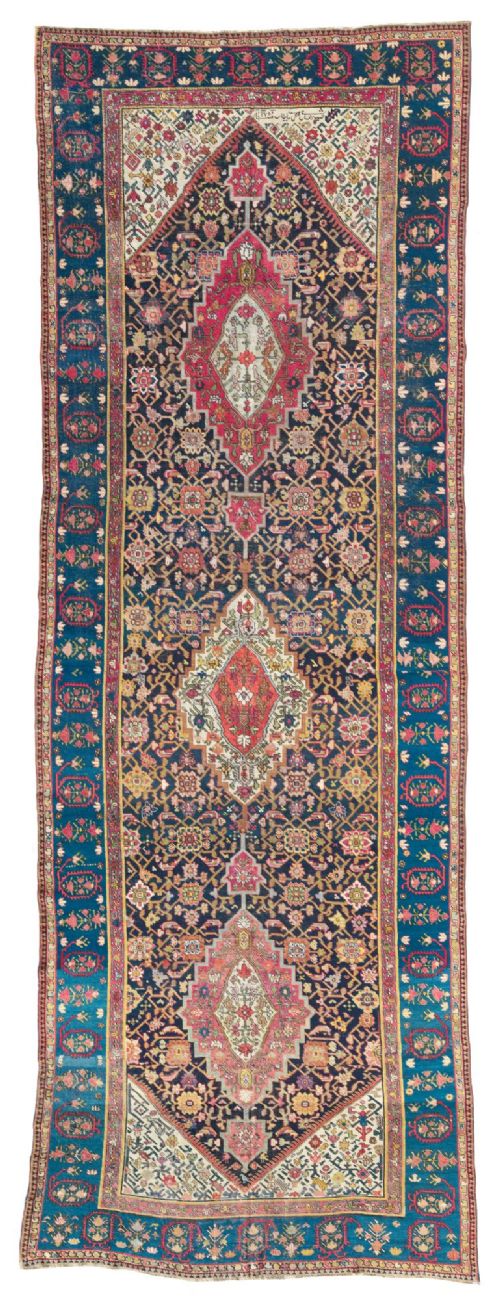


Persian Tribal Kelleh Carpet
A persian tribal kelleh carpet is a long, narrow floor covering woven by nomadic or village communities, offering rich geometric patterns and remarkable floor presence.
Persian Tribal Kelleh Carpet
A persian tribal kelleh carpet is a distinct format of large floor covering, traditionally proportioned longer than it is wide to suit the room layouts of village homes and nomadic tents. You are most likely to meet examples originating from nineteenth-century and early twentieth-century weaving traditions across Western Asia.
The selections span various regional groups including Kurdish, Bidjar, Hamadan, Baktiari, and Khamseh traditions. These pieces reflect specific tribal aesthetics through field motifs like the tree of life, boteh, and bold geometric borders.
How they were made
These carpets are constructed using hand-spun wool for the pile, providing resilience and a rich tactile quality that deepens with age. The foundation typically relies on cotton or wool warps andwefts, ensuring structural stability across the long format.
Weavers employed traditional upright vertical looms, utilising symmetric or asymmetric knots depending on the regional workshop or tribal group. Natural dyeing traditions yielded deep tones from local plants and minerals, fixing colours firmly into the hand-spun fibres.
Listings feature pieces spanning several decades from the mid nineteenth century through the early twentieth century, utilising hand-spun wool and cotton.
What varies in quality
Quality in a persian tribal kelleh carpet rests upon the fineness of the knotting and the crispness of the drawing within the geometric or pictorial elements. Tighter knot density allows intricate border details, such as dragon or crab patterns, to maintain sharp definition along the extended runner format.
The integrity of the wool handle and the balance of natural dye distribution dictate the visual harmony of the piece. Superior examples display harmonious dye saturation and even wear across the heavy wool pile, reflecting skilled execution by the weaver.
The Persian Tribal Kelleh Carpet Glossary
- Kelleh
- A large format carpet traditionally longer than a standard room carpet but wider than a corridor runner. This specific proportion was designed for the specific architectural dimensions of traditional Persian reception rooms.
- Boteh
- A stylised floral motif resembling a pear, almond or curved pine cone. It appears frequently in traditional textile designs across Persia and the Caucasus.
- Warps
- The vertical foundational threads stretched taut on the loom before weaving begins. The pile knots are tied around these stationary parallel strands.
- Wefts
- The horizontal threads passed alternately over and under the warp threads after each row of knots. They pack down firmly to secure the pile in place.
- Pile
- The dense upright surface of a carpet formed by the ends of knotted yarn. Hand-spun wool pile provides both warmth and durability under foot.
Persian Tribal Kelleh Carpet: Frequently Asked Questions
Where should I place a kelleh carpet?
A kelleh carpet fits naturally in narrow reception rooms, long hallways, or large galleries where standard rectangular carpets fail to fit properly. Their extended proportions draw the eye down the length of the space.
Ensure you place them away from direct, harsh sunlight to protect the natural wool dyes from fading over the years. Using a quality underlay helps prevent slipping on hard wooden floors.
How do I clean an antique wool carpet?
Regular gentle vacuuming without a rotating brush bar keeps dust from settling deep into the hand-spun wool pile. Professional specialist cleaning remains essential every few years to preserve the integrity of the fibres.
Avoid using domestic chemical detergents or hot water extraction methods on antique textiles. Spot cleaning should be handled strictly by professionals experienced in traditional woven rugs.
How can I tell a tribal rug from a workshop rug?
Tribal rugs typically feature more geometric, spontaneous designs stemming from memory rather than precise drawn cartoons. You may notice subtle shifts in symmetry and colour shading known as abrash.
Workshop carpets tend to exhibit rigid symmetry and highly refined, curvilinear floral patterns executed with strict uniformity. Both styles offer distinct historical insights into their makers.
What is abrash in antique carpets?
Abrash refers to subtle horizontal bands of colour variation within the field of a carpet. This occurs naturally when a weaver switches to a newly dyed batch of wool yarn.
Far from being a flaw, knowledgeable collectors view abrash as evidence of authentic hand-dyed materials and traditional production methods. It adds depth and character to the overall surface texture.