

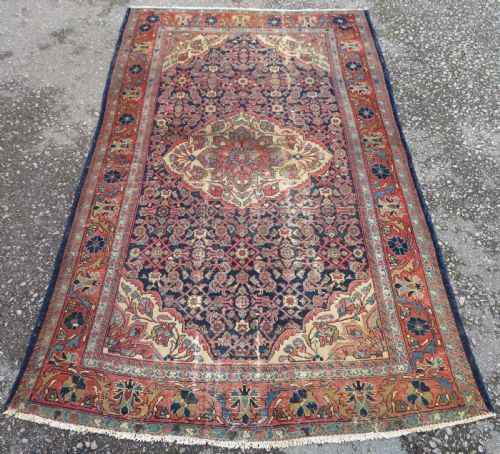

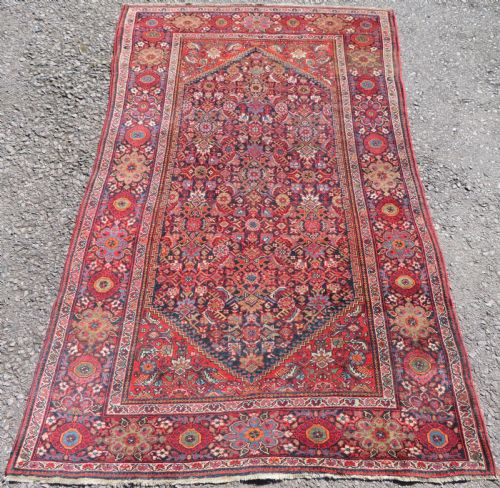


Persian Malayer Rug
When you search for a persian malayer rug, you encounter hand-knotted village weavings from West Persia that bring character to any floor.
Persian Malayer Rug
A persian malayer rug is a village weaving originating from the West Persia region, often categorized under styles such as traditional persian and tribal. These pieces appear in formats ranging from smaller area rugs to long hallway runners and substantial kelleh carpets.
Most examples found here date from the late nineteenth century through to the early decades of the twentieth century, specifically spanning the 1880s to the 1930s. Buyers frequently encounter designs incorporating boteh motifs, herati patterns, lattice work, and pictorial elements including animals and figures.
Village weavers produced these items using traditional techniques, resulting in varied formats like narrow runners and square-proportioned carpets. The typical piece reflects the aesthetic of West Persian workshops and village communities from the era.
Materials and Construction
The construction relies fundamentally on wool and cotton, with wool traditionally utilised for the pile and cotton commonly forming the foundation warps and wefts. These natural materials provide the structural integrity necessary for floor coverings designed to endure regular use.
Weavers knotted the wool pile by hand onto the cotton foundation, allowing for intricate pattern work such as the boteh, shield, and herati designs seen across the inventory. This manual process accounts for the subtle irregularities and individual character inherent in each piece.
Persian Malayer Rug Retail Price Guide 2026
Typical asking prices for persian malayer rug among the pieces listed under this phrase on Sellingantiques today, from the lower quarter to the upper quarter. They describe what is for sale here now, not the wider market.
The listings span periods from 1880 to 1930, utilising wool and cotton across diverse forms including village rugs and long hallway runners.
Factors of Quality
Quality in these textiles depends heavily on the fineness of the knotting and the crispness of the design execution, which dictates how sharply patterns like the lattice or boteh render. Tighter, denser knots generally correspond to greater durability and more refined pictorial detail in the finished textile.
The composition of the colour palette also distinguishes pieces, with softer tones, ivory grounds, and cream fields adding visual appeal. Furthermore, the overall condition of the wool pile and the structural stability of the cotton foundation influence the longevity and presentation of the rug.
The Persian Malayer Rug Glossary
- Kelleh
- A long format carpet, typically longer than a standard rug but wider than a runner, suited to specific hallway or room dimensions.
- Boteh
- A stylised almond or paisley-shaped motif representing a leaf or bush, frequently repeated across the field of West Persian carpets.
- Herati
- A repeating floral pattern composed of a central rosette enclosed by a rectangle of leaves, flanked by curved palmettes.
- Runner
- A long, narrow carpet format designed primarily for corridors, hallways, and staircases.
- Foundation
- The underlying structure of warps and wefts that supports the knotted wool pile of the rug.
Persian Malayer Rug: Frequently Asked Questions
What is a Malayer rug?
A Malayer rug is a hand-knotted textile produced in the West Persia region, known for distinctive village designs and wool construction.
These pieces typically date from the late nineteenth to the early twentieth century and feature motifs such as boteh, herati patterns, and pictorial elements.
Where were these rugs made?
These textiles originate from Malayer and surrounding villages in West Persia, an area with a long tradition of rug weaving.
Local artisans produced them in home workshops using regional designs that often blended tribal influences with classic Persian motifs.
How do I use a runner rug?
Runner rugs are long, narrow formats specifically designed for hallways, corridors, entryways, and narrow transitional spaces.
They protect high-traffic flooring while introducing traditional colour and pattern to otherwise plain architectural areas.
How are different periods identified?
Periods are identified through a combination of structural analysis, material wear, dye palettes, and stylistic characteristics recorded in the weaving.
Pieces from the late nineteenth century often display specific wool textures and natural dye variations that differ from later twentieth-century production.